
If you’ve ever had a leak under the sink or a burst pipe in the basement, you know how fast water can ruin a home. In 2026, the best smart water leak detectors are no longer just alarms—they’re part of a broader water protection setup. From compact under-sink sensors to automatic shutoff systems that can stop water at the main line, the right setup can help prevent costly damage.
Short answer: In 2026, the best protection is usually a combo—local leak sensors for high-risk spots plus a whole-home shutoff system for broader protection. It helps you catch leaks early and, in the right setup, stop water before damage spreads.
Why Smart Water Leak Detection Matters in 2026
Imagine this: You’re on vacation, sipping a cold drink by the beach, while back home a burst pipe is quietly flooding your basement. According to the Insurance Information Institute, water damage and freezing account for nearly 29% of all home insurance claims in the U.S. That’s billions in property damage each year — and the right smart water leak detector can prevent home damage before it happens.
But here’s the good news—smart water leak detection has moved well beyond basic alarms. With app alerts, connected sensors, and smart shutoff options, today’s systems can do more than just warn you—they can help you respond faster and reduce damage. Whether that means shutting off your water automatically or notifying your phone when moisture is detected under your kitchen sink, the right device can save you thousands.
So which smart water leak detector setup makes the most sense in 2026? How do you choose between a simple battery-powered sensor, a multi-sensor kit, and a smart shutoff system? This guide walks through the leading options, how they differ, and where each setup fits best.
Repairing water damage isn’t cheap. Industry reports show the average claim often exceeds $11,000. For many families, installing a smart leak detector is less about convenience and more about avoiding the stress—and cost—of tearing out floors, cabinets, or drywall after a hidden leak.
Types of Water Leak Detectors in 2026 (Sensors vs. Smart Shutoff Systems)
Smart water leak detectors do not all work the same way. In 2026, most homeowners are choosing between three broad setups:
Point Sensors for Kitchens, Bathrooms, and Laundry Rooms
These are the small, battery-powered sensors you place under sinks, behind toilets, or next to appliances. They’re often the best water leak detectors for kitchens and bathrooms because they send an instant alert to your phone when water is detected. They’re inexpensive, quick to install, and ideal for spot protection in high-risk areas.
Cable-Style Leak Alarms: When They Still Make Sense
Cable alarms use a long sensing cord laid along the floor or around equipment like a water heater. If any part of the cable touches water, the alarm sounds. While affordable, they can be sensitive to condensation and cleaning water, which sometimes leads to false alerts. They also rarely connect with WiFi or smart home apps, so many U.S. homeowners now prefer newer options.
Whole-Home Smart Shutoff Systems with Leak Detection
Instead of just warning you, these systems can actually close your water supply. Known as the best water shutoff systems with leak detection, they pair with sensors around the house to form the best automatic water leak detection and shut-off system. If a leak is detected in the kitchen, bathroom, or basement, the valve shuts automatically—protecting the entire home even if no one is there.
1. What Features Actually Matter in 2026
Before comparing brands, it helps to focus on the features that actually change how well a system protects your home:
| Feature | Description |
|---|---|
| WiFi Connectivity | Sends instant notifications to your phone via app. |
| Smart Shutoff Valve | Automatically turns off water supply to prevent flooding. |
| Multiple Sensor Support | Supports expansion with sensors in various locations. |
| Battery Life | Long battery life or backup power for reliability. |
| Integration | Works with smart home systems like Alexa, Google, or SmartThings. |
The best leak detection products today are not just alarms—they are part of a smarter water protection workflow.
If you are comparing leak detectors for real home protection, it helps to look beyond alerts alone and consider systems that can also trigger shutoff.
Want to understand when a smart water valve with leak detector makes more sense than alerts alone? See how shutoff-based protection works for kitchens, laundry rooms, and whole-home setups.
See when a shutoff valve setup makes sense →2. Best Smart Water Leak Detectors for 2026: Reviews & Best-Fit Use Cases
Here is how the leading options compare across coverage, automation, installation style, and overall fit:
Moen Flo Smart Water Monitor and Shutoff
- Pros: Whole-home monitoring, automatic shutoff, strong brand recognition
- Cons: Higher upfront cost, usually best with professional installation
- Best for: Homeowners who want a premium whole-home shutoff system
Phyn Plus Smart Water Assistant + Shutoff
- Pros: Pressure-based leak detection, remote shutoff, detailed plumbing insights
- Cons: Premium price, professional main-line installation required
- Best for: Homeowners who want pressure-based whole-home monitoring
YoLink Smart Water Leak Sensor Kit
- Pros: Very long range, flexible multi-sensor coverage, good for larger homes
- Cons: Shutoff is not built in by default and depends on the broader setup
- Best for: Multi-room leak detection in larger homes or detached spaces
Govee Wi-Fi Water Leak Detector
- Pros: App alerts, loud local alarm, approachable price for entry-level users
- Cons: Not a whole-home shutoff solution on its own
- Best for: Budget-minded homeowners who want connected leak alerts in a few key spots
Grus AquaNet Smart Water Protection Setup
Unlike basic alert-only sensors, AquaNet is better understood as a connected water protection setup that can combine leak detection with shutoff control.
- Products:
- AquaNet-BD (Smart Water Shutoff Valve)
- AquaNet-VM (Smart Water Valve Pro)
- Pros:
- App-connected monitoring and control
- Supports shutoff-based protection in the right setup
- Designed for North American home use
- Fits users looking for a Grus-based water protection workflow
- Cons:
- Currently optimized for North American plumbing sizes
- Best for: Homeowners who want a Grus-centered water protection setup instead of a standalone sensor
🔍 Want something that works out of the box with your thermostat, energy monitor, and safety devices? Grus AquaNet is part of a unified smart home protection suite.
Explore AquaNet Devices →
| Model | Auto Shutoff | App Alerts | Flow Monitoring | Freeze Alerts | Price | Black Friday Deal |
|---|---|---|---|---|---|---|
| Grus AquaNet | ✔ Yes | ✔ Yes | ✔ Yes | ✔ Yes | $$ | Up to 30% OFF |
| Moen Flo | ✔ Yes | ✔ Yes | ✔ Yes | ✔ Yes | $$$$ | Limited |
| Phyn Plus | ✔ Yes | ✔ Yes | ✔ Yes | ✔ Yes | $$$$ | Small Discount |
| YoLink Sensor | ✖ No | ✔ Yes | ✖ No | ✖ No | $ | Varies |
| Govee Sensor | ✖ No | ✔ Yes | ✖ No | ✖ No | $ | Varies |
Other connected leak-detection options still exist across the market, but most homeowners can simplify the choice by deciding first whether they want: a basic alert sensor, a multi-sensor kit, or a true whole-home shutoff system.
3. Best Setups for Kitchens, Bathrooms, Laundry Rooms, and Basements
If you are choosing protection by room, compact sensors are still useful under sinks and near appliances—but they are only one part of the decision. Kitchens and laundry rooms are the top sources of water damage. A dishwasher leak can ruin cabinets within hours, while a burst washer hose can cause thousands in damage in minutes.
Different rooms, different risks. Here’s where homeowners most often deploy smart leak sensors:
---
title: "Smart Water Leak Detector Installation Map"
---
graph TD;
    Kitchen["Kitchen Sink Area"] --> Risk1["Dishwasher Leaks"];
    Laundry["Laundry Room"] --> Risk2["Washing Machine Hose Bursts"];
    Basement["Basement"] --> Risk3["Water Heater Failures"];
    Bathroom["Bathroom"] --> Risk4["Toilet or Shower Leaks"];
    HVAC["HVAC Closet"] --> Risk5["Condensation Drain Issues"];
| Location | Reason for Risk |
|---|---|
| Kitchen | Sink or dishwasher overflows |
| Bathroom | Leaking pipes, toilet failures |
| Laundry Room | Hose bursts, overflowing machines |
| Basement | Sump pump failure, heater leaks |
| HVAC Closet | Clogged condensation drain pans |
If you’re not sure how smart shutoff valves actually work, this guide to smart water valves breaks it down in plain English.
4. How Smart Leak Sensors and Shutoff Systems Are Typically Installed
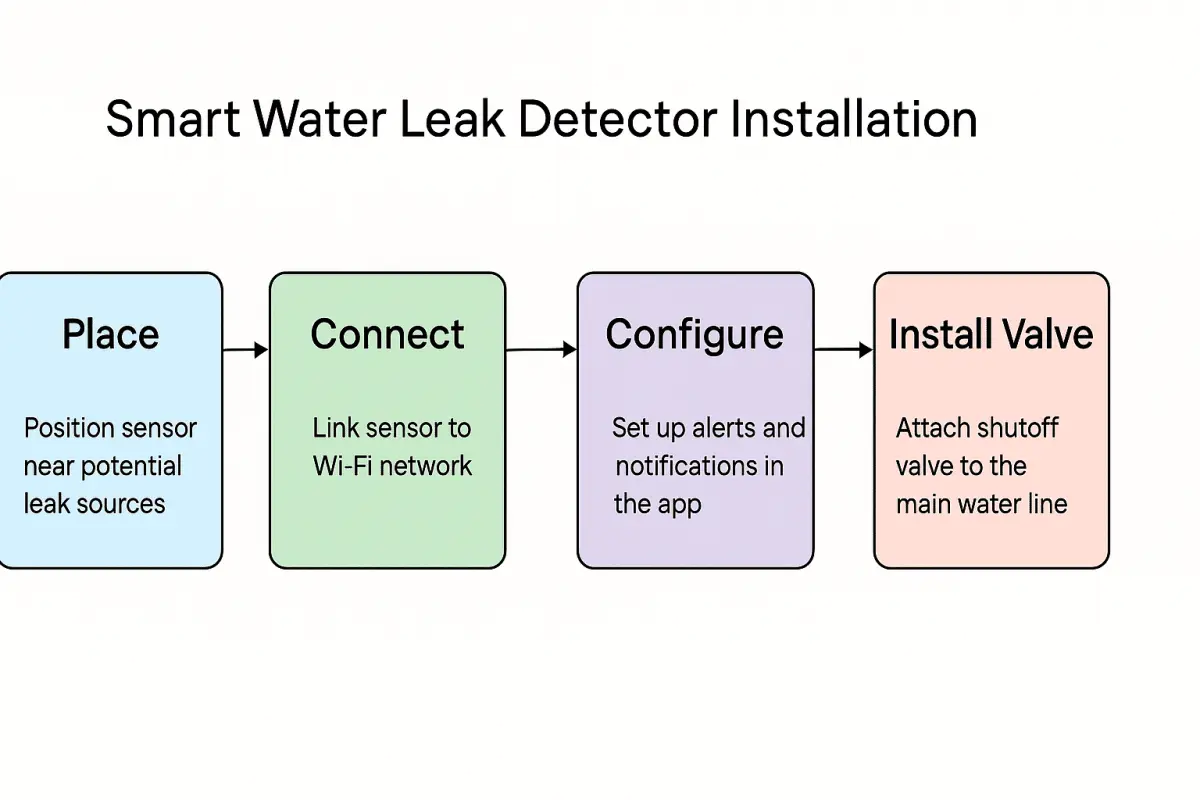
Installing a smart leak sensor isn’t rocket science—most can be set up in under 10 minutes. Here's how you can do it yourself:
🛠️ A. Water Leak Sensor Installation
Tools Needed: None (battery-powered)
- Choose Your Location:
Place the sensor near water sources—under the sink, behind the toilet, beside the water heater. - Avoid These Mistakes:
- Don’t block airflow; leave room around the sensor.
- Avoid metallic surfaces that might interfere with WiFi.
- Activate the Device:
- Insert batteries and press the power/test button.
- Follow the product app instructions to connect the sensor and complete setup.
Tip: Most sensors emit a beep when they detect moisture. You can test using a wet towel.
🧰 B. Smart Shutoff Valve Installation
Tools Needed: Adjustable wrench, Teflon tape
Installation Time: ~30–45 minutes
- Shut Off Your Water Supply
- Locate your main water valve and shut off the flow before starting.
- Install Inline with Main Pipe
- Replace a section of the pipe near the valve with the smart valve body.
- Use Teflon tape to ensure a leak-proof seal.
- Connect to Power and App
- Plug the valve controller into an outlet.
- Pair it using the Grus app’s on-screen instructions.
- Test the Shutoff Function
- Trigger the valve remotely or with an attached sensor to simulate a leak.
---
title: "Smart Water Shutoff System Flow"
---
graph LR;
    Sensor["AquaNet-LD (Leak Detector)"] --> App["Grus Home App"];
    App --> Valve["AquaNet-VM (Water Valve Controller)"];
    Valve --> Pipe["Main Water Pipe"];
This setup ensures your system works as the best water shutoff system with leak detection, protecting your home automatically even when you’re away.
Need more step-by-step guidance? Visit our support center installation guide for detailed manuals.
5. Real-World Examples: How Leak Sensors and Shutoff Systems Help
Whether you’re living in a high-rise condo or managing a multi-floor home, Grus smart leak detectors adapt easily to your needs.
Scenario 1: Kitchen Disaster Prevention
- Problem: Dishwasher hose cracked and began leaking slowly over time.
- Solution: AquaNet-LD detected the moisture and triggered AquaNet-VM to shut off the water immediately.
- Result: $0 in damage and no disruption to daily life.
Scenario 2: Laundry Room Flood Avoidance
- Problem: Old washing machine overflowed while unattended.
- Solution: Sensor under the machine detected water within 3 seconds.
- Result: Notification sent through the app, allowing the homeowner to respond quickly while away.
“We’ve had it for 4 months, and it already saved us from a $3,000 cleanup!” — Jennifer R., California
Scenario 3: Bathroom Leak Under the Sink
Problem: A slow drip from a worn faucet connection under the bathroom sink went unnoticed for weeks.
Solution: A compact WiFi sensor placed under the vanity detected moisture early and sent an alert.
Result: The homeowner shut off the water remotely before the cabinet warped, saving hundreds in potential repairs.
6. Smart Leak Detectors with Alexa, Google, and Home Assistant
For DIY enthusiasts, knowing which smart leak sensors integrate with Home Assistant is key. Grus devices are designed to fit into your existing smart home ecosystem:
| Platform | Compatibility |
|---|---|
| Google Assistant | ✅ Voice Control |
| Amazon Alexa | ✅ Routine Setup |
| SmartThings | ✅ Custom Scenes |
| Apple HomeKit | 🔜 Coming Soon |
You can automate routines like:
- If leak detected → Shut off water + Send SMS + Flash hallway lights
- Voice command: “Alexa, check for water leaks”
Many homeowners also connect leak detectors with a smart thermostat or energy monitor to create full-home automation routines.
7. Which Water Leak Detector is Best for Preventing Home Damage?
A. Choose Based on Use Case
| Use Case | Recommended Device | Key Features |
|---|---|---|
| Kitchen/Bathroom | AquaNet-M | Compact, easy placement, WiFi support |
| Water Heater / Laundry Room | AquaNet-LD + AquaNet-VM | Auto shutoff with high sensitivity |
| Whole Home Protection | AquaNet-M (multi-pack) + AquaNet-BD | Multi-zone alerts + auto shutdown |
| Vacation Home | AquaNet-BD + Mobile Alerts | Remote management, no monthly fee |
If your priority is preventing home damage, choose a system that combines leak detection with auto shutoff.
B. Prioritize These Features in 2025
- ✅ Real-Time WiFi Alerts (not just sound-based)
- ✅ Integration with Alexa, Google, SmartThings
- ✅ Battery backup
- ✅ Auto Shutoff Capabilities
- ✅ Durability for wet/humid environments
Don’t fall for cheap sensors that only beep locally—what if you’re not home?
8. Cost of Water Leak Detectors and Insurance Savings in 2025
Budget leak sensors are cheap, but mid-range and premium models offer home damage prevention and insurance discounts.
| Feature | Budget Options ($10–30) | Mid-Range ($40–100) | Grus Premium ($60–150) |
|---|---|---|---|
| Local Alarm Only | ✅ | ✅ | ✅ |
| WiFi Notifications | ❌ | ✅ | ✅ |
| Auto Water Shutoff | ❌ | Some Models | ✅ |
| App Integration | ❌ | Partial | ✅ |
| Multi-device Synchronization | ❌ | ❌ | ✅ |
| Works with Smart Home Ecosystem | ❌ | Some | ✅ |
9. Final Thoughts: Choose the Best Water Leak Detector for 2025
Water damage repairs can exceed $11,000—don’t wait until it’s too late.
According to the Insurance Information Institute, water damage is among the most common and costly claims, averaging over $11,000 per incident. Preventive protection is no longer optional—it’s smart, proactive homeownership.
If you’ve ever dealt with a burst pipe, leaking washer, or a forgotten faucet—you know peace of mind is priceless.
Ready to Protect Your Home?
Grus.io offers a complete smart water protection system trusted by thousands of homeowners.
Featured Product:
AquaNet-LD Leak Detector
AquaNet-VM Automatic Water Shutoff Valve
- Real-time alerts
- App control
- Easy installation
- Seamless integration with Alexa and Google Home
💧 Protect your home. Prevent costly water damage. Sleep better.
→ Explore our smart home water protection system
What is the best smart water leak detector in 2025?
The best smart water leak detectors in 2025 are those that combine WiFi connectivity, real-time alerts, and automatic shutoff capability. Popular models include Moen Flo, Phyn Plus, AquaNet and other WiFi-enabled shutoff valves.
Are automatic water shutoff valves with sensors worth it?
Yes. Automatic shutoff valves with sensors cost more than stand-alone leak detectors, but they can prevent thousands in water damage by shutting off the supply when a leak is detected.
Do the best smart water shutoff systems with leak detection lower insurance costs?
Many U.S. insurers give discounts if you install a whole-home shutoff system with leak detection. Since these devices stop leaks before damage spreads, they’re often viewed as a preventive measure.
Which smart leak detectors work with Home Assistant?
Several leak detectors can integrate with Home Assistant, either natively or via third-party bridges. Tuya-based devices, for example, can often be connected using integrations or community add-ons.
How do smart water leak detectors work?
Smart water leak detectors use moisture or flow sensors to detect leaks. When water is detected, they send an alert through a mobile app or smart home system. Advanced models can also shut off the main water supply.
What are the best water leak detectors for kitchens and bathrooms?
Compact, battery-powered leak sensors are most suitable for kitchens and bathrooms, where they can be placed under sinks, near dishwashers, toilets, or tubs to detect leaks early.
Can automatic water shutoff valves with sensors really stop a flood?
Yes. Automatic shutoff valves with sensors close the main line as soon as water is detected. That means even if a pipe bursts while you’re away, the leak is contained.
How long do smart water leak detectors last?
Battery-powered leak detectors usually last 2–3 years on a set of batteries. Shutoff valves and hubs typically last 5–10 years with proper maintenance.
What’s the difference between a water leak detector and a smart water meter?
A water leak detector is designed to sense and alert about leaks. A smart water meter tracks overall water consumption and can sometimes identify unusual usage patterns. Some advanced devices combine both functions.
Do I need a plumber to install a smart shutoff valve?
It depends on the product. Some shutoff valves require professional installation on the main water line, while others like Aquanet-BD are designed for DIY installation and can be set up with basic tools.
What is the best water leak detector for kitchens?
The best water leak detectors for kitchens are compact, battery-powered sensors that fit under sinks and dishwashers. In 2025, WiFi alerts and can trigger shutoff systems to prevent cabinet damage.
Protecting your home from water damage is no longer optional. Investing in the best smart water leak detector gives you peace of mind—whether it’s under the sink, in the bathroom, or across your entire home.