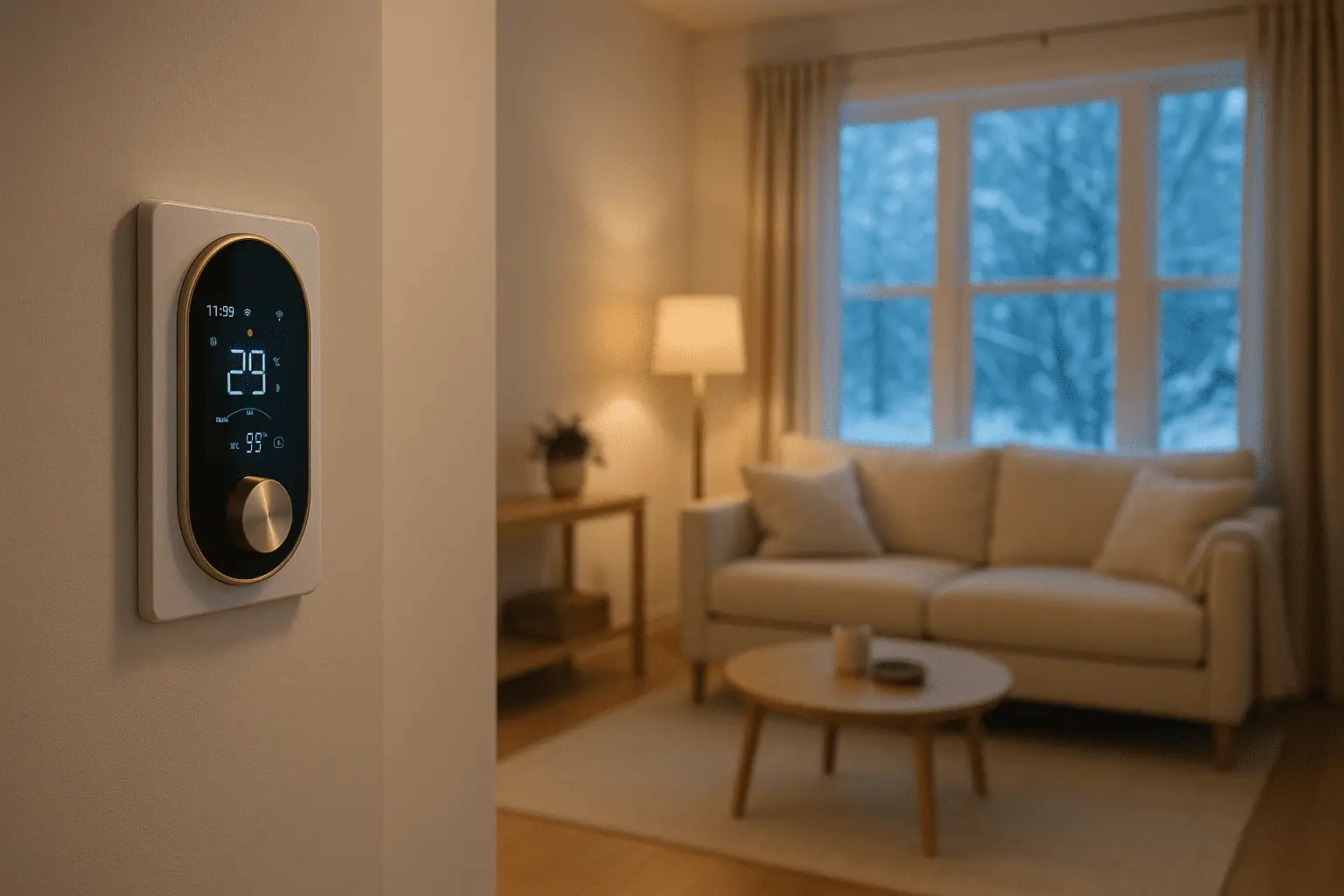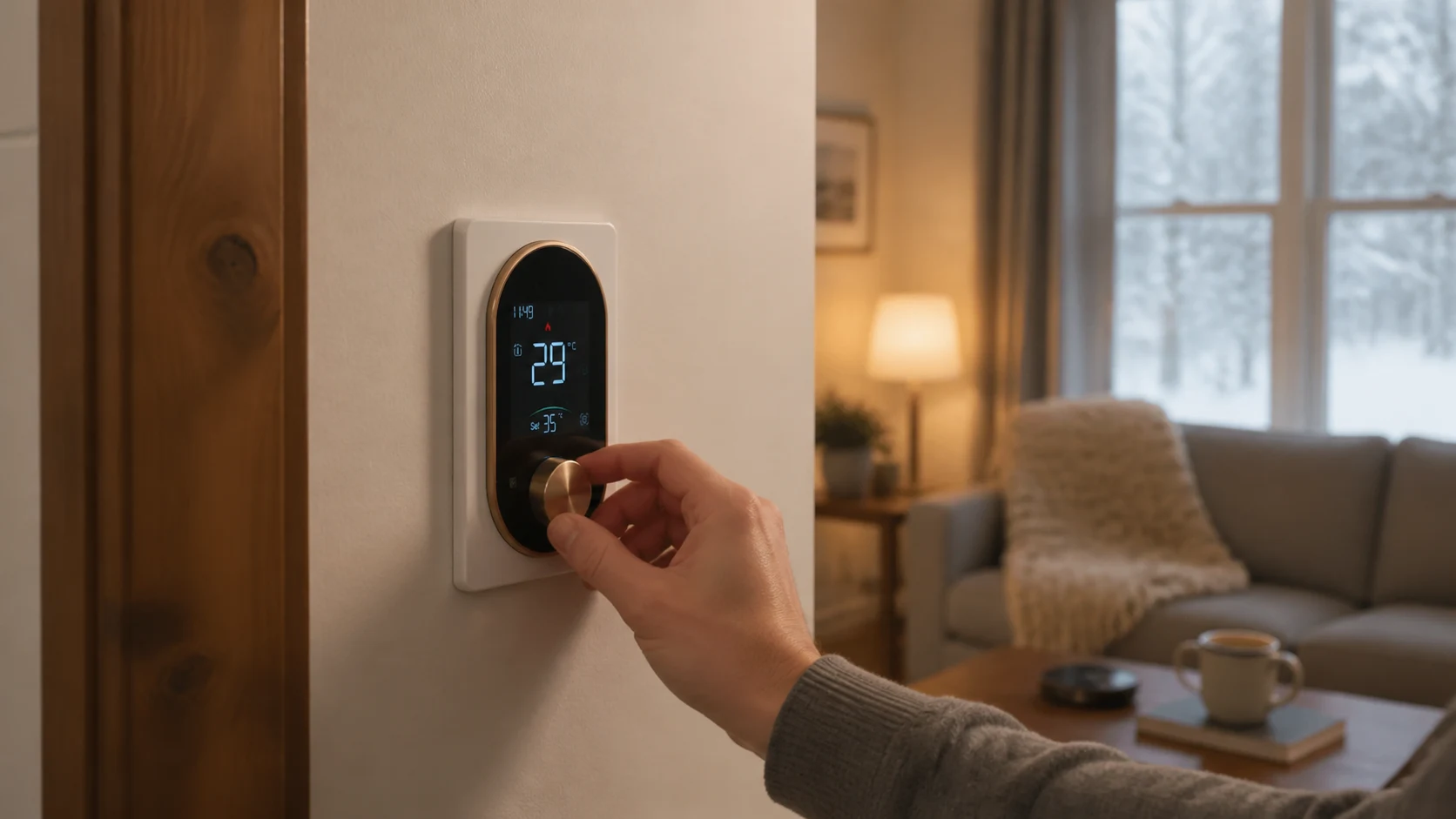
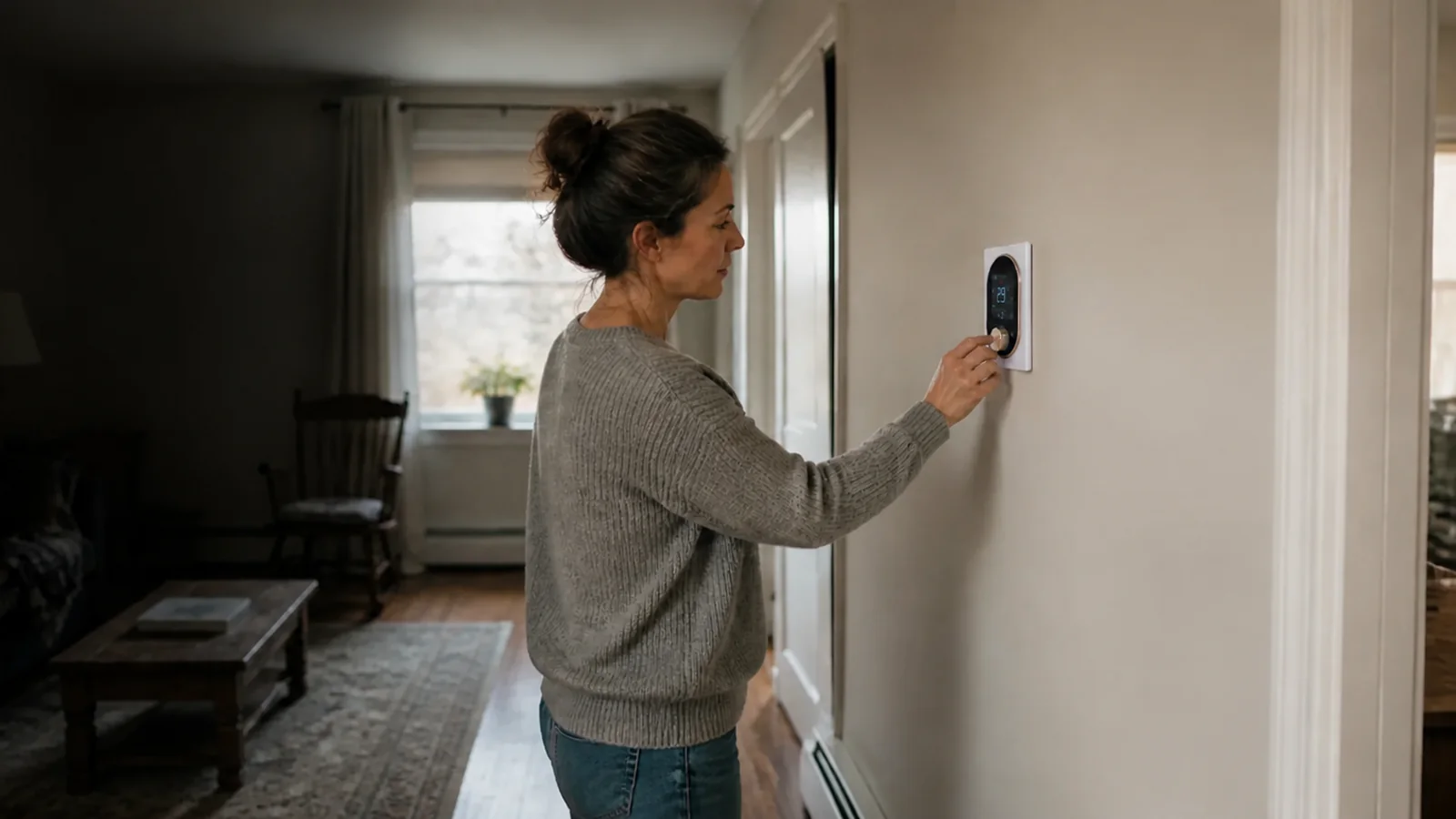
A smart thermostat can create a savings opportunity, but “smart” does not make every home’s bill go down. The opportunity depends on whether the thermostat fits the heating or cooling system, how much energy that system uses, whether the household can maintain a different schedule, what the previous settings were, and whether weather and utility rates change during the comparison.
Start with a simpler question than “How much will I save?” Ask: Which part of my energy use can this thermostat actually change? If the answer is unclear, a savings estimate is not ready.
This article follows a hypothetical homeowner named Taylor. Taylor is not a customer result, and the scenario does not predict savings for another home or claim that any Grus thermostat has a particular certification.
The short answer: savings need a controllable difference
A thermostat changes when and how a compatible heating or cooling system runs. It does not lower the electricity rate, improve insulation, repair equipment, change the weather, or reduce unrelated loads such as water heating, cooking, an EV, or a pool pump.
For Taylor, a credible savings opportunity requires all three of these conditions:
- The thermostat is compatible with the system and can preserve its required control functions.
- There is avoidable heating or cooling runtime under the household’s current routine.
- Taylor will use and maintain settings that reduce that runtime without creating an unacceptable comfort or safety tradeoff.
If one condition is missing, the product may still add convenience, remote access, scheduling, or clearer control. Those benefits are different from a guaranteed bill reduction.
Seven reasons the opportunity may be limited
Use these reasons as a pre-purchase screen, not as a prediction.
| Reason | What to verify | What it means for the decision |
|---|---|---|
| The thermostat category does not fit | Heating equipment, voltage or control class, required functions, product documentation | Stop. Features and savings claims cannot correct a compatibility mismatch. |
| The old schedule was already disciplined | Previous setpoints, setback periods, manual habits | There may be less avoidable runtime to remove. |
| Someone is usually home | Occupancy, comfort, health, pet, plant, or building needs | Long setbacks may not fit the household. |
| The thermostat controls only a small share | Zones and equipment controlled by this thermostat | Whole-home bill movement may be hard to see. |
| Weather or rates changed | Comparable weather, billing days, rate plan, fees | The bill can move even when thermostat-controlled use improves. |
| Smart features are not maintained | Schedule, local overrides, app use, household access | Available automation is not the same as actual use. |
| Another problem dominates | Insulation, air leakage, equipment condition, unrelated loads | The thermostat may not address the largest source of cost. |
The table does not say “do not buy.” It separates a control or convenience purchase from a savings-led purchase.
Reason 1: system fit comes before savings
Line-voltage baseboard heat, central HVAC, heat pumps, boilers, and radiator controls are different paths. A thermostat that looks suitable on a screen can still be the wrong electrical or equipment category.
Grus product facts reflect that separation. EcoNet-BH is a high-voltage baseboard thermostat path, while EcoNet-HP is a 24-volt heat-pump or HVAC thermostat path. They are not universally interchangeable. The exact equipment, controlled functions, product manual, installation requirements, and local rules must align before features are compared.
Do not remove a thermostat, open wiring, or perform energized testing to estimate savings. Use equipment records and product documentation, and involve a suitably qualified professional when the system or installation path is uncertain.
Reason 2: an efficient existing routine leaves less to change
Taylor already lowers the temperature before leaving and restores it shortly before returning. A new schedule may make that routine easier, but it may not create a large new reduction in runtime.
The opposite can also be true: a home held at one setting while empty may have more schedule flexibility. The difference comes from the before-and-after routine, not from the word “smart” on the product.
This is why a percentage copied from another household is weak buying evidence. Two homes can use the same model with different equipment, climates, schedules, comfort needs, and starting behavior.
Reason 3: the household may not have long setback periods
A schedule only helps when it fits real occupancy. Remote work, shift work, infants, older residents, medical needs, pets, plant rooms, rental turnover, or a home business can reduce the time available for a setback.
Taylor maps a normal week before shopping:
- when the home is usually occupied;
- when comfort must be restored;
- which rooms or zones need different treatment;
- who is allowed to change the setting;
- which exceptions happen often enough to break a fixed schedule.
A schedule that is repeatedly overridden is not a stable savings plan. It may still be useful as a starting point, but the purchase case should acknowledge how the household actually lives.
Reason 4: the thermostat may control only part of the bill
The U.S. Energy Information Administration notes that residential heating and cooling electricity use is strongly weather driven and varies from year to year. It also sits alongside other household electricity uses. See the current EIA explanation of residential electricity use.
Taylor’s thermostat controls one heating zone. The utility bill includes every electric load at the service address. Even if that zone uses less energy, an EV charging change, more hot-water use, a rate increase, or colder weather can make the total bill rise.
This is not proof that the thermostat failed. It is a reminder to compare the controlled system with the right measurement scope.
Reason 5: weather, rates, and billing windows can hide the signal
A January bill and a mild October bill are not a clean before-and-after test. Neither are bills with different day counts, estimated reads, rate changes, new fees, or a household occupancy change.
Taylor records:
- billing-period start and end dates;
- the number of days in each period;
- local weather context;
- electricity or fuel rate changes;
- major household routine or equipment changes;
- the thermostat schedule and important overrides.
The result is still observational. It can show whether a pattern deserves more investigation, but it does not isolate every cause or create a universal savings claim.
Reason 6: available features must become maintained behavior
Some thermostats provide schedules, remote control, occupancy-related functions, or equipment-use feedback. The ENERGY STAR smart thermostat guidance also tells buyers to research feature differences and confirm HVAC compatibility.
The existence of a feature does not prove Taylor will use it. A weekly schedule can become stale after a job change. A household member can override it. Remote access can become a convenience tool without reducing runtime. A disconnected account or weak Wi-Fi can change which connected features are available.
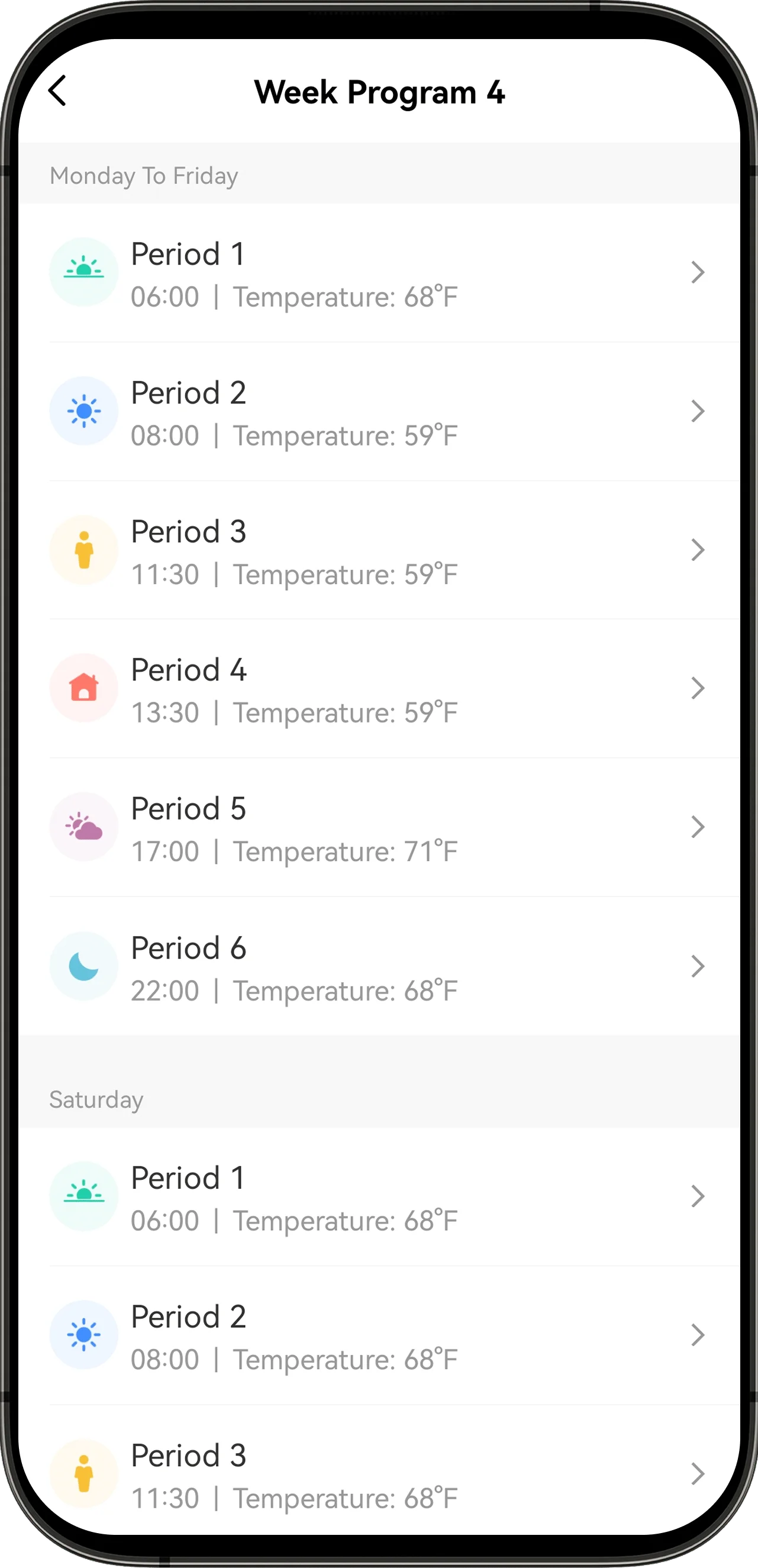
This approved EcoNet-BH App visual shows that a schedule can be configured. It does not show what Taylor’s home should use, whether the product fits Taylor’s system, or how much energy or money a household will save.
Reason 7: certification evidence is not an individual guarantee
ENERGY STAR’s current smart thermostat key product criteria explain that certified service providers demonstrate savings criteria using aggregated field data from many homes. That evidence is meaningful for the certified product and service scope, but it is not the same as promising a result for every sampled or future home.
This article does not claim that EcoNet-BH, EcoNet-HP, or another Grus model is ENERGY STAR certified. Exact certification status requires traceable model-level evidence. Do not transfer a category statement, another manufacturer’s listing, or a utility-program requirement to a Grus product.
Use a savings-opportunity decision flow
The flow keeps compatibility, opportunity, use, and measurement as separate gates.

The orange branches are valid outcomes. A homeowner may still value control or convenience, but the purchase should not be justified by an unproven bill reduction.
Follow Taylor through the decision
Taylor has electric baseboard heat in one part of the home and sees a smart thermostat advertised with savings language. Taylor does not start with the advertised number.
First, Taylor confirms the heating category and compares the candidate documentation with the equipment and installation path. Next, Taylor reviews two weeks of normal occupancy and learns that the home is occupied most afternoons. A long daytime setback would be unrealistic, but a consistent overnight and short weekday routine may be maintainable.
Taylor also sees that the baseboard zone is only part of the total electricity bill. Weather, an electric water heater, and other loads can move the bill. Taylor therefore treats any future change as an observed household pattern, not as proof of a product-wide result.
This process can support a purchase even if the expected savings opportunity is modest. It makes system fit, daily control, and convenience explicit instead of hiding them behind a percentage.
Ask these questions before buying
- What equipment and zones will this thermostat control?
- Is the thermostat’s voltage or control category compatible with that system?
- Which required equipment functions must remain available?
- What schedule does the household follow now?
- Which periods could realistically use a different setting?
- Who will maintain the schedule and handle exceptions?
- How much of the household bill is related to the controlled equipment?
- What weather, rate, billing, or occupancy changes could affect a comparison?
- Is the purchase still worthwhile if savings are small or difficult to isolate?
The ninth question is the most useful guardrail. It keeps comfort, control, product fit, support, and purchase cost visible even when the savings outcome is uncertain.
Make the purchase case without a savings promise
A smart thermostat has the clearest savings opportunity when it fits the equipment, controls a meaningful heating or cooling load, replaces a less disciplined routine, and is used consistently under conditions that can be compared. The opportunity is smaller or harder to prove when the home is always occupied, the previous schedule was already efficient, the thermostat controls a small zone, or weather, rates, and other loads dominate the bill.
Do not use a generic percentage as a compatibility check or budget assumption. Define the controllable difference first, then decide whether the product still makes sense if the observed result is limited.
Use the Grus smart thermostat buying guide to classify the heating system, verify the thermostat path, and review control, schedule, documentation, and installation questions before buying.