There Is No Universal Away Setting
Whether to change cooling while you are away depends on the household, weather and the installed system. A fixed number of hours away does not by itself determine a suitable temperature or justify turning cooling off.
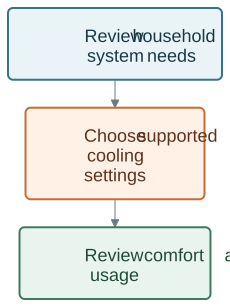
Before changing cooling settings, consider the household and the installed system. Use supported controls and review comfort when circumstances change.
Consider anyone remaining at home and conditions the building or equipment needs to maintain. Follow the system’s guidance rather than a generic geofencing rule.
Check the Factors Behind the Decision
Time away is only one consideration. Choose settings with the household, weather and system requirements in mind.
| Consideration | Question |
|---|---|
| Occupants | Will anyone remain at home? |
| Pets or sensitive needs | Are there special comfort requirements? |
| Indoor conditions | Does humidity or heat need attention? |
| System | What does its guidance recommend? |
| Time away | When will conditions be checked again? |
A startup-current reading or short equipment event does not show total daily energy use. Compare energy over the full relevant period, using consistent units and accounting for weather and occupancy.
An app schedule is not proof of a saving. A home that is unoccupied according to one phone may still contain other occupants.
Use the Supported Controls
If the thermostat offers scheduling or remote adjustment, use the functions documented for the exact model. Understand what happens after a temporary override and when the next schedule begins.
EcoNet-HP is the heat-pump thermostat product. Have the exact equipment and control requirements checked before selecting it. If geofencing, automatic pre-cooling or electricity readings matter to you, ask whether the exact model and setup support them.
Review Comfort and Consumption Together
Make one supported change at a time and record the dates, settings and relevant household conditions. Review both comfort and comparable usage rather than judging success from a single bill.
There is no fixed daily kWh saving or universal pre-cooling temperature promised here. A fictional household bill comparison should not be treated as a measured Grus result.
When to Ask for Help
Use qualified HVAC support if cooling behavior is unexpected or you are unsure which settings are appropriate for the system. Do not repeatedly cycle equipment, change wiring or use a generic article to diagnose a fault.
For an extended absence, establish who can respond to a problem. Remote access is useful only within the product’s documented connection requirements and is not a substitute for that plan.
Related Guides
- Benefits to evaluate in a smart thermostat
- Choosing a compatible thermostat
- Baseboard thermostat selection
- Reviewing summer heat-pump use
The useful decision is a setting suited to the actual household and system, followed by a measured review. Automatic control is not inherently the right answer for every absence.