When a leak sensor detects water, it has completed only the first step in a response chain. Detection may lead to a local alarm or a signal to a paired system, but it does not by itself prove that someone received an alert, a valve closed, the leak stopped, the area is safe, or water service can be restored.
A useful response plan treats six stages separately: detect, communicate, control the water when the configured system supports it, inspect onsite, repair and dry, then authorize restoration. Each stage has its own dependencies and possible failure points.
This article follows a hypothetical homeowner named Morgan. Morgan is not a customer case or proof of a product outcome. The scenario is a way to make the handoffs visible without promising that every sensor, home, network, valve, or leak will behave the same way.
The short answer: detection starts a workflow
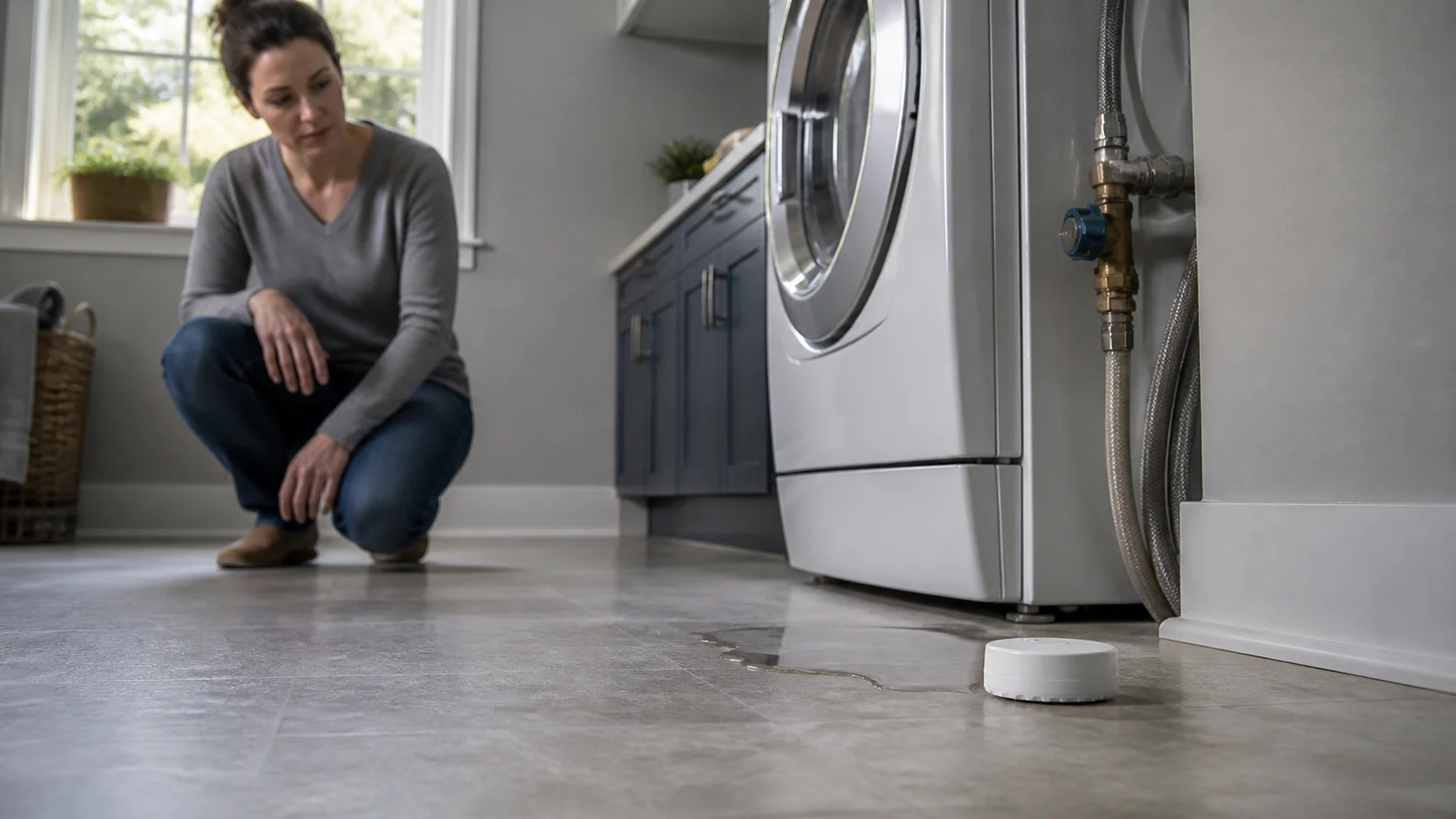
Morgan places a water sensor near the washing machine, where a slow supply or drain leak could first reach the floor. One morning, water reaches the sensor.
What should happen next depends on the equipment and configuration:
- The sensor recognizes water at its sensing points.
- It may provide a local indication and send a signal through its supported paired path.
- A person or system must receive and interpret that signal.
- A compatible, correctly configured valve path may be commanded to close.
- Someone must assess the source, remaining water, affected materials, and immediate hazards.
- Repair, drying, and an authorized return to service happen only after the situation is understood.
The word may matters. A dead battery, misplaced sensor, unavailable hub, network interruption, incomplete automation, incompatible device, valve problem, or leak outside the protected area can interrupt the chain.
What the sensor can and cannot tell you
A point sensor answers a narrow question: did water reach the sensing area? That is valuable, but it is not a complete diagnosis.
| Stage | What it can establish | What it cannot establish by itself |
|---|---|---|
| Water detected | Water changed the condition at the sensor’s sensing points | The source, leak rate, affected area, or whether more water is coming |
| Local indication | The device attempted to show or sound a local event when supported | That a person heard, saw, or understood it |
| Paired signal | The sensor attempted to send an event through its supported paired path | That a phone, cloud service, or valve received it |
| Valve command | A configured system requested a compatible valve action | That the valve moved, sealed the line, or stopped every source of water |
| Onsite response | A person can inspect visible conditions and follow the property response plan | Hidden moisture, structural condition, contamination, or repair completeness |
| Restore decision | An authorized person can decide when to test and return service | A sensor cannot make the site safe or authorize restoration |
For Morgan, finding water at the laundry sensor does not prove that the washing machine caused it. The source could be a supply connection, drain path, nearby appliance, wall penetration, condensation, or water traveling across the floor from somewhere else.
Stage 1: water reaches the sensing area
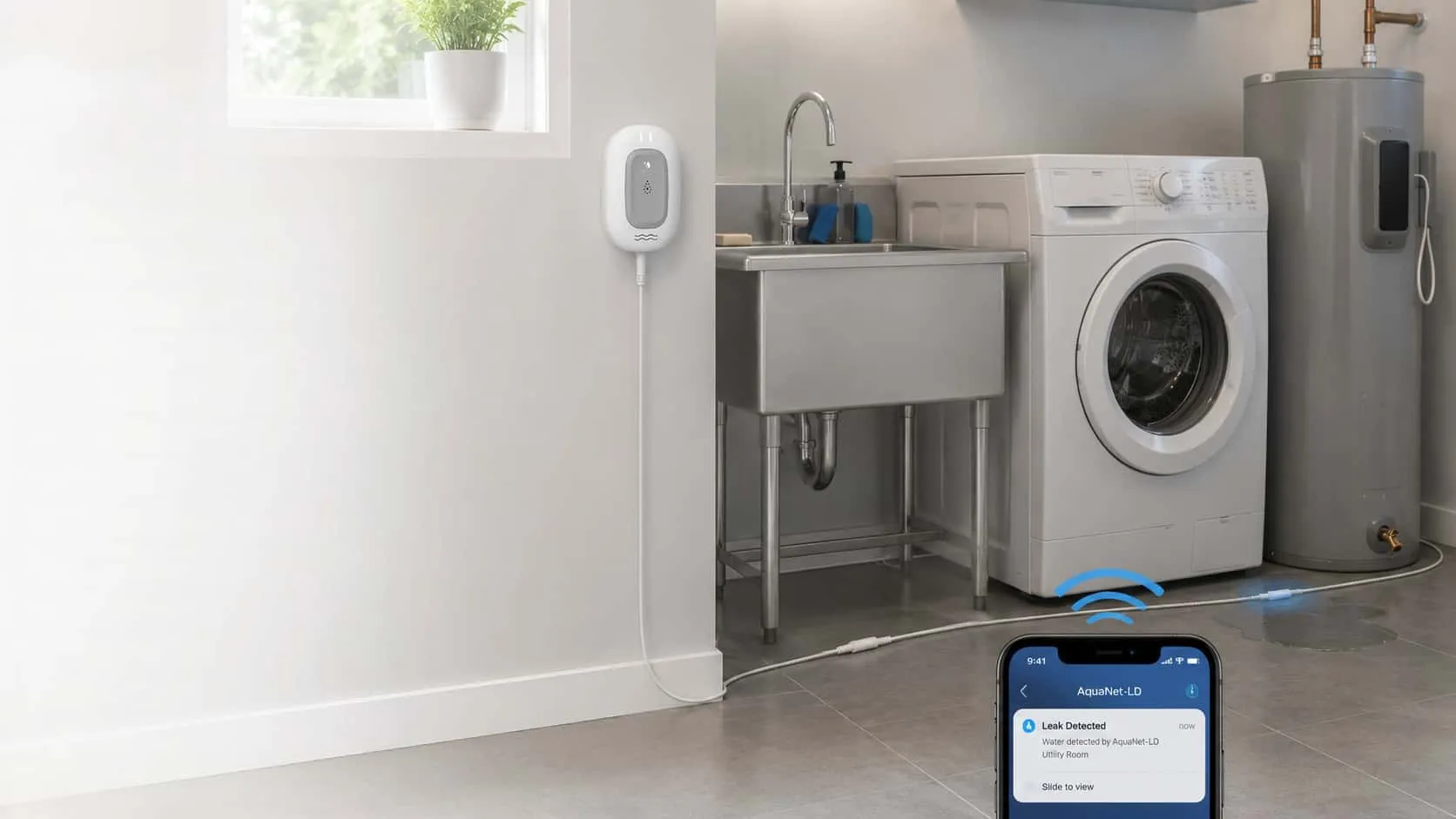
Grus product facts define a conservative boundary for AquaNet-M: its electrodes detect a change in resistance when water contacts the sensing area. When its two sensors detect water, it can show a red LED and send a wireless signal. The paired alarm-system path matters; this article does not treat AquaNet-M as proof of direct Wi-Fi access or direct valve control.
Placement therefore affects what can be detected. A sensor in one corner does not monitor every pipe, wall cavity, drain, appliance, or level of the home. Furniture, floor slope, absorbent materials, and the route water takes can determine whether water reaches it.
The practical planning question is not “Does one sensor protect the room?” It is “Which credible leak paths can reach this sensing location, and what remains outside that coverage?”
Stage 2: the event must reach a person or system
Morgan may be close enough to notice a local indication. If Morgan is away, the response depends on the supported paired system, its power, connectivity, account state, notification settings, and the person responsible for acting.
An alert path should have an owner. The household should know:
- who receives the event;
- what information they should verify;
- who can access the property;
- how to escalate when no one is onsite; and
- what to do when the app, network, or paired system is unavailable.
A phone notification graphic in an advertisement is not evidence that an alert will reach every user under every condition. That is why the Hero for this article shows the physical leak context, not a fabricated App result.
Stage 3: water control is conditional
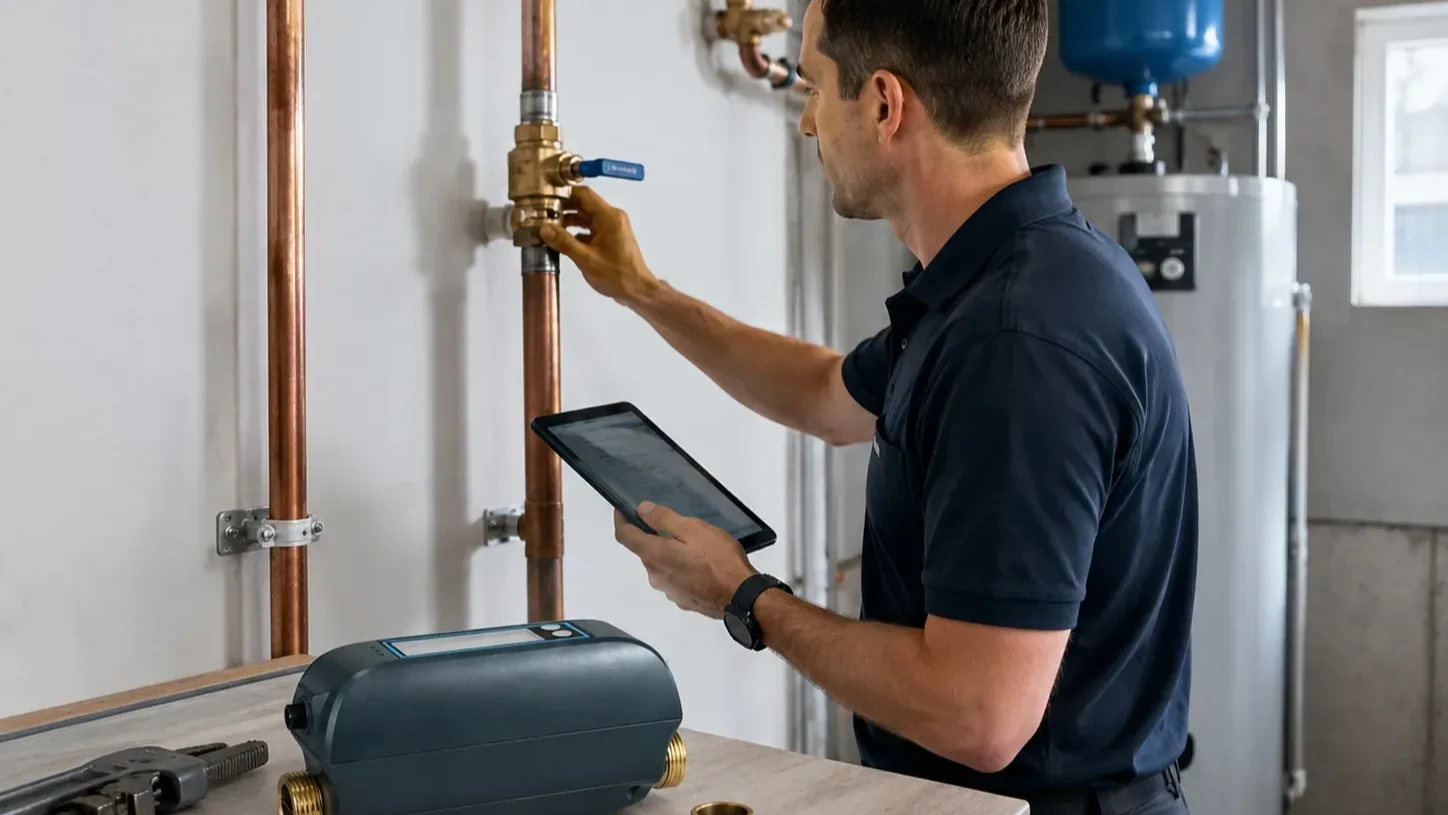
Some systems can link a compatible detector event to a smart water valve. In the approved Grus AquaNet-BD context, detector-triggered closure must be described as conditional Smart Life/Tuya app-based automation with compatible equipment when correctly configured. It is not a direct sensor-to-valve hardware connection.
That distinction creates several checkpoints:
- the detector event must enter the configured automation path;
- the linked devices and account must be available;
- the automation rule must still be enabled and valid;
- the valve must receive and execute the command; and
- the closed valve must actually control the line feeding the leak.
Even a confirmed valve closure cannot remove water already released, stop water from an uncontrolled source, diagnose the cause, or dry the building. During external-power loss, the approved AquaNet-BD boundary is local valve control; Wi-Fi and App remote access are unavailable. A response plan should not promise remote control in that condition.
Follow Morgan through the six-stage response
The flow below keeps device events and human decisions separate.

The repeated route to onsite assessment is deliberate. Whether the alert arrives or a valve closes, the property still needs a person with the right access and authority to determine what happened.
Stage 4: inspect the situation without assuming the cause
Morgan finds a small wet area beside the washer. The immediate priorities are people, obvious hazards, and limiting exposure under the household’s emergency plan. This article does not provide plumbing, electrical, appliance-disassembly, or contaminated-water instructions.
The U.S. Environmental Protection Agency’s Fix a Leak Week guidance recommends identifying and fixing household leaks rather than letting them continue. The right responder depends on the source and conditions. Visible water near electrical equipment, sewage, damaged building materials, or an uncertain source can require qualified help rather than household troubleshooting.
Morgan records what can be observed safely: when the event appeared, where water is visible, whether a valve action was reported, and what changed in the home. That record helps the appropriate responder without converting an uncertain observation into a diagnosis.
Stage 5: repair and drying are separate from detection
Stopping new water and addressing existing moisture are different jobs. A closed valve can reduce supply from a controlled line, but it cannot extract water from flooring, walls, cabinets, insulation, or contents.
EPA’s mold cleanup guidance emphasizes acting promptly and matching the response to the amount of water damage and mold growth. Morgan therefore does not use a dry-looking sensor as proof that concealed materials are dry or that the repair is complete.
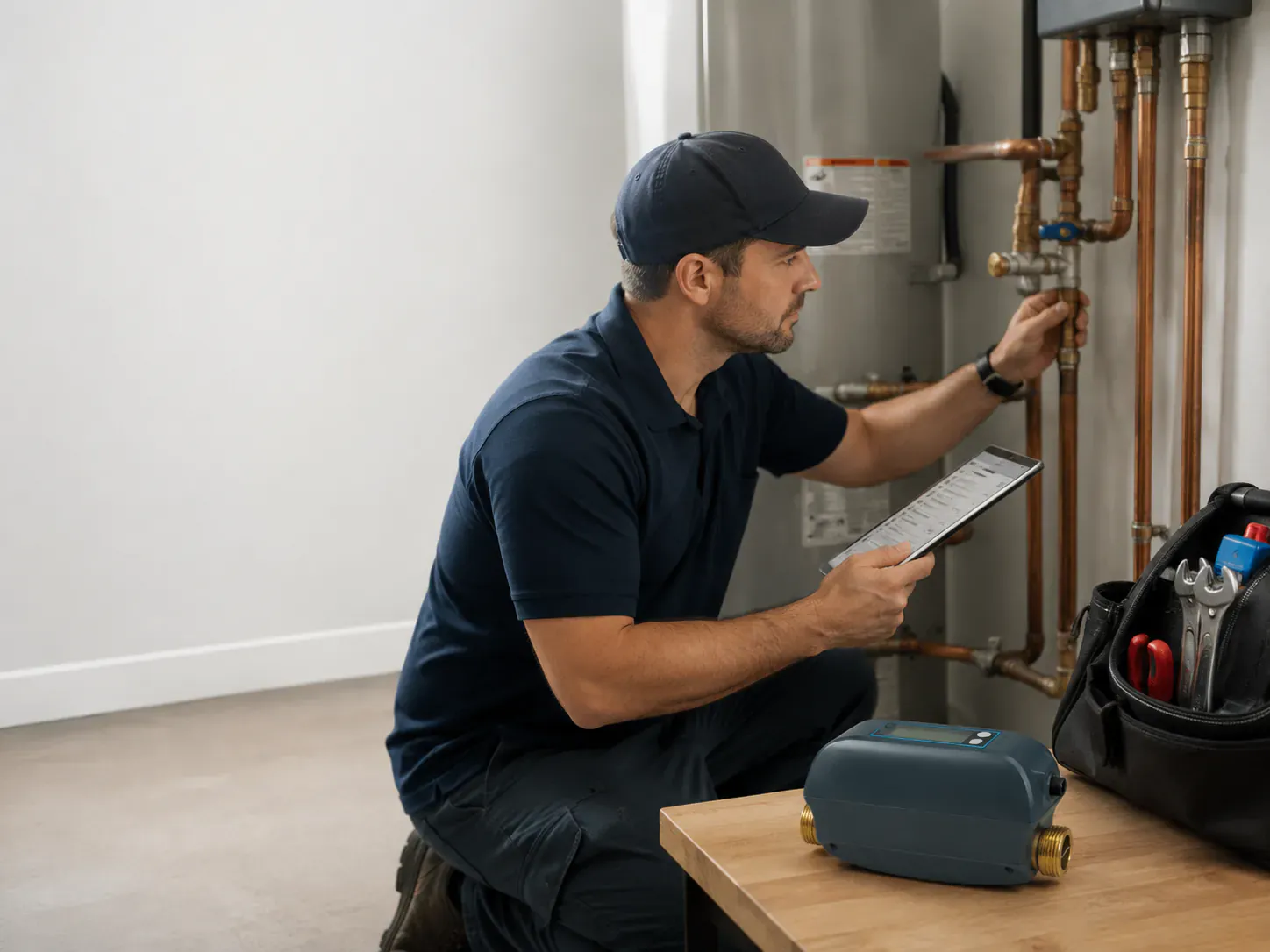
The return-to-service decision can involve the property owner, plumber, appliance service provider, restoration professional, electrician, insurer, building manager, or another responsible party. Which roles are needed depends on the actual event; a connected device cannot choose or replace them.
Stage 6: restoration needs authorization and a test plan
Reopening a water line is not the automatic final step after an alert clears. Before restoration, the responsible person should know that the source has been addressed, affected conditions have been evaluated, and the system can be tested under the appropriate authority.
For Morgan, the authorized sequence is defined by the responder and property plan. After service returns, monitoring helps check for recurrence, but a quiet sensor does not certify the plumbing, appliance, structure, or electrical environment.
The household should also review the event path: Was the sensor in the right place? Did the paired signal arrive? Did the intended person respond? Was the valve path available? Was closure independently confirmed? Did the contact list work? Any weak handoff is an improvement task, not evidence that the next event will resolve itself.
Questions to settle before relying on the workflow
Use these questions before treating a detector-and-valve combination as part of a response plan:
- Which leak paths can actually reach each sensor?
- What local indication and paired communication path does the exact model support?
- Who owns the alert during the day, overnight, and while traveling?
- What happens when power, network, cloud, or App access is unavailable?
- Is the detector-to-valve action a supported App automation, and has it been tested within the approved setup?
- Which water line does the valve control, and which sources remain outside it?
- Who can enter the property and assess the source?
- Who is authorized to repair, dry, test, and restore service?
- What records should be kept after an event?
These questions do not guarantee an outcome. They turn a product feature into a response plan with named dependencies and owners.
Build the plan around handoffs, not promises
A leak sensor can provide earlier awareness when water reaches the right place. A paired system may communicate the event, and a compatible smart valve may support conditional control when the linkage is correctly configured. Those capabilities matter, but none of them replaces onsite assessment, repair, drying, or an authorized restoration decision.
The strongest household plan assumes that any handoff can fail and defines a backup. Detection starts the workflow; people, product fit, configuration, access, and professional judgment determine what happens next.
Review the Grus leak detector and valve path to compare the product context with your valve fit, installation access, sensor placement, and response-plan requirements before buying.