

A smart thermostat rebate should be the last eligibility check, not the first product-selection shortcut. Before buying, confirm seven separate facts: the thermostat fits the heating system, a current program serves the property, the exact model is eligible, the purchase and installation dates qualify, the required installation or connection conditions can be met, the application documents are available, and the program administrator still accepts the application.
A rebate listing is not an approval. A thermostat can fit a home but miss a program rule, or appear on a qualifying list but be wrong for the home’s voltage, wiring, equipment, or control needs. Treat compatibility and rebate eligibility as two gates that both need evidence.
This article uses a hypothetical homeowner named Alex. It is not a customer result, a rebate offer, or a claim that any Grus thermostat qualifies for a particular program.
The seven checks at a glance
Use this table before placing an order. Save the evidence beside each answer rather than relying on a search result or an old screenshot.
| Check | Evidence to collect | What it cannot prove by itself |
|---|---|---|
| 1. Heating-system fit | Equipment type, voltage class, current thermostat records, product manual | Rebate eligibility |
| 2. Service address and program | Current utility or program-administrator page for the property | Exact-model qualification |
| 3. Exact model | Current qualified-product list and full model identifier | Compatibility with the home |
| 4. Purchase and installation timing | Current program dates and planned purchase/install dates | Application acceptance |
| 5. Installation or connection rules | Current program terms plus the product installation boundary | That every homeowner may self-install |
| 6. Required documents | Receipt, invoice, model record, account details, and any required installation evidence | That the submission is complete until checked against current instructions |
| 7. Funding and acceptance | Current application status and administrator decision | Guaranteed future availability |
If one answer is unknown, pause that part of the decision. “Needs verification” is more useful than assuming a discount that may not apply.
Check 1: confirm thermostat compatibility first
Start with the heating system, not the incentive list. Identify whether the home uses line-voltage electric heat, a 24-volt HVAC or heat-pump control system, a boiler, another zoned system, or a combination. Then compare the exact thermostat manual with the system records and installation requirements.
This is a product-fit decision. A rebate administrator does not replace a compatibility review, and a product page does not replace the program rules.
Grus maintains different thermostat paths because these systems are not interchangeable. For example, the approved Grus product facts identify EcoNet-BH as a high-voltage baseboard thermostat, while EcoNet-HP and EcoNet-TU are 24-volt HVAC thermostat paths. None is universally compatible. Installation belongs to a suitably qualified person where the product documentation, system, or local requirements call for one.
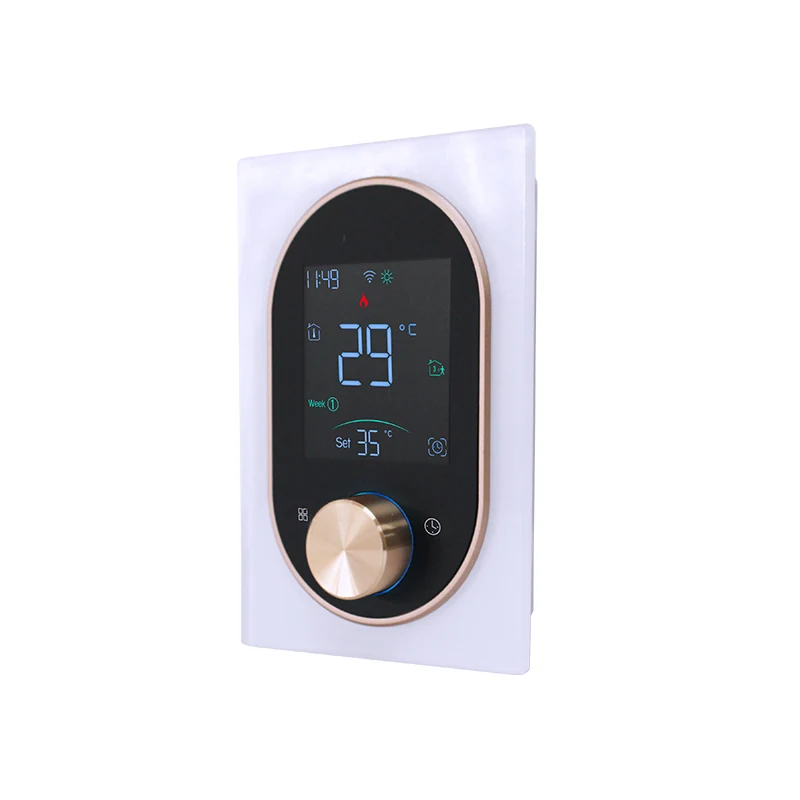
The image identifies a thermostat product format. It does not show that the product fits Alex’s home or appears on a current qualifying-products list.
Check 2: find the program for the service address
Rebates are usually tied to a place and an administrator. Start with the property’s current utility account, then check applicable state, local, or other program-owner sources. Do not assume that a program found for a neighboring city, a different utility territory, or a previous residence applies.
The ENERGY STAR Rebate Finder asks for a ZIP code before showing partner offers. That is a useful discovery tool, but the current program administrator still owns eligibility, dates, product lists, evidence requirements, and acceptance.
Alex records the service address, utility account, program name, official URL, and date checked. If the program page redirects, is archived, or no longer accepts applications, an old search result is not enough.
Check 3: match the exact model, not only the brand
“Smart thermostat” is a category, not an eligibility decision. Programs may publish a qualifying-products list with exact manufacturer and model identifiers. A similar name, color, product family, or retailer listing does not establish a match.
Before buying, compare all of the following:
- the exact model identifier on the program list;
- the exact model on the product page or quote;
- the identifier expected on the receipt or invoice;
- any required certification or feature stated by the program;
- the version or bundle, if the administrator distinguishes them.
An ENERGY STAR reference, a utility category, or a certification status in another context does not establish Grus eligibility. The program owner must confirm the exact model under its current rules.
Check 4: verify purchase, installation, and submission dates
Three clocks may matter: when the product is purchased, when it is installed or connected, and when the application is submitted. A program can change between research and purchase, or require submission within a stated period after purchase.
Alex saves the official terms on the decision date and writes down the planned purchase and installation dates. Immediately before ordering, Alex checks the live page again. After purchase, the receipt date—not the date Alex first researched the offer—becomes part of the evidence record.
Avoid copying a deadline into a personal checklist without its source and year. An evergreen buying article cannot guarantee that a current program will remain open, funded, or unchanged.
Check 5: read installation and connection conditions
Some programs distinguish centralized smart thermostats from line-voltage connected thermostats. Others may require professional installation, Wi-Fi registration, a specific heating source, a particular control capability, or another condition defined by the administrator.
The current Puget Sound Energy smart thermostat rebate page illustrates the point. It publishes separate qualification sections for smart thermostats and line-voltage connected thermostats, plus service, heating-source, model, connection, purchase, installation, and documentation rules. That is one live program example, not a nationwide standard and not proof that a Grus product qualifies.
Program language also does not authorize unsafe work. Do not open wiring, remove a thermostat, or perform energized testing to answer a rebate question. Use existing equipment records, the exact product manual, and a qualified installer or program administrator as appropriate.
Check 6: prepare the application evidence
A complete evidence folder makes the final decision auditable. Follow the current instructions rather than assuming every program requests the same documents.
A practical folder may include:
- the service-address and utility-account details requested by the program;
- the current program terms and qualifying-products page;
- the receipt or paid invoice with the exact brand and model;
- purchase and installation dates;
- installer or connection evidence when required;
- the submitted application and confirmation number;
- messages from the administrator about missing or accepted information.
Redact sensitive account details before sharing records outside the application process. Grus does not need private utility credentials to explain the general compatibility and eligibility boundary.
Check 7: treat funding and acceptance as separate outcomes
Even when the first six checks look complete, the applicant has not approved the rebate. Programs can have funding limits, processing rules, inspection steps, or other current conditions. The administrator’s decision—not the product purchase—closes eligibility.
For purchase planning, Alex evaluates the thermostat at its normal purchase cost and fit. Any potential rebate stays conditional until accepted. This avoids choosing an incompatible thermostat or exceeding a budget because an estimated incentive was treated as cash already received.
If the application is denied, keep the reason. It may show a missing document, a model mismatch, an address or customer-rule issue, a timing problem, or a closed program. Do not rewrite a denial as proof that all thermostat rebates are unavailable.
Use a two-gate decision flow
The flow below keeps product fit, program eligibility, and administrator acceptance separate.

The “no or unknown” branches are deliberate. A purchase can still make sense without a rebate, but only after product fit and full-price value are clear.
Follow one household through the checklist
Alex has electric heating and sees a thermostat offer in a search result. Instead of ordering immediately, Alex first checks the equipment records and learns that the home uses a system that needs a specific thermostat class. That removes several products from consideration before rebate research begins.
Next, Alex enters the property ZIP code in an official finder, opens the administrator’s live page, and records the program URL. Alex then compares the full product model—not just the brand—with the current qualifying list. The model is listed, but the program also has timing, connection, documentation, and customer rules.
Alex asks a qualified installer to handle the installation path required for the home, keeps the itemized invoice, and submits the application according to the current instructions. Until the administrator responds, Alex’s budget still treats the rebate as conditional.
This scenario demonstrates a decision process. It does not claim that Alex is a real customer, that every program uses these exact steps, or that a Grus product will be accepted.
Avoid five common rebate assumptions
- “The brand is listed, so every model qualifies.” Eligibility can be model-specific.
- “The thermostat qualifies, so it must fit my home.” Program eligibility and system compatibility answer different questions.
- “The offer appeared in search, so it is current.” Check the live administrator page and date.
- “Buying the product secures the rebate.” Installation, connection, documents, submission, funding, and acceptance may remain open.
- “The rebate proves the thermostat will save a fixed amount of energy or money.” A program incentive is not a household savings guarantee.
These guardrails protect both the heating decision and the application record.
Finish with a decision file, not a discount guess
Before buying, Alex should be able to show two evidence sets. The first proves the thermostat is appropriate for the heating system and installation path. The second shows that the service address, exact model, dates, installation or connection conditions, documents, and current program terms align.
If either set is incomplete, keep the rebate conditional. If the program closes or the model does not qualify, reassess the purchase on fit and normal cost instead of forcing the application.
Use the Grus thermostat rebate guide to organize the current compatibility, exact-model, program, timing, and evidence checks before buying.