
A negative power reading does not, by itself, tell you whether your home is exporting electricity or whether a monitor is configured incorrectly. The sign depends on the monitor’s documented convention, what the sensor measures, and how the system is configured. In a supported bidirectional setup, a negative value may represent a direction the system labels as export. On another device, the same sign may mean something different. Check the model-specific manual and installation record first; do not open an electrical panel or reposition a sensor to test a guess.
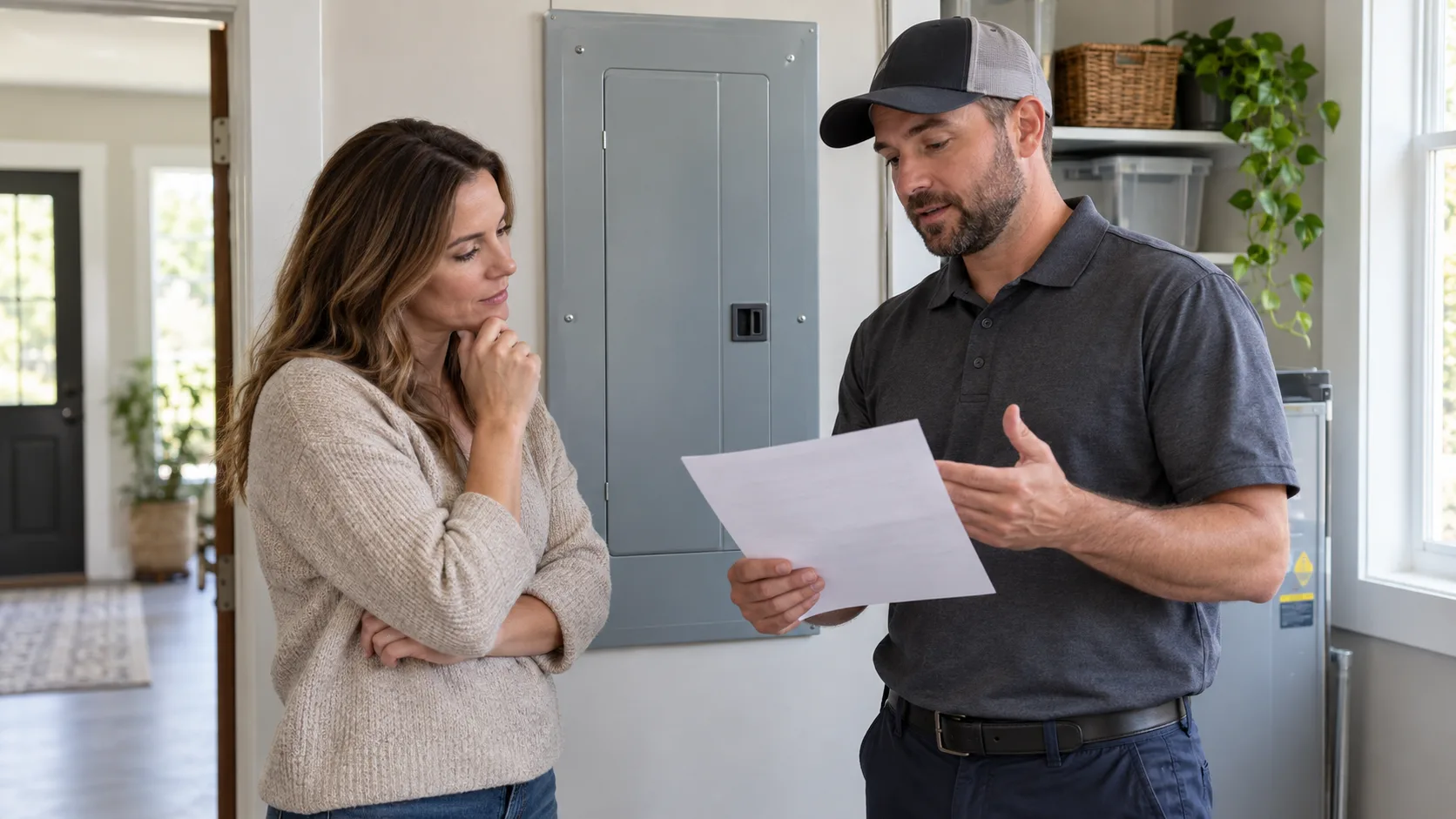
The image above is an illustrative home scene, not a Grus app screen or evidence of a particular product feature.
What a negative sign can—and cannot—tell you
Power monitoring systems use a sign convention to show direction relative to their measurement reference. That convention is not universal. OpenEnergyMonitor documents its own import/generation convention and explains that a current transformer facing the opposite way can make an expected positive reading appear negative. This describes that system, not every monitor or a Grus model.
Solar adds another possibility. When a home’s on-site generation exceeds its use at a particular moment, some electricity may flow back to the grid. The U.S. Department of Energy’s homeowner solar guide describes exported solar electricity in net-metering arrangements; terms depend on the local utility. A monitor can show that direction only if its model and configuration are designed to measure and label it.
The useful question is not “Is negative bad?” It is “What does this exact screen and model define as positive and negative, and what point in the electrical system is being measured?” A sign without that context is not a diagnosis. If you are still learning what each graph represents, start with how to read home energy monitor data.
Four explanations to keep separate
| Possible explanation | What it means at a high level | What you can safely check |
|---|---|---|
| Supported reverse-flow or export view | A bidirectional setup may represent flow toward the grid with a sign defined by its documentation. | Whether the home has generation, whether it was active at that time, and whether the manual says this view includes export. |
| Device sign convention | Different systems can assign positive and negative signs differently. | The model-specific manual’s definition of positive, negative, import, and export. |
| Sensor direction or reference relationship | Measurement direction and voltage reference can affect the sign on some systems. | The installer handoff or support record; do not move or reverse a sensor yourself. |
| Channel, phase, or configuration mismatch | A displayed channel may not correspond to the expected circuit or reference. | Existing app labels and saved configuration. Ask the installer or support to review unclear records. |
These are categories for a conversation, not a remote checklist for changing electrical equipment. One pattern may fit more than one explanation, and the same symptom can have different meanings across products.
A safe, non-invasive review
You can gather useful context without touching wiring:
- Record the product model, app screen, channel name, date, and time shown with the negative value.
- Check whether the view shows instantaneous power or energy over an interval; do not compare unlike units or time windows.
- Note whether solar or another on-site generator was operating, if that information is already available to you.
- Read the model-specific manual’s sign convention and compare it with the wording on the screen.
- Compare the view with the existing installation handoff and saved channel labels. Mark missing details as unknown rather than guessing.
- Share the screenshot and these details with the installer or product support if the sign remains unexplained.
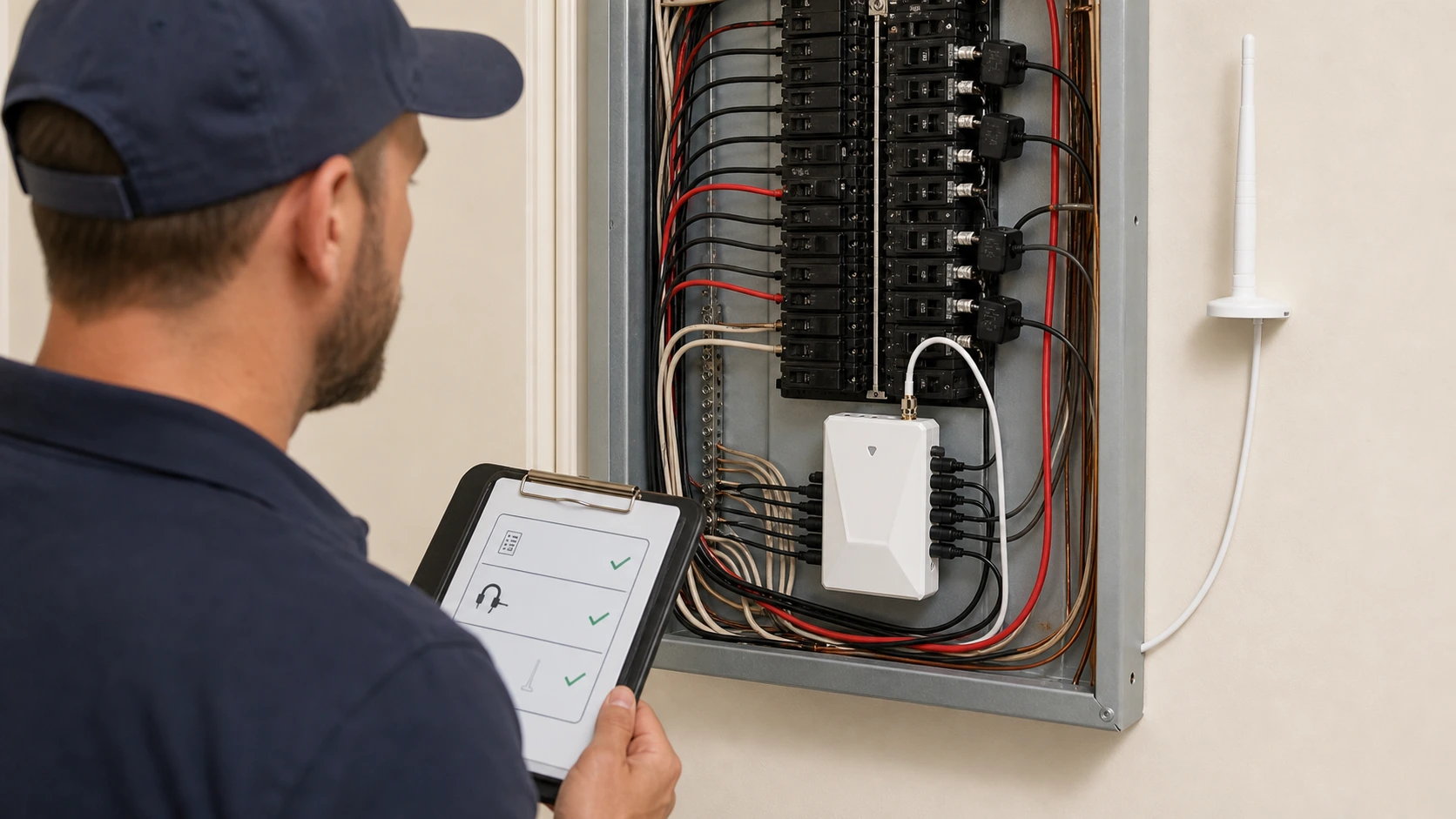
Do not open a panel, move a CT, access a conductor, or alter a voltage reference based on an app reading or this article. A remote dashboard cannot establish that an installation is safe to inspect or modify. Ask an appropriately qualified professional when equipment access is needed. For a separate discussion of measurement scope, see how many CT clamps a home energy monitor needs.
When to request a professional review
Ask the installer or product support to review the setup when a negative value is unexpected, persists in a view that the manual says should use another sign, appears on one channel but not comparable channels, or changes after equipment or configuration work. Share the exact model, screenshot, timestamp, and existing configuration record.
If there are signs of physical damage, exposed wiring, heat, arcing, or an electrical smell, stop interacting with the equipment and contact an appropriately qualified professional or local emergency service as appropriate. Do not use the monitor to assess immediate electrical safety.
If the documentation confirms that the view measures bidirectional flow and the time aligns with on-site generation, the negative sign may be an expected direction label. If the manual or installation record does not explain it, leave the system unchanged and request a model-specific review. Neither conclusion can be drawn from the sign alone.
What this reading does not prove
A negative value alone does not prove that a home is exporting power, a sensor is installed backward, wiring is wrong, a product is defective, or a utility meter is inaccurate. It also does not establish a safety condition. Those conclusions require the product’s actual measurement convention and, where equipment inspection is needed, an appropriately qualified professional.
For help interpreting a Grus setup, contact Grus Support with the model, screenshot, timestamp, and relevant manual or installation note.
FAQ
Does negative power always mean solar export?
No. Export is one possible interpretation in a documented bidirectional setup, but sign conventions and configurations differ. Check the exact monitor manual and setup record.
Should I reverse the CT if the graph is negative?
No. Do not reposition a CT or open electrical equipment based on this article. Ask the installer or product support to determine whether the model’s documented measurement convention matches the configured installation.
Can a dashboard tell me whether my panel is safe?
No. A dashboard reading is not an electrical safety inspection. If the question requires access to electrical equipment, use an appropriately qualified professional.