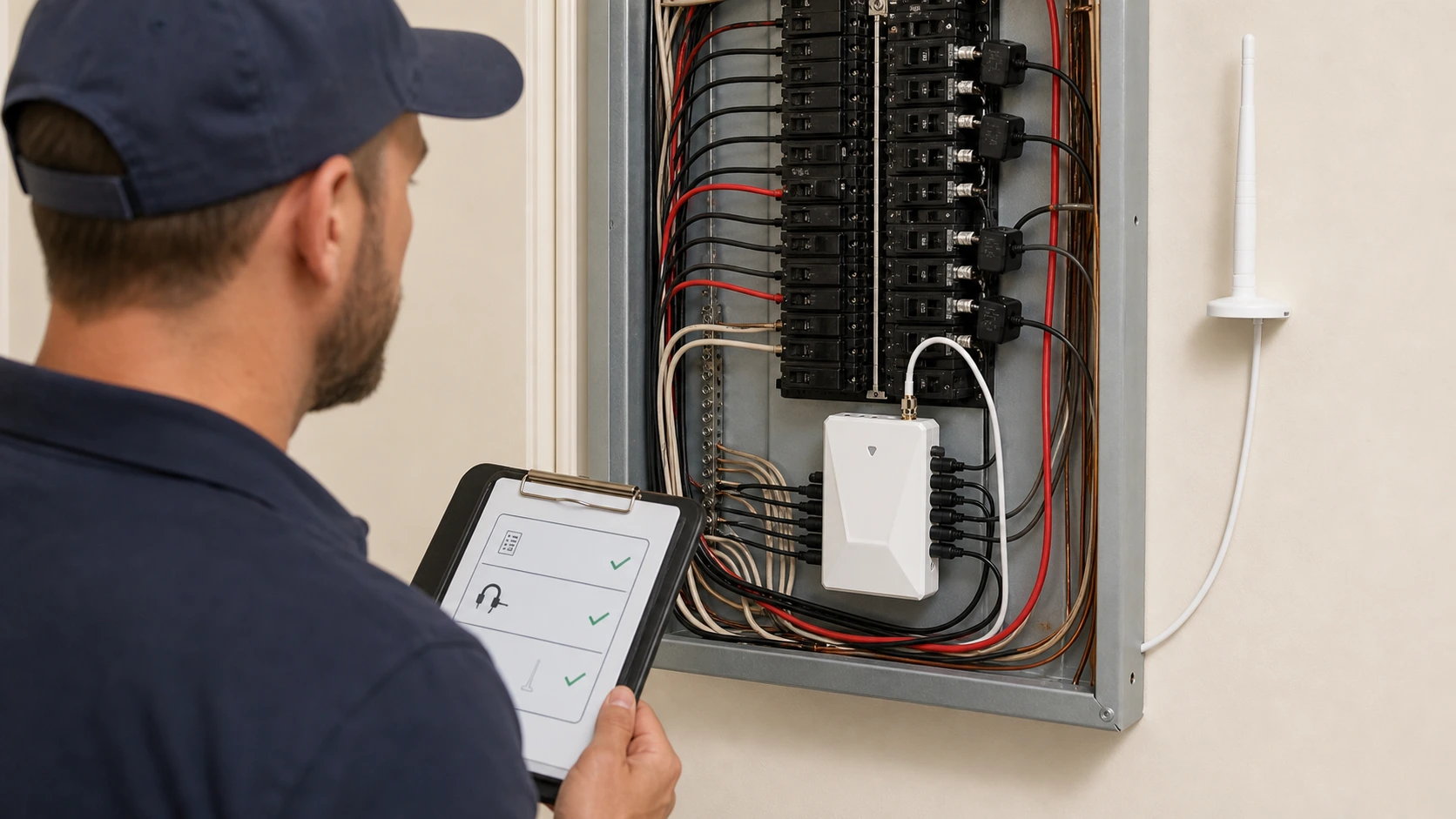
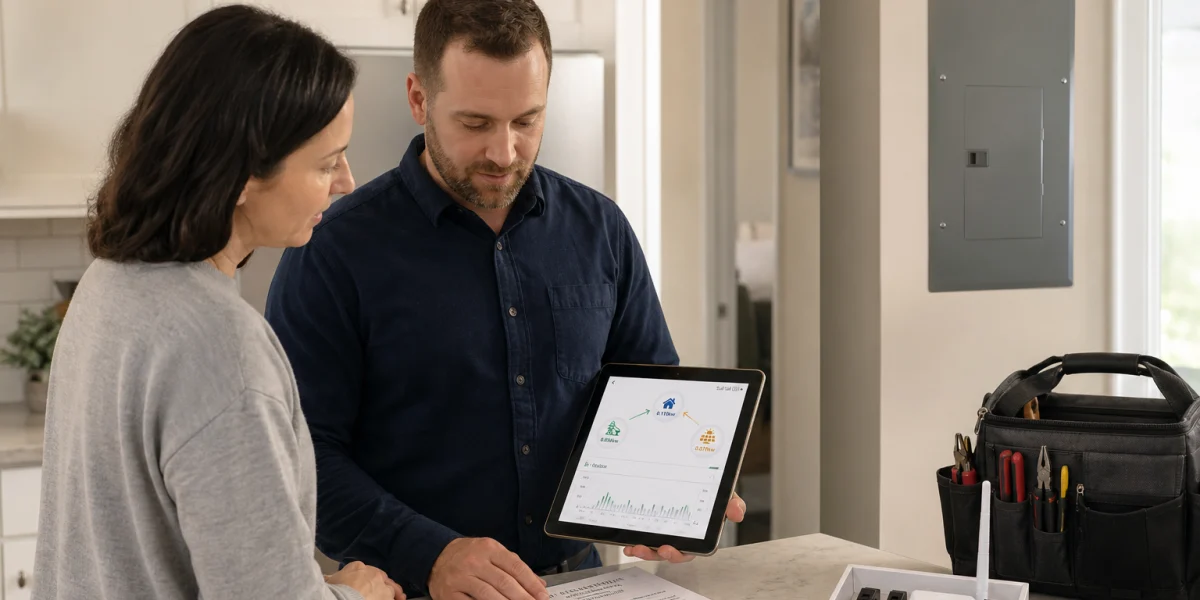
Electricians can offer home energy monitoring as a service when they define the service around a clear customer outcome: assess the home, select an appropriate documented configuration, complete qualified electrical work, confirm that data is visible, and hand the homeowner a usable baseline. The value is not the monitor by itself. It is the contractor’s ability to turn a product into a scoped, understandable, and supportable job.
That scope needs a firm boundary. The local electrician owns the site assessment, electrical work, local requirements, job pricing, scheduling, and customer relationship. Grus can discuss available products and documentation, but it does not replace the contractor’s judgment or promise a local installation. Program terms, training, territory, pricing, and support commitments also require a qualified discussion and written agreement.
This article uses one example throughout. Elena runs a residential electrical company. A homeowner asks whether an energy monitor can make a recent increase in electricity use easier to investigate. Elena does not quote a device immediately. She treats the request as a small service project with defined inputs, deliverables, and limits.
Start with the decision the homeowner needs to make
A useful first conversation is about the decision behind the request, not about a list of product features. The homeowner may want to establish a whole-home baseline, compare daily patterns, observe a known large load, or keep a record before and after a planned home upgrade. Those are different service outcomes, and each changes what Elena must verify before proposing work.
The U.S. Energy Information Administration explains that kilowatts describe power at a moment, while kilowatt-hours describe energy used over time. Its guide to measuring electricity is a useful foundation for the customer conversation. A live kW value can show what the home is drawing now; a daily or monthly kWh total is the better starting point for comparing energy across periods.
Elena asks the homeowner to choose one primary question:
- Do you want a whole-home usage baseline?
- Do you want visibility into selected documented circuits or large loads?
- Are you preparing for solar, an EV charger, heat-pump equipment, or another planned change?
- Do you need help reading trends rather than diagnosing a physical electrical problem?
If the request is really a utility-billing dispute, a code inspection, a power-quality investigation, or a guarantee of savings, Elena separates that work from the monitoring proposal. A monitor may provide useful visibility, but it is not automatically a utility meter, a billing instrument, a safety inspection, or a savings guarantee.
Package the job into five service stages
The cleanest service offer is a sequence with a stop/go decision between stages. Elena can quote the stages together or separately, but she should state what evidence completes each one.
| Service stage | Electrician deliverable | Customer-visible completion evidence |
|---|---|---|
| 1. Discovery | Primary question, property context, desired views, and constraints recorded | A written scope that names what the project will and will not answer |
| 2. Site and fit assessment | Electrical-system and installation-context review under applicable local practice | A fit decision, open questions, and any required follow-up listed before installation |
| 3. Qualified installation | Work completed to product documentation and local requirements | Installed hardware, job record, and required labels or documentation |
| 4. Data handoff | Confirmed account access and the intended visible whole-home or circuit views | Homeowner can open the approved dashboard and identify the agreed views |
| 5. Baseline and support handoff | Initial observation period, notes, and support route | A dated baseline summary plus responsibility and escalation contacts |
The table matters because it prevents “install a monitor” from becoming an unlimited promise. Elena is selling a defined professional service, not responsibility for every future bill, network outage, appliance change, utility adjustment, or undocumented third-party integration.
The U.S. Department of Energy describes a professional home energy assessment as a detailed, equipment-based look at a home’s energy efficiency. Energy monitoring is narrower: it makes electrical-use data visible. Elena can coordinate the two when appropriate, but she should not market a monitoring installation as a complete building energy assessment unless that broader work is actually in scope. See DOE’s Consumer Guide to Home Energy Assessments for the distinction.
Make the pre-install assessment a paid professional step
The assessment is where Elena protects the customer and her own schedule. She reviews the service request, the documented product requirements, the electrical context, physical fit, communications conditions, and the customer’s expectations before committing to an installation date.
This article does not provide instructions for opening a panel, routing conductors, positioning current transformers, or connecting equipment. Those decisions belong to qualified people working from the applicable product documentation and local requirements. OSHA guidance defines a qualified person in relation to familiarity with the construction and operation of the equipment and the hazards involved. Its electrical safety work-practice guidance also makes clear that qualification depends on the equipment and task, not just a general job title.
A practical assessment record can stay concise:
- the homeowner’s primary monitoring question;
- the service and panel context the electrician verified;
- which documented whole-home or circuit views are expected;
- any solar, generation, EV, HVAC, water-heating, or other major-load context relevant to the scope;
- network availability at the intended location, when the documented product requires it;
- physical, access, scheduling, permitting, or local-rule constraints;
- what remains unknown and who owns the next answer.
If fit is uncertain, Elena stops before promising an installation. “Needs verification” is a valid assessment result. It is better than turning an unresolved condition into a field change order or an unsupported compatibility claim.
Define what the customer receives after installation
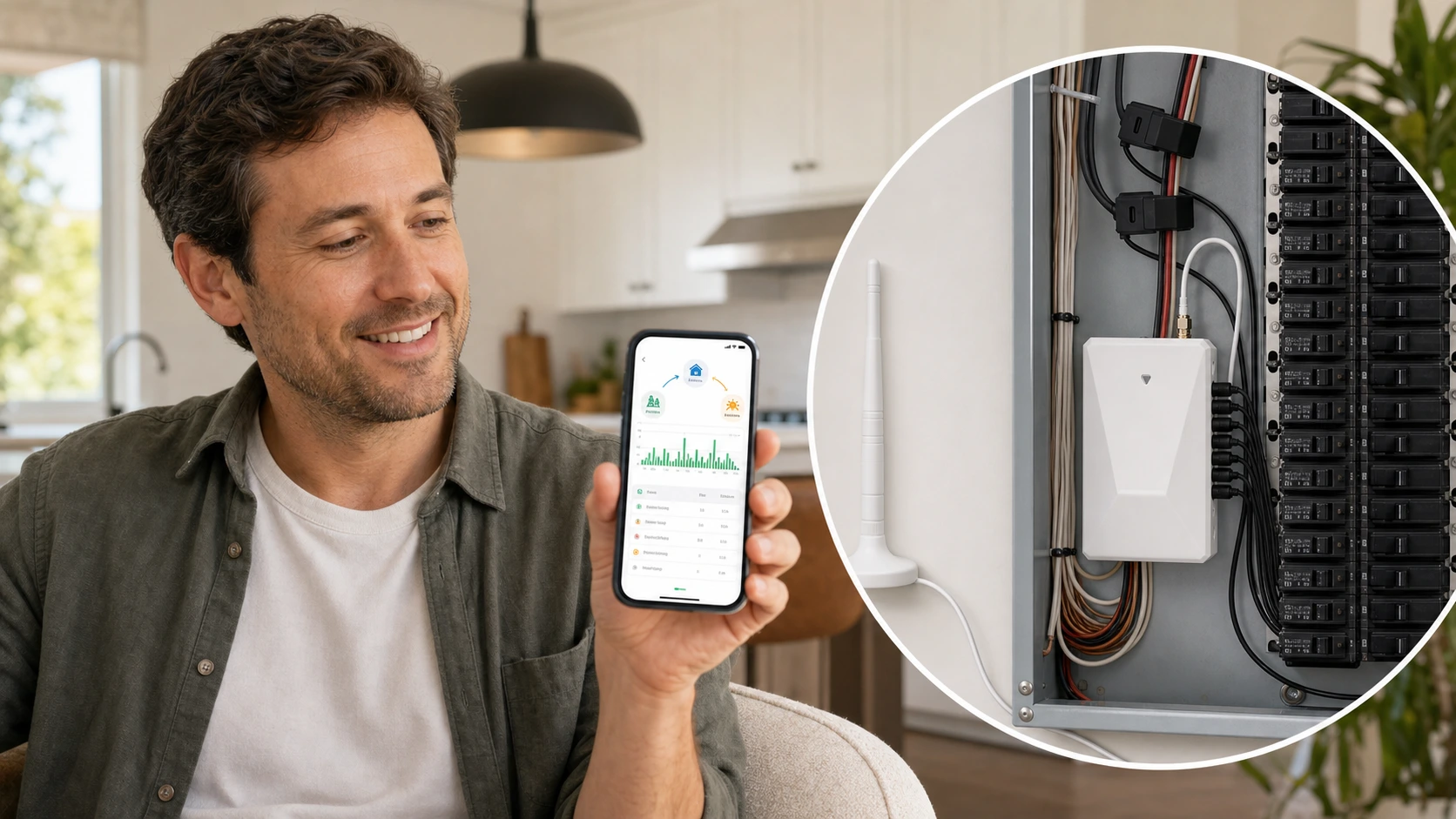
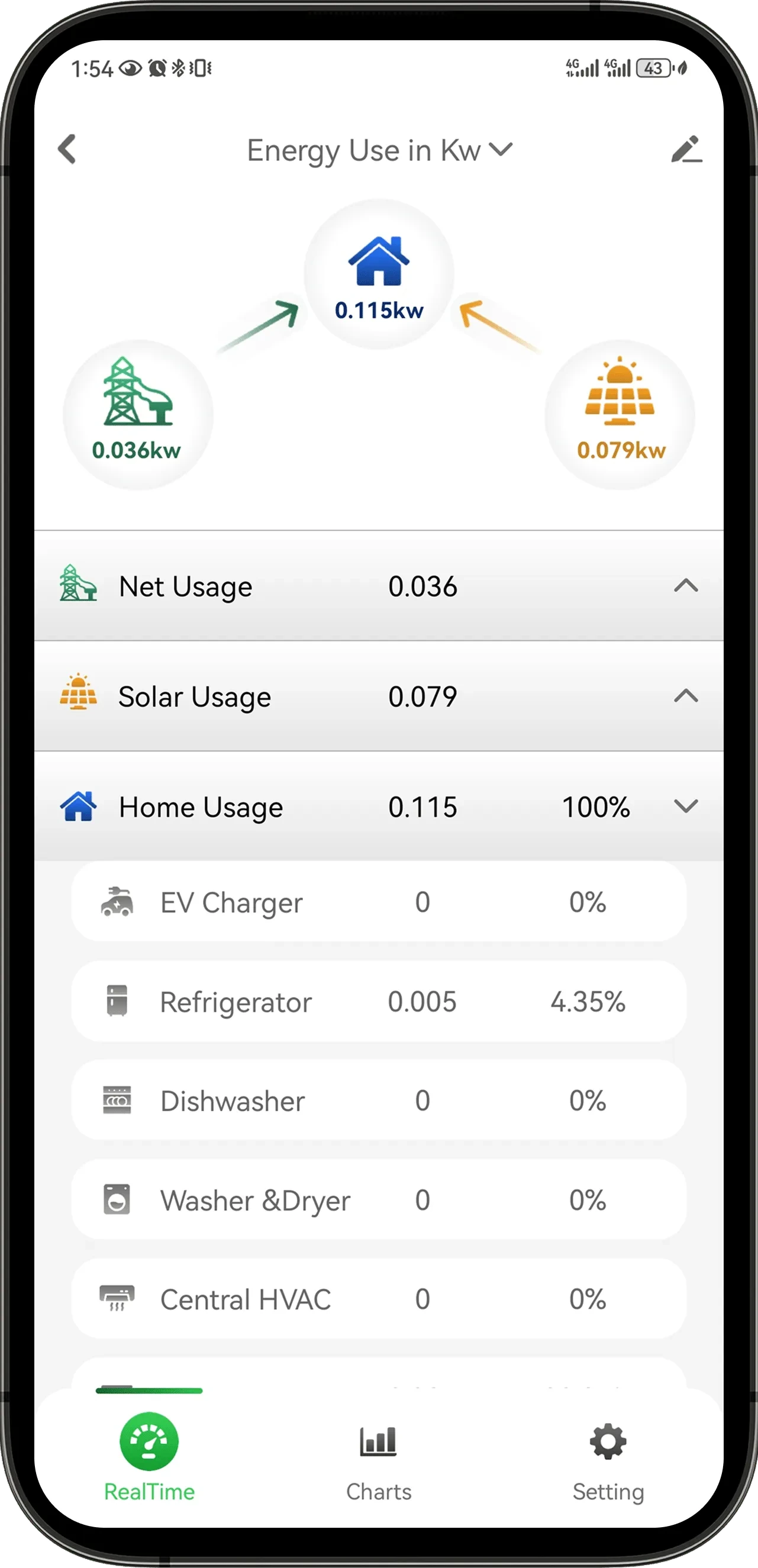
The handoff is the part most likely to turn a one-time project into a trusted service. A powered device and an app login are not enough. Elena needs to show the homeowner which screen answers the agreed question and what the data can—and cannot—establish.
For the example project, Elena’s handoff includes:
- The agreed monitoring objective in one sentence.
- The date the visible baseline begins.
- The approved whole-home or circuit views included in the job.
- A short explanation of live power versus accumulated energy.
- A note about expected data gaps, time boundaries, or network dependence when those apply to the documented setup.
- The contractor contact for installation and local electrical questions.
- The product-support route for documented account or product questions.
- A statement that the utility meter and utility statement remain the billing source.
That last point is important. The EIA notes that utilities use meters to measure customer electricity use. A home monitor should not be described as billing-grade, utility-grade, or a replacement for the utility meter without specific approved evidence. Elena can help the homeowner compare aligned kWh periods, but she should not promise exact agreement or turn a difference into an accuracy verdict without controlled evidence.
The baseline summary can be intentionally modest. It might record seven complete days, identify the home’s recurring high-use windows, and note which known loads were active. It should not claim automatic appliance identification, predict a guaranteed bill reduction, or diagnose an electrical fault from a chart alone.
Separate electrician, homeowner, utility, and Grus responsibilities
Responsibility becomes clearer when it is written before the job begins.
| Party | Owns | Does not automatically own |
|---|---|---|
| Local electrician | Site assessment, safe work, local rules and permits, job price, schedule, access, installation record, and customer relationship | Utility billing decisions, undocumented product claims, or unlimited future support |
| Homeowner | Accurate project context, site access, account participation, network availability where required, and questions about intended use | Electrical installation decisions or unsafe troubleshooting |
| Utility | Utility meter, billing-period data, tariff application, and bill questions | Product dashboard support or contractor workmanship |
| Grus | Discussion of available products and approved documentation; product-specific support within confirmed terms | Local site assessment, local electrical work, permits, contractor pricing, scheduling, or unapproved partner-program commitments |
This boundary also shapes the warranty and support conversation. Elena should use actual written product and partner terms rather than inventing a blanket service promise. If a customer asks about program discounts, lead allocation, territory, certification, training, or response times, those questions need a qualified partner discussion and written agreement.
Price the service by deliverables, not by implied savings
Elena can build a commercial offer without claiming that monitoring will save a particular percentage. The price can reflect professional work that is visible and controllable: discovery, site assessment, installation labor, documentation, customer education, baseline review, and an optional scheduled follow-up.
A proposal can show these as separate line items or one fixed scope. What matters is that the homeowner can see where the contractor’s time goes. A return visit should have a defined purpose, such as reviewing a complete baseline period or answering questions about the agreed dashboard views. It should not be described as an open-ended promise to reduce the bill.
Avoid making the hardware the only visible value. If the proposal lists only a device and labor, the customer may compare it with an online product price and miss the professional assessment and handoff. When the proposal names each deliverable, Elena can explain why the job starts before installation and continues through a usable baseline.
Use a release checklist before calling the job complete
Elena closes the project only when the agreed evidence exists. Her release checklist is short enough to use on every job:
- The original customer question and agreed scope are in the job record.
- Fit and unresolved conditions were documented before installation.
- Qualified electrical work and local requirements are complete under the electrician’s process.
- The customer can access the agreed dashboard view.
- The first complete data period is identified rather than inferred from a partial day.
- Live kW and accumulated kWh were explained in plain language.
- Utility billing remains outside the monitor’s authority.
- Installation, utility, and product-support contacts are separated.
- No savings, certification, universal compatibility, partner benefit, or service-level claim appears unless it is supported by current written evidence.
- The customer received the dated handoff summary.
If any item fails, the project is not ready for the final handoff. That does not always mean the installation failed; it means the service evidence is incomplete and the owner of the next action should be named.
A monitoring service succeeds when the boundary is as clear as the data
Elena’s offer works because it is more than a hardware installation and less than an unlimited energy-management promise. She helps the homeowner define a question, checks documented fit, completes qualified work, confirms the intended data view, and leaves a baseline and support map. The homeowner knows what the data can show, the utility remains the billing authority, and Grus remains within its documented product and partner role.
For an electrician or service company evaluating this kind of offer, the next step is a scoped conversation rather than an assumed program benefit. Discuss energy monitoring for your electrical business and bring the markets you serve, typical project context, and the customer outcomes you want to support.