A useful smart water protection pilot is a limited, documented test of fit, detection, communication, response, and restoration at one property or a small, comparable group of properties. It is not a promise that every leak will be detected, every valve will be compatible, or every incident will be prevented.
Before equipment is selected or work is quoted, the installer and property manager should agree on the water paths being evaluated, the device role at each location, who receives an alert, who can attend the property, who may authorize shutoff or restoration, and what evidence will decide whether the pilot should expand. Product selection and installation must then follow current manufacturer documentation, verified compatibility information, local requirements, and qualified professional judgment.
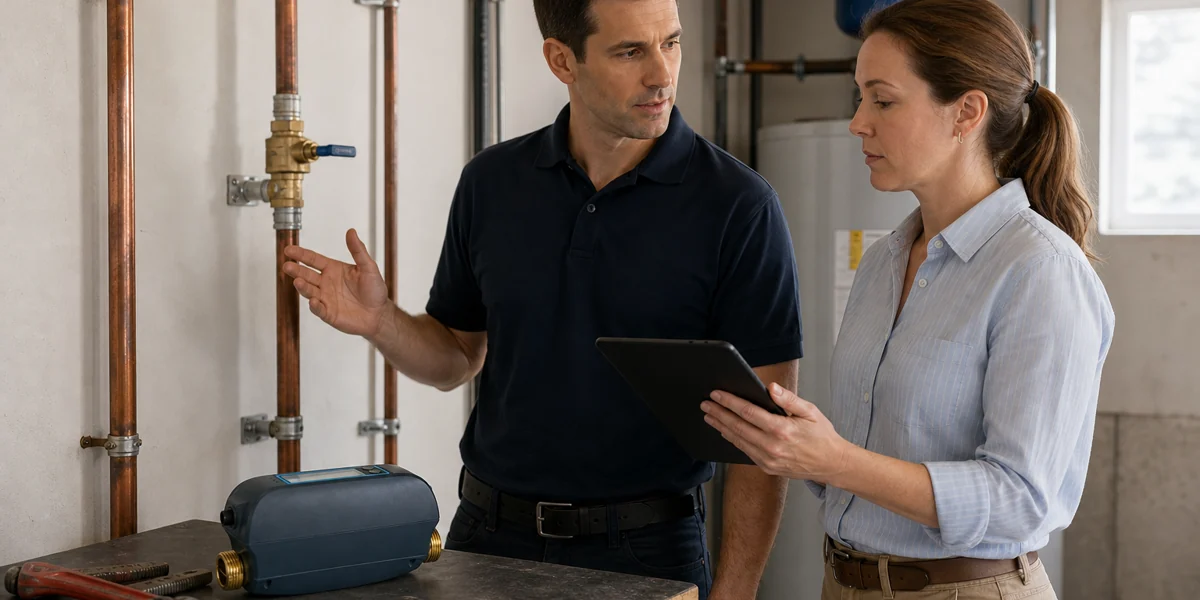
This checklist uses one example throughout. Maya manages a 12-unit residential property. Luis is a local plumbing contractor evaluating a limited pilot in one vacant unit and its utility area. They do not begin by promising a complete building rollout. They begin by defining one decision: Can a small, documented system help the property team detect selected water events and execute a clear response process without creating unacceptable operational burden?
Define the pilot decision before discussing devices
A pilot needs a decision that can be answered with evidence. “Try smart water protection” is too vague because it does not say what success means or what remains outside scope.
Maya and Luis write a one-paragraph pilot charter:
- Property scope: one vacant unit and the accessible utility area serving it.
- Water paths in scope: selected leak-prone locations and the verified main-water context for that pilot area.
- Operational question: can the team receive, acknowledge, inspect, document, and close a test event using named owners?
- Excluded scope: occupied units, concealed piping, emergency service replacement, insurance qualification, and any unverified automatic-shutoff behavior.
- Decision date: after a defined observation period and completed test record.
This keeps the pilot from turning into an open-ended product demonstration. It also makes “not ready” a valid outcome. If the property, water path, product documentation, communications conditions, or response coverage cannot be verified, the team can stop before purchase or installation.
Record the property and water path
The first site record should describe how water enters the pilot area and where an unintended release would likely become visible. It should not assume that a room name alone determines sensor placement.
Luis records:
- property type, occupancy status, access hours, and responsible property contact;
- the verified water-service and shutoff context relevant to the pilot;
- visible pipe material, valve type, size, condition, and access, marked
needs verificationwhere documentation is incomplete; - water-using fixtures and appliances inside the approved scope;
- locations where water could collect, drain away, remain concealed, or reach sensitive finishes;
- environmental constraints such as freezing exposure, outdoor use, washdown, humidity, or restricted access;
- available power and network conditions only where the candidate product documentation requires them;
- the local professional and approval path for any plumbing work.
The U.S. EPA WaterSense program notes that leak detection and flow monitoring devices use different approaches: some detect moisture at a location, while others monitor water flow and patterns. Its current Leak Detection and Flow Monitoring Devices guide is a useful neutral reference when a team is deciding what kind of problem it wants to observe.
Map each device role to one question
The pilot should not treat a sensor, notification path, valve, and onsite responder as one combined capability. Each has a separate role and a separate failure mode.
| Pilot role | Question it can help answer | What it does not prove by itself |
|---|---|---|
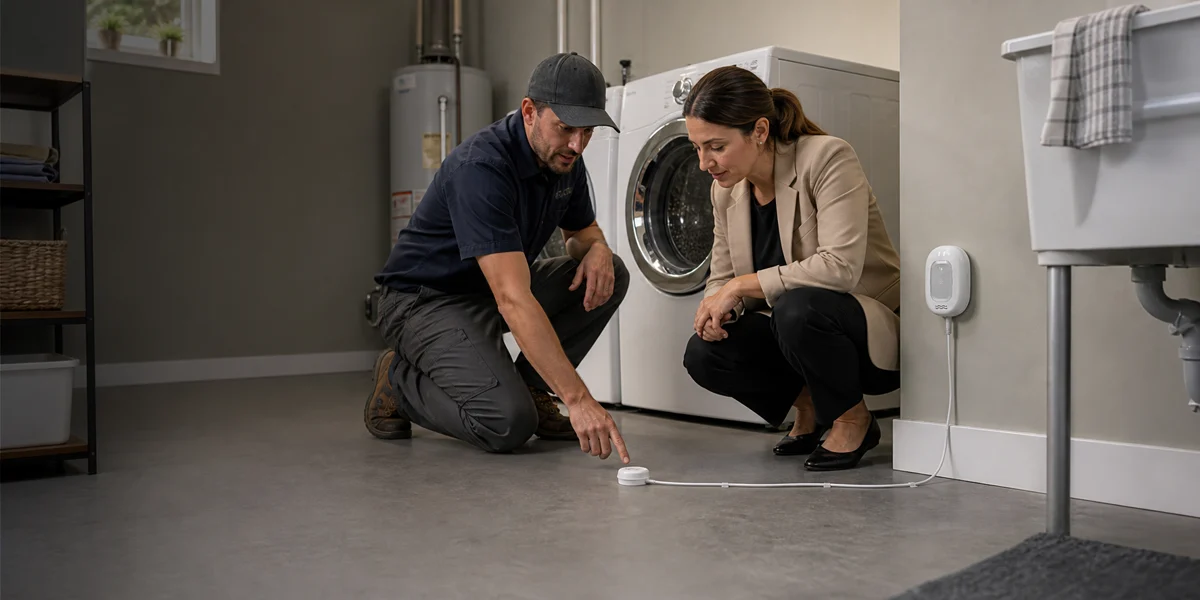
| Point moisture sensor | Did water reach this specific monitored location? | That the source was found, the flow stopped, or every nearby area stayed dry |
| Extended sensing cable | Did water contact part of the monitored cable path? | That all possible water paths were covered or that the leak was repaired |
| Flow monitoring device | Did the monitored pipe show a pattern the configured system treated as unusual? | The exact leak location or the cause of the event |
| Notification path | Did an alert reach the intended account or contact during the test? | That someone acknowledged it or attended the property |
| Shutoff control | Did the documented system execute an approved test command under the verified setup? | That every future incident will be stopped or that restoration is safe |
| Human response | Did a named person inspect, document, escalate, and close the event? | That the device replaces plumbing repair or emergency judgment |
EPA’s 2026 WaterSense guide to leak detection and flow monitoring devices recommends starting with the monitoring goal, notification preferences, shutoff needs, installation requirements, and supported pipe context. Maya and Luis use those categories as planning prompts, not as proof that a specific Grus product supports a feature.
Assign response ownership before the first test
An alert without a response owner is only a message. For every planned test window, Maya and Luis name the people and boundaries in advance.
| Responsibility | Named owner for the pilot | Required evidence |
|---|---|---|
| Product and fit questions | Installer plus current product documentation | Written fit decision and open questions |
| Local plumbing work | Qualified local installer | Job record under the installer’s process |
| Account and notification setup | Property manager or authorized delegate | Approved contacts and successful access check |
| Alert acknowledgement | On-duty property contact | Timestamped acknowledgement in the pilot log |
| Onsite inspection | Named local responder | Arrival, observed condition, photos where permitted, and escalation note |
| Repair decision | Property owner or authorized maintenance lead | Work order or documented no-repair result |
| Restore authorization | Named property authority after physical inspection | Closure record and restoration decision |
| Grus discussion | Product and partner questions within confirmed written scope | Inquiry or support record; no assumption of local field service |
Grus does not become the local installer, emergency responder, property operator, or repair contractor through the pilot. Local partners remain responsible for installation and customer service in their markets. Any product kit, documentation, software, training, branding, commercial term, or support scope must be confirmed in the current written offer rather than assumed from this checklist.
Build a safe test and evidence plan
The team should test only documented, non-destructive scenarios that the current product instructions and local professional approve. This article does not provide pipe-cutting, valve-installation, forced-leak, emergency, or bypass instructions.
For each approved test, the pilot record should include:
- The location and device role being tested.
- The documented test method and person authorized to perform it.
- The expected local indication or remote notification, if supported by the verified configuration.
- The alert recipient and acknowledgement target.
- The onsite inspection or follow-up step.
- The conditions required before any restore action.
- Start, alert, acknowledgement, attendance, and closure timestamps.
- Unexpected behavior, including missed alerts, duplicate alerts, connectivity gaps, or unclear ownership.
The flow should be simple enough that a new property-team member can understand it without relying on verbal memory.

This sequence deliberately puts responsibility and restore authority before the live pilot. A technically successful alert is not an operational success if nobody knows who should act next.
Define the restoration rule explicitly
Restoration is often the least documented part of a water-protection workflow. A closed alert or a remote command does not prove that the leak source has been found, the repair is complete, or the property is ready for water service to resume.
Maya’s pilot rule is conservative: restoration requires the named property authority to review the onsite inspection record and any required repair evidence. If conditions remain uncertain, the system stays in the state chosen by the responsible local professional and property authority. The team does not use an app screen as a substitute for physical inspection.
The closure record names:
- what triggered the event or test;
- what the onsite responder observed;
- whether repair was required and who owned it;
- who authorized restoration;
- whether the monitored area was rechecked;
- what configuration, documentation, training, or staffing change is needed before the next test.
Review the pilot with operational metrics
The pilot should measure the workflow it controls, not claim that a short trial proves long-term loss prevention.
Useful operational measures include:
- percentage of approved tests with a recorded alert or local indication;
- alert delivery and acknowledgement timestamps;
- percentage of events with a named onsite responder;
- completeness of inspection, repair, and restoration records;
- number of unresolved fit, connectivity, access, or ownership issues;
- staff time required to operate the process;
- false, duplicate, or unclear events observed during the defined test window.
Avoid turning the pilot into an insurance, savings, or damage-prevention claim. Insurance eligibility and discounts depend on the insurer, location, policy, device evidence, installation record, and other requirements. The pilot may produce documentation a property owner can discuss with an insurer, but it cannot promise a discount or coverage outcome.
At the review meeting, Maya and Luis make one of four decisions:
- Scale: the workflow is complete, the open facts are closed, and the next property group is genuinely comparable.
- Iterate: the concept is useful, but placement, notification, access, documentation, or staffing needs another bounded test.
- Hold: a product, fit, network, local-rule, or owner dependency remains unresolved.
- Stop: the operational burden, uncertainty, or property mismatch outweighs the expected value.
Use the final go/no-go checklist
Before calling the pilot ready, confirm that every statement below is supported by a current record:
- The pilot has one property scope, one decision, and a fixed review date.
- The water path, shutoff context, monitored locations, access, and constraints are documented.
- Each device role is tied to one question and one evidence item.
- Product specifications, compatibility, installation requirements, and supported behaviors come from current approved documentation.
- A qualified local professional owns plumbing work and local requirements.
- Alert recipient, acknowledgement owner, onsite responder, repair owner, and restoration authority are named.
- Test methods are documented, approved, and non-destructive.
- The team can distinguish detection, notification, shutoff, physical inspection, repair, and restoration.
- Unknown price, MOQ, inventory, certification, warranty, insurance, or partner terms remain unknown rather than becoming marketing copy.
- The final decision will be based on pilot evidence, not on a staged demo or a single successful alert.
Maya and Luis now have a pilot they can explain, operate, audit, and stop. That is more valuable than a broad promise. A responsible pilot makes the limits visible before it tries to prove the benefits.
For a qualified service company or property operator evaluating this path, discuss a smart water protection pilot with Grus and bring the property type, service area, local installation capability, intended pilot size, water-path context, and response ownership you can support.