

A smart radiator valve and a room thermostat are not interchangeable controls. A smart radiator valve attaches to a compatible radiator valve body and adjusts flow at that radiator. A room thermostat is part of the heating or cooling system’s control circuit and requests operation from compatible equipment. The correct choice starts with the heating system and existing control point—not with the App features or the shape of the device.
In a hydronic radiator room, a compatible smart radiator valve may be the relevant path. In a 24V forced-air or heat-pump system, a compatible room thermostat may be the relevant path. Electric baseboard heating is a separate line-voltage category and should not be treated as either of those by appearance alone.
This guide follows one hypothetical homeowner, Alex. The scenario is not a customer case and does not prove compatibility for any home. Alex has radiators in an older part of the house and a separate 24V heat-pump system in an addition. That makes the control boundary visible: one product sits at a radiator valve; the other belongs to an equipment-control system.
Smart radiator valve vs room thermostat at a glance
| Decision factor | Smart radiator valve | Room thermostat |
|---|---|---|
| Physical control point | Mounted on a compatible radiator valve body | Mounted on a wall and connected to a compatible control circuit |
| Primary job | Adjust flow through one radiator | Request heating, cooling, fan, or supported system modes from compatible equipment |
| System question to ask first | “Does this radiator already have a compatible thermostatic valve body?” | “What equipment, voltage category, terminals, stages, and functions does this system use?” |
| Typical scope | One radiator or room-level emitter | A defined HVAC or heating/cooling control zone |
| Fit dependency | Valve connection, adapter, clearance, radiator system, and product documentation | Equipment type, voltage, wiring functions, required power path, and product documentation |
| What it does not automatically prove | Boiler control, whole-home zoning, compatibility with every radiator valve, or coordination with another thermostat | Control of radiator-valve flow, compatibility with electric baseboard heat, or compatibility with every HVAC system |
| Installation boundary | Confirm valve-body fit and follow current product instructions | A suitably qualified person should confirm system compatibility and installation requirements |
Both devices can offer schedules and App features on supported models. Those similarities do not make their physical jobs the same.
What a smart radiator valve controls
A thermostatic radiator valve controller acts at the radiator. It moves the valve mechanism that changes hot-water flow through that emitter. The control decision is local to that radiator position, even when schedules or App commands are involved.
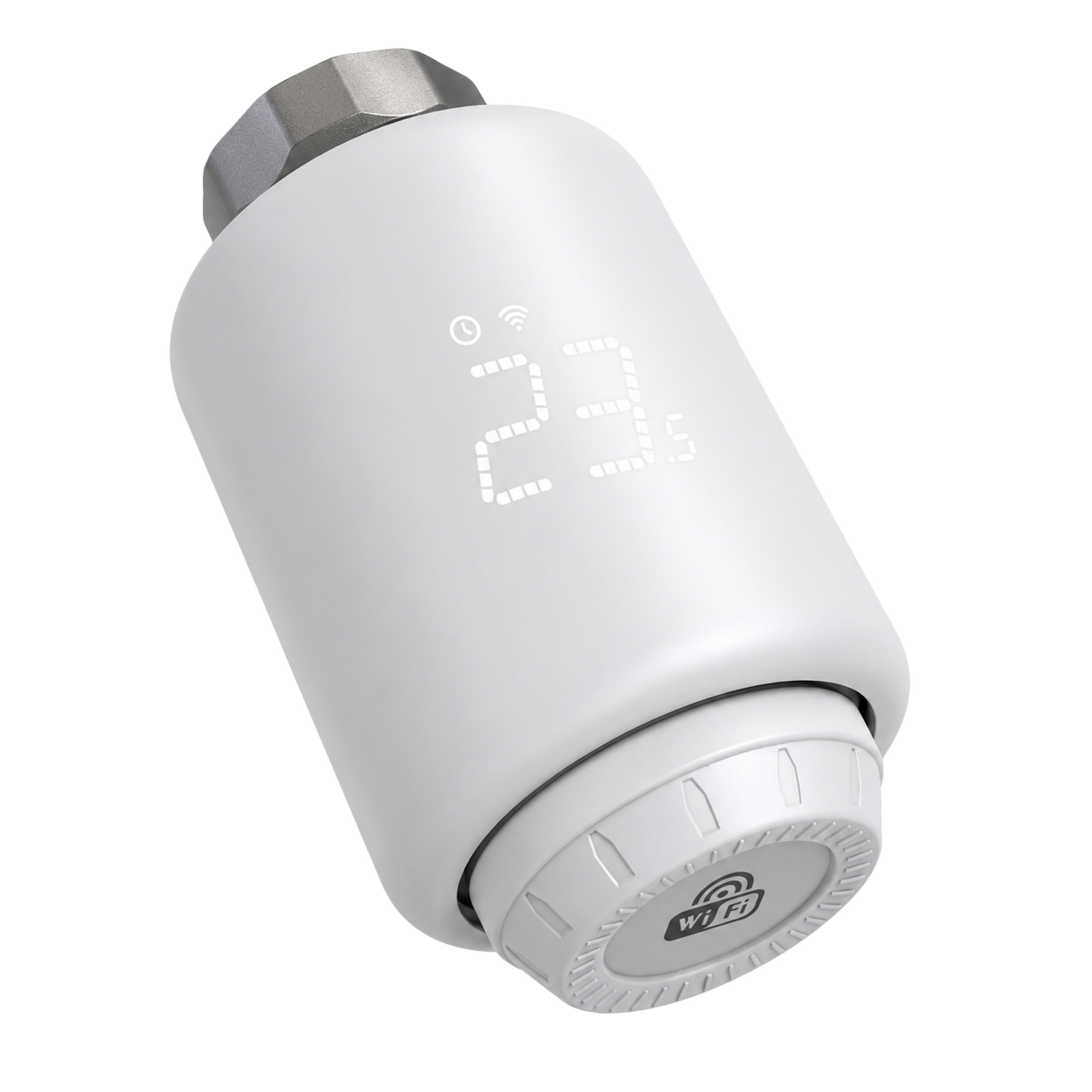
Current Grus EcoNet-RV product documentation, available through the official Grus Manuals Hub, confirms:
- an M30 x 1.5mm connection;
- listed adapters for Danfoss RA, RAV, and RAVL, Caleffi, Giacomini, and M28 valve types;
- Manual, Auto, ON, and OFF modes;
- a weekly schedule with up to four heating events per day;
- open-window detection, child lock, screen rotation, anti-calcification protection, and frost protection;
- Smart Life App control and supported Alexa and Google Assistant use; and
- App statistics for temperature and valve-open degree.
Those facts do not establish universal radiator compatibility. If the existing connector is not M30 x 1.5mm, a supported adapter is required. The listed adapter set is not permission to assume that every valve body, radiator, pipe arrangement, or mechanical condition will fit.
A smart radiator valve also does not become a central HVAC thermostat. Current EcoNet-RV facts do not support describing it as a hardwired thermostat or a controller for central forced-air heating and cooling.
What a room thermostat controls
A room thermostat belongs to an equipment-control path. It senses and displays room conditions and requests supported modes through the terminals and control logic of a compatible heating or cooling system. Its scope depends on the equipment connected to that control circuit, not on the number of rooms shown in an App.
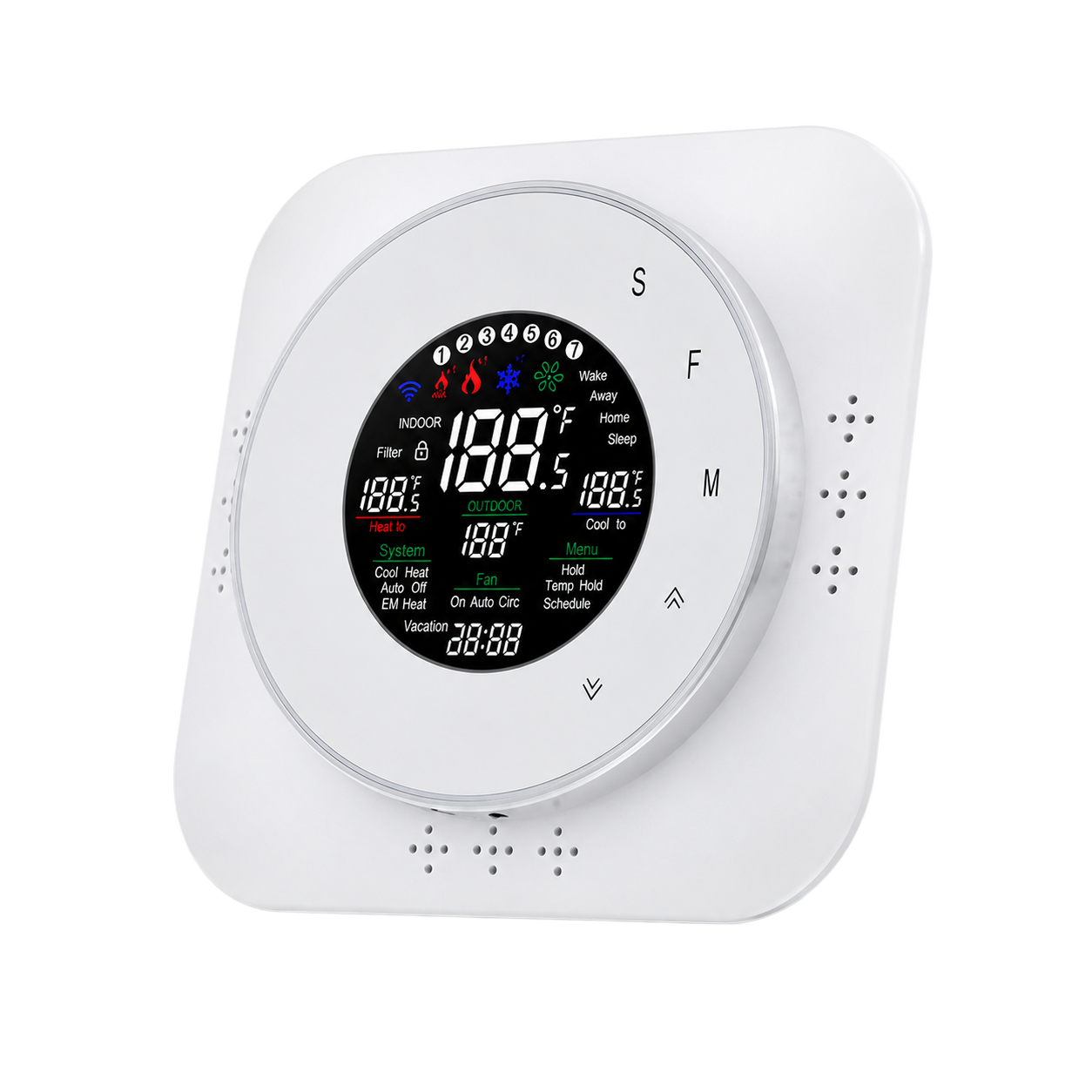
Current Grus EcoNet-TU documentation in the same official Manuals Hub describes a 24VDC/AC room and HVAC thermostat with heating-only, cooling-only, auto, emergency-heat, and off modes; fan modes; hold behavior; schedule periods; and Smart Life App setup. It also lists terminals such as Rh, Rc, C, W1, W2, Y1, Y2, G, O/B, and S.
That list is a compatibility checklist, not a promise that every terminal must be present or that every system will work. The documentation explicitly excludes using EcoNet-TU when the power source is 95–220V. It also does not support claims of universal HVAC compatibility, high-voltage baseboard control, or no-C-wire compatibility in every installation.
EcoNet-HP is another 24V heat-pump/HVAC thermostat path with model-specific functions and a C-wire or compatible power-module requirement. EcoNet-BH is different again: it is a 95–240VAC, 16A electric-heating thermostat intended for compatible baseboard heaters. Product names such as “smart thermostat” should never replace the voltage and system check.
Why the two controls cannot simply replace each other
Alex cannot solve the radiator question by buying a wall thermostat that looks more capable. The thermostat would still need a compatible equipment-control path, while the radiator valve still needs a compatible mechanical valve body. Likewise, fitting a smart valve to one radiator would not establish control over the heat pump in the addition.
The mismatch usually appears in one of four places:
- Control point: a valve actuator and a wall control work at different parts of the heating system.
- Energy and signal path: a battery-powered radiator valve and a 24V or line-voltage thermostat have different power and connection requirements.
- Scope: one radiator is not automatically the same as one HVAC zone.
- Compatibility evidence: a supported App, schedule, or voice assistant does not prove mechanical or electrical fit.
Treating the controls as interchangeable can produce a product that cannot mount, a thermostat that cannot safely or correctly control the equipment, or an App experience that looks complete while the physical system boundary remains unresolved.
Use the heating system to choose the path
The decision flow begins with what emits heat and where control already occurs.

The orange branches are valid decisions. They mean the current evidence is not sufficient to choose a product safely and accurately.
Check radiator-valve compatibility without guessing
For the radiator part of Alex’s house, the useful pre-purchase record includes:
- whether the system uses hot-water radiators and an existing thermostatic valve body;
- the valve-body make, connection, and current valve-head type;
- whether an M30 x 1.5mm connection or a specifically listed adapter applies;
- available clearance for the controller and access for battery replacement and local operation;
- whether the valve moves and the radiator operates normally before adding a smart control;
- the number of radiators that need independent control; and
- who owns boiler or system-level control and who can inspect mechanical fit.
A radiator’s appearance alone cannot confirm valve-body compatibility. A similar-looking metal collar or adapter is not enough. Use current product documentation and the actual valve identification.
Check room-thermostat compatibility as a system question
For the heat-pump addition, Alex records the equipment type and required control functions before comparing thermostat features. A qualified person should confirm:
- whether the control path is 24V or another voltage category;
- conventional or heat-pump equipment type;
- O/B reversing-valve use where relevant;
- auxiliary or emergency heat requirements;
- heating and cooling stages;
- fan-control requirements;
- terminal functions and the required power path; and
- local installation rules and the exact model documentation.
This is not a wiring guide. Conductor colors, terminal labels seen in a photo, or a thermostat’s front appearance do not establish a safe replacement. Do not remove a thermostat, move wires, open equipment, or perform energized measurements based on this comparison.
Can a radiator valve and a room thermostat coexist?
They can appear in the same property, as Alex’s two-system example shows. They may also appear within a broader heating design. But physical coexistence does not prove automatic coordination, shared zoning, supported automation, or correct control logic.
If two controls are intended to work together, document the relationship explicitly:
- which device requests heat from the heat source;
- which device limits flow at each radiator;
- what happens when one room is satisfied but another calls for heat;
- where schedules and setpoints are stored;
- which App or account manages each device;
- what behavior is documented if connectivity is unavailable; and
- who verifies commissioning and unexpected behavior.
Current Grus product facts should not be expanded into a blanket claim that EcoNet-RV automatically coordinates with every Grus room thermostat, boiler, zone controller, or third-party system.
Questions to answer before choosing
- What type of system produces and distributes heat in this part of the home?
- Is the intended control point a radiator valve, a 24V equipment circuit, a line-voltage baseboard circuit, or something else?
- What exact valve connection, equipment functions, voltage category, terminals, stages, and power path are documented?
- Is a listed adapter required, and is the exact valve body supported?
- What area does the proposed control actually govern: one radiator, one equipment zone, or another defined scope?
- Which schedules, App features, voice features, and statistics are confirmed for the exact model?
- Who will verify compatibility and installation requirements?
- What remains uncontrolled or uncertain after the product is added?
The durable rule is simple: choose the control that matches the physical heating system and control point. Use a smart radiator valve only after verifying the radiator valve body and supported fit. Use a room thermostat only after verifying the equipment, voltage, terminal functions, stages, and power requirements. If the category is unclear, stop before buying and document the system first.
To compare Grus heating paths without assuming compatibility, review the Grus Smart Heating compatibility path.