Choose a leak detector by the path water is likely to take, not by the room name alone. A point leak sensor watches one selected contact location. A sensing-cable detector watches a longer, deliberately routed contact path. Neither format covers an entire room automatically, identifies the source of a leak, repairs plumbing, or guarantees that every water event will be detected.
That distinction is more useful than asking which device is “better.” A point sensor can be the simpler fit when water is likely to collect at one predictable low spot. A sensing cable can be the better fit when water could appear anywhere along an accessible edge, around equipment, or across several adjacent risk points. In both cases, placement, access, notification behavior, and human response must be verified before relying on the system.
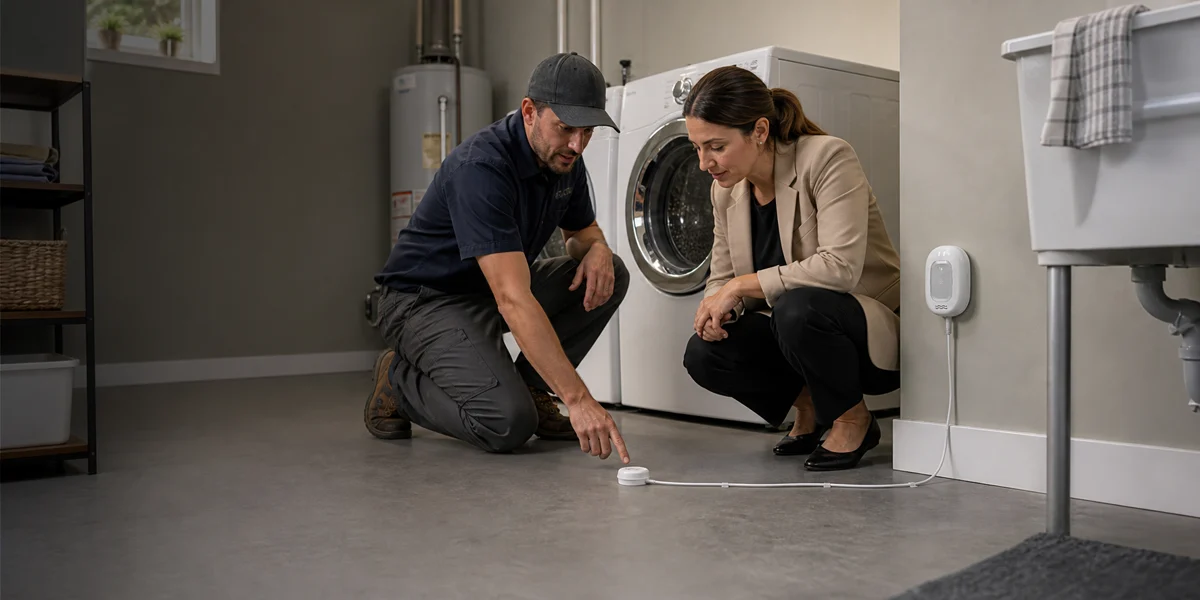
This guide follows one household. Maya owns a home with a laundry room next to a utility space. Her washer has several possible release points, while the water heater has an accessible perimeter where water could travel. Luis, a qualified local installer, helps her compare detection geometry without treating either device as a substitute for inspection, repair, or an approved shutoff system.
Point sensor vs sensing cable at a glance
| Decision factor | Point leak sensor | Sensing-cable detector |
|---|---|---|
| Detection geometry | One selected contact location | A longer routed contact path |
| Strongest fit | A predictable low point or collection spot | An accessible edge, perimeter, or series of nearby risk points |
| Main blind spot | Water that travels around the selected point | Water that never reaches the routed cable |
| Placement question | “Where is water most likely to collect?” | “Which accessible path is water likely to cross?” |
| Access need | The sensor location must remain reachable for checking and maintenance | The detector body, cable route, connectors, and monitored area must remain reachable under current documentation |
| What contact can indicate | Water reached the selected sensing point | Water reached part of the sensing-cable path |
| What contact cannot prove | The source, amount, repair status, or condition of the rest of the room | The exact source, amount, repair status, or condition outside the cable path |
| Response dependency | A supported alert still needs a named recipient and onsite follow-up | A supported alert still needs a named recipient and onsite follow-up |
The U.S. EPA WaterSense program describes moisture-sensing devices as one category within a broader group of leak detection and flow monitoring technologies. Its current overview of leak detection and flow monitoring devices notes common locations such as near water heaters, washing machines, and sinks. That is a useful starting point, but the room or appliance name does not determine exact placement. The expected water path does.
Start with water-path geometry
Maya and Luis inspect the dry laundry and utility areas before choosing a device. They look for visible supply connections, appliance edges, drains, thresholds, floor slope, obstructions, and places where water might disappear behind finishes. They also record which areas can be reached later without moving heavy equipment or creating an unsafe maintenance task.
They do not assume that water will spread evenly. A small release may follow a seam, slope toward a drain, remain under an appliance, or take a path that bypasses a nearby sensor. A detector only responds to the condition and location it is designed and configured to sense. The team therefore maps three things:
- Likely release area: where water might first become present.
- Likely travel path: where gravity, barriers, and the floor surface may carry it.
- Practical contact zone: where a documented detector can be placed, checked, and maintained.
This map is not a prediction that every leak will follow the same route. It is a placement hypothesis that should remain visible in the household’s water-protection record.
Where a point leak sensor fits
A point sensor fits when Maya can name one accessible location where water is reasonably likely to arrive. Examples can include a verified low spot beside a washing machine or near a water heater, subject to the product’s current placement instructions and the actual site.
The useful question is narrow: Did water reach this monitored point? That question can support an early warning workflow, but it cannot answer how much water is present, where the release began, whether water also reached a concealed area, or whether the source has stopped.
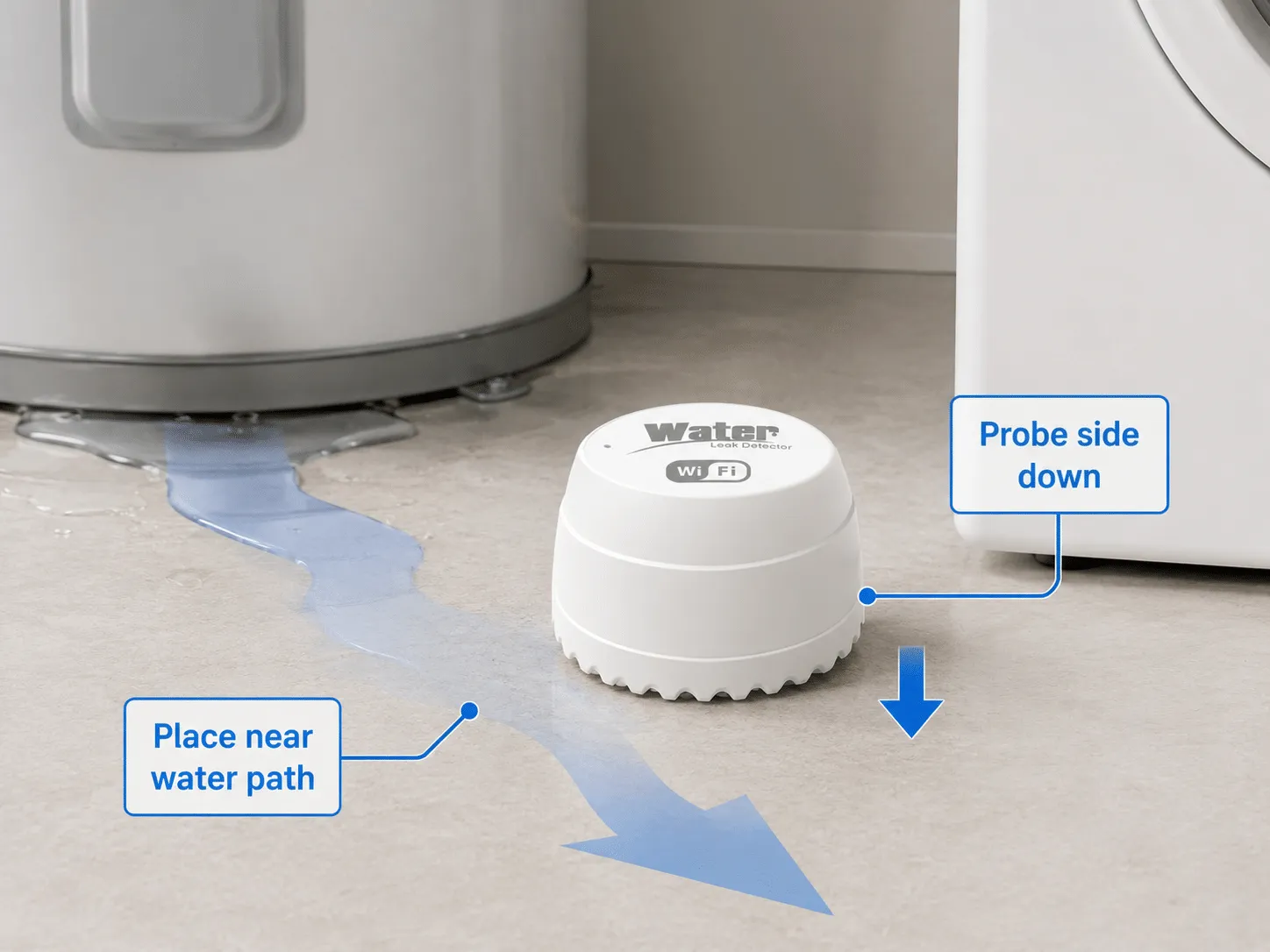
In Maya’s laundry room, a point sensor may be practical if the floor and appliance arrangement direct water toward one clear, reachable low spot. Luis checks the current product documentation for orientation, environmental limits, setup, testing, maintenance, and supported notification behavior. This article does not replace those instructions.
A point sensor is a weaker fit if several separated water paths matter or if the chosen point is likely to be blocked, moved, submerged beyond its documented conditions, or bypassed by the floor slope. Adding devices may change the design, but it does not remove the need to document each sensing point and its blind spots.
Where a sensing-cable detector fits
A sensing cable fits when the monitored contact zone needs to follow an accessible line rather than one point. Around Maya’s water heater, for example, a cable path may be considered along a verified perimeter where water could cross it. The exact route, bend limits, connections, detector-body location, environmental conditions, and test procedure must come from current approved product documentation.
The useful question becomes: Did water reach part of this monitored cable path? The cable expands the shape of the monitored contact zone, but it still does not cover water that travels elsewhere. It also does not identify the release source, establish the amount of water, confirm that a repair is complete, or guarantee notification.
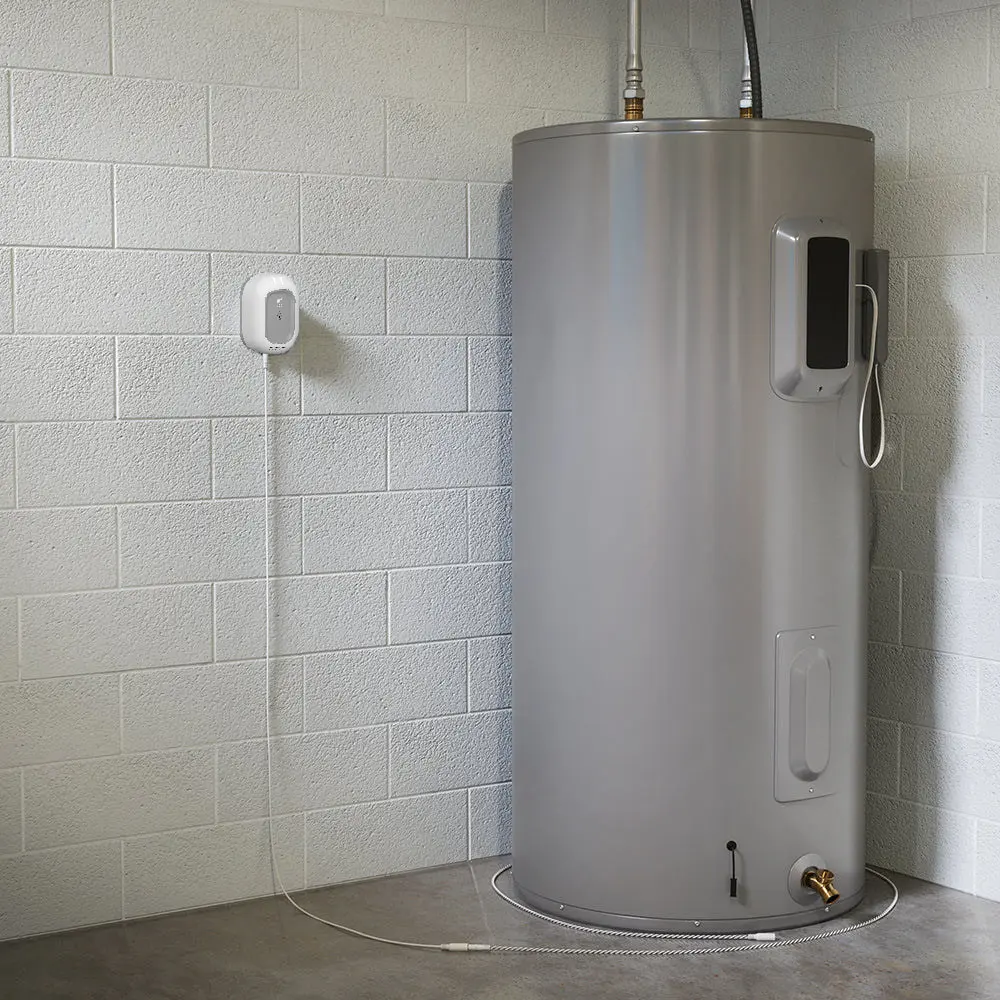
For the approved Grus AquaNet-LD product context used here, the detector body must remain dry; the sensing cable is the part routed through the monitored contact area. Maya and Luis keep that distinction in the placement record. They do not treat the wall-mounted body and the sensing cable as interchangeable water-contact surfaces.
A sensing cable is a weaker fit when the proposed route is inaccessible, exposed to routine washdown or unrelated moisture, likely to be disturbed, or unable to intersect the relevant water path under documented conditions. A longer-looking route is not automatically better. It must remain deliberate, inspectable, and consistent with the current product instructions.
Use one decision flow for both formats
The device format should follow the geometry and operating plan. Maya and Luis use this sequence before selecting a point or cable detector.

This flow allows “neither yet” as a valid result. If the likely path is concealed, inaccessible, environmentally unsuitable, or unsupported by approved documentation, the safe next step is to reassess the scope with a qualified professional rather than force a device into the plan.
Compare blind spots, not marketing labels
Every placement creates a monitored area and an unmonitored area. Maya writes those limits next to the device choice.
For a point sensor, she records the exact contact location and nearby routes that may bypass it. For a sensing cable, she records the full approved route and the areas outside that route. She also notes changes that could invalidate the original assumption, such as moving the washer, adding storage, replacing the water heater, changing flooring, or rerouting a drain.
The 2026 EPA WaterSense guide to leak detection and flow monitoring devices recommends considering the monitoring goal, notification preferences, shutoff needs, installation requirements, and supported plumbing context. Those categories help Maya ask complete questions. They do not prove the features, fit, or performance of a particular product.
Neither a point sensor nor a sensing cable should be described as whole-home coverage by itself. Neither should be described as appliance identification, guaranteed prevention, or automatic shutoff unless the complete, verified system and current documentation explicitly support the claimed behavior. Detection, notification, shutoff, onsite inspection, repair, and restoration are separate steps.
Plan the alert and response path
Maya’s comparison is incomplete until someone owns the response. For either format, she documents:
- which local indication or remote notification is supported by the verified setup;
- who owns the account and receives the alert;
- who acknowledges it and within what household process;
- who can inspect the property onsite;
- who decides whether plumbing repair or professional escalation is required;
- who may authorize restoration after physical inspection;
- how tests, maintenance, device movement, and unresolved events are recorded.
An app message does not confirm the source has been found or the property is safe. A closed notification does not prove that water stopped. If automatic shutoff is part of a broader design, its compatibility, installation, authorization, and restoration rules must be verified separately. This comparison does not grant permission to open plumbing, perform electrical work, install a valve, or simulate a damaging leak.
Verify fit before relying on either detector
Before Maya treats the chosen format as part of her household plan, she and Luis confirm the following against current documentation and the actual site:
- the intended environment and placement are supported;
- the sensing surface or cable path can contact the expected water route;
- the point sensor, cable, connectors, and detector body are oriented and protected as documented;
- the location remains accessible for approved testing, inspection, cleaning, and maintenance;
- network, account, power, and notification dependencies are understood where applicable;
- alerts are tested using a documented, non-destructive method;
- household members know the monitored area and its blind spots;
- a named person owns onsite inspection, repair escalation, and restoration decisions.
Maya chooses based on her mapped water paths: a point sensor for a predictable, reachable collection location in the laundry room, and a documented sensing-cable route for the accessible perimeter risk around the water heater. Those are site-specific decisions, not universal room-by-room prescriptions.
The durable rule is simple: use a point sensor when one monitored contact point matches the likely water path; consider a sensing cable when the path needs a longer, accessible contact geometry. Then document what remains outside the monitored area and who acts when a supported alert occurs.
To review the broader detection, response, and shutoff roles before choosing equipment, explore smart home water protection.