
Separate Connected Features From Autonomous Control
AI energy management is a useful topic to examine as a system concept. It is not a capability that can be inferred from every connected thermostat or monitor, and this article is not evidence of a deployed Grus AI controller.
Compare the capabilities individually. Remote access, scheduling and analysis are different features, not automatic stages that every device passes through.
| Capability | What to establish |
|---|---|
| Remote access | Commands supported |
| Scheduling | Timing and system compatibility |
| Analysis | Inputs and useful output |
| Automatic action | Documented integration and permission |
Start with the question the household needs to answer. Better visibility, a temperature schedule and automatic equipment dispatch are different objectives with different requirements.
A Person Reviews the Recommendation
In this conceptual example, measurements inform a recommendation that a person reviews. Any equipment action remains a separate, explicitly supported step.
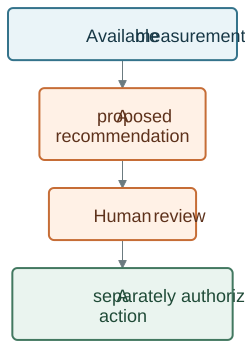
Check the exact product and integration before treating a recommendation as an executable action.
Define the input readings, units, time range and measurement scope. Require an explanation to refer to those records and separate observations from hypotheses. Missing circuit data must not become a confident appliance-level claim.
Solar, Storage and Grid Arrangements
Document the equipment, supported measurements and control interfaces for the actual system. A conceptual AI description is not a wiring or dispatch plan.
| Part | Evidence required |
|---|---|
| Solar | Generation equipment and data |
| Storage | System requirements and controls |
| Loads | Supported control options |
| Coordination | Documented interfaces and permissions |
Use the applicable tariff and export arrangements when evaluating a proposal. A software diagram does not grant permission to trade or control electricity.
Solar, storage and backup operation require suitable equipment and a site-specific design. An analysis feature does not establish independent or automatic power operation.
Keep physical electricity connections separate from software data and command links. A monitor does not become an inverter, battery manager or grid controller because those items appear together in a diagram.
Heating and Cooling Need System-Specific Controls
Review heating and cooling features for the installed system. Separate a supported setting from a claimed prediction or saving.
| Claim | Evidence needed |
|---|---|
| Weather-based adjustment | Supported input and control |
| Occupancy response | Actual sensing or integration |
| Energy reduction | Comparable measured results |
| Compatibility | Exact equipment requirements |
Do not assume an occupancy signal, weather feed or learning function exists for a particular thermostat. A schedule supported by the product is different from a prediction made by another service.
Any equipment action must respect the actual system and household requirements. Use the equipment’s documented controls rather than a model-generated instruction or a universal temperature rule.
Investigate a Changed Reading
A changed reading is a reason to review context, not a diagnosis of a failed appliance. Use the equipment’s guidance or qualified support when further investigation is needed.
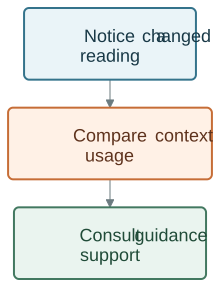
A change in energy use needs context. Compare the reading with normal activity and the equipment’s guidance before drawing a conclusion.
Record when the change occurred, the measurement label and relevant household activity. A higher reading alone does not identify a failed refrigerator, motor or heater. Ask the appropriate service provider when a fault is suspected.
Evaluate Forecasts and Savings With Records
Define what a forecast predicts and the period it covers. Compare it with later observations and report errors as well as useful results. A successful prediction for one interval does not establish autonomous control readiness.
For a claimed saving, keep the original and later readings and note weather, occupancy, tariff and equipment changes. Do not present a generic percentage as a measured product result.
Review the Actual Grus Product
Check the monitor’s product information and manual for its supported measurements. Review automation and other integrations separately.
WattPanel-2X provides monitoring for supported split-phase systems. Other models have different scopes. Review the exact product and bundle rather than treating a monitor as a replacement electrical panel or an AI automation hub.
Explore Grus for current products. Broader AI analysis and control proposals must be evaluated separately from those product capabilities.