
If you’ve ever had a leak under the sink or a burst pipe in the basement, you know how fast water can ruin a home. In 2026, the best smart water leak detectors are no longer just alarms—they’re part of a broader water protection setup. From compact under-sink sensors to automatic shutoff systems that can stop water at the main line, the right setup can help prevent costly damage.
Short answer: In 2026, the best protection is usually a combo—local leak sensors for high-risk spots plus a whole-home shutoff system for broader protection. It helps you catch leaks early and, in the right setup, stop water before damage spreads.
Why Smart Water Leak Detection Matters in 2026
Imagine this: You’re on vacation, sipping a cold drink by the beach, while back home a burst pipe is quietly flooding your basement. According to theInstituto de Información de Seguros,Los daños por agua y la congelación representan casi el 29% de todas las reclamaciones de seguros de hogar.in the U.S. That’s billions in property damage each year — and the right smart water leak detector canPrevenir daños en el hogarAntes de que suceda.
But here’s the good news—smart water leak detection has moved well beyond basic alarms. With app alerts, connected sensors, and smart shutoff options, today’s systems can do more than just warn you—they can help you respond faster and reduce damage. Whether that means shutting off your water automatically or notifying your phone when moisture is detected under your kitchen sink, the right device can save you thousands.
So which smart water leak detector setup makes the most sense in 2026? How do you choose between a simple battery-powered sensor, a multi-sensor kit, and a smart shutoff system? This guide walks through the leading options, how they differ, and where each setup fits best.
Repairing water damage isn’t cheap. Industry reports show the average claim often exceeds $11,000. For many families, installing a smart leak detector is less about convenience and more about avoiding the stress—and cost—of tearing out floors, cabinets, or drywall after a hidden leak.
Types of Water Leak Detectors in 2026 (Sensors vs. Smart Shutoff Systems)
Smart water leak detectors do not all work the same way. In 2026, most homeowners are choosing between three broad setups:
Point Sensors for Kitchens, Bathrooms, and Laundry Rooms
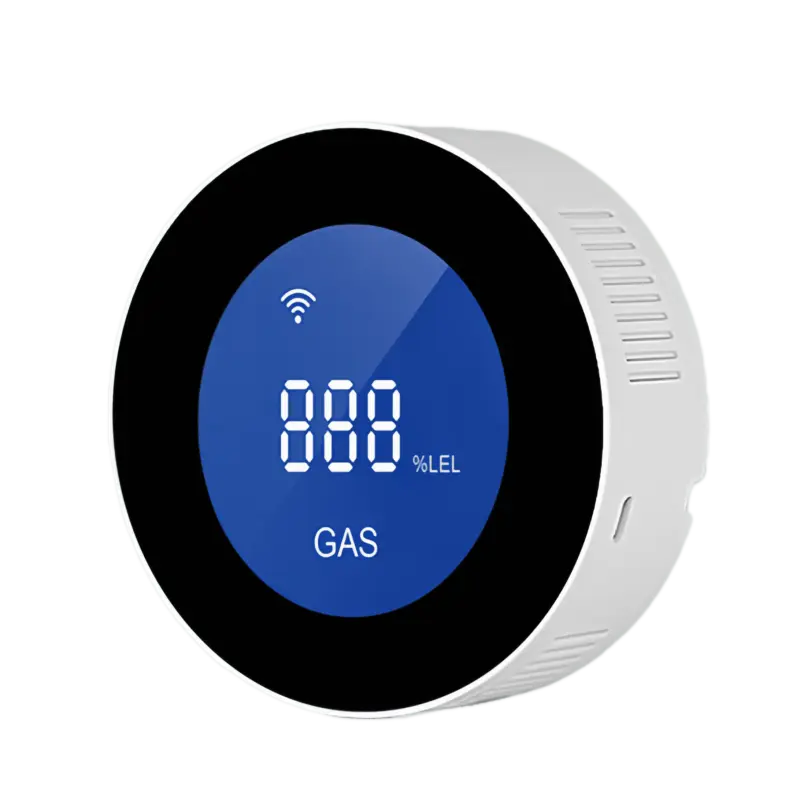
These are the small, battery-powered sensors you place under sinks, behind toilets, or next to appliances. They’re often the best water leak detectors for kitchens and bathrooms because they send an instant alert to your phone when water is detected. They’re inexpensive, quick to install, and ideal for spot protection in high-risk areas.
Cable-Style Leak Alarms: When They Still Make Sense
Cable alarms use a long sensing cord laid along the floor or around equipment like a water heater. If any part of the cable touches water, the alarm sounds. While affordable, they can be sensitive to condensation and cleaning water, which sometimes leads to false alerts. They also rarely connect with WiFi or smart home apps, so many U.S. homeowners now prefer newer options.
Whole-Home Smart Shutoff Systems with Leak Detection
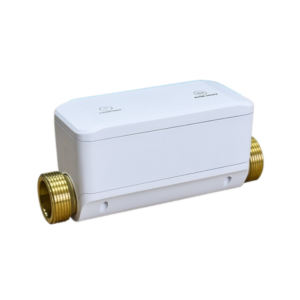
Instead of just warning you, these systems can actually close your water supply. Known as the best water shutoff systems with leak detection, they pair with sensors around the house to form the best automatic water leak detection and shut-off system. If a leak is detected in the kitchen, bathroom, or basement, the valve shuts automatically—protecting the entire home even if no one is there.
1. What Features Actually Matter in 2026
Before comparing brands, it helps to focus on the features that actually change how well a system protects your home:
| Característica | Descripción |
|---|---|
| Conectividad WiFi | Envía notificaciones instantáneas a tu teléfono a través de la aplicación. |
| Válvula de cierre inteligente | Corta automáticamente el suministro de agua para evitar inundaciones. |
| Compatibilidad con múltiples sensores | Admite expansión con sensores en varias ubicaciones. |
| Duración de la batería | Batería de larga duración o energía de respaldo para mayor confiabilidad. |
| Integración | Funciona con sistemas domésticos inteligentes como Alexa, Google o SmartThings. |
The best leak detection products today are not just alarms—they are part of a smarter water protection workflow.
If you are comparing leak detectors for real home protection, it helps to look beyond alerts alone and consider systems that can also trigger shutoff.
Want to understand when a smart water valve with leak detector makes more sense than alerts alone? See how shutoff-based protection works for kitchens, laundry rooms, and whole-home setups.
See when a shutoff valve setup makes sense →2. Best Smart Water Leak Detectors for 2026: Reviews & Best-Fit Use Cases
Here is how the leading options compare across coverage, automation, installation style, and overall fit:
Moen Flo Smart Water Monitor and Shutoff
- Pros:Whole-home monitoring, automatic shutoff, strong brand recognition
- Contras:Higher upfront cost, usually best with professional installation
- Ideal para:Homeowners who want a premium whole-home shutoff system
Phyn Plus Smart Water Assistant + Shutoff
- Pros:Pressure-based leak detection, remote shutoff, detailed plumbing insights
- Contras:Premium price, professional main-line installation required
- Ideal para:Homeowners who want pressure-based whole-home monitoring
Kit de sensor de fugas de agua inteligente YoLink
- Pros:Very long range, flexible multi-sensor coverage, good for larger homes
- Contras:Shutoff is not built in by default and depends on the broader setup
- Ideal para:Multi-room leak detection in larger homes or detached spaces
Govee Wi-Fi Water Leak Detector
- Pros: App alerts, loud local alarm, approachable price for entry-level users
- Cons: Not a whole-home shutoff solution on its own
- Best for: Budget-minded homeowners who want connected leak alerts in a few key spots
Grus AquaNet Smart Water Protection Setup
Unlike basic alert-only sensors, AquaNet is better understood as a connected water protection setup that can combine leak detection with shutoff control.
- Productos:
- AquaNet-BD (Smart Water Shutoff Valve)
- AquaNet-VM(Smart Water Valve Pro)
- Pros:
- App-connected monitoring and control
- Supports shutoff-based protection in the right setup
- Designed for North American home use
- Fits users looking for a Grus-based water protection workflow
- Contras:
- Actualmente optimizado para tamaños de plomería de América del Norte
- Ideal para:Homeowners who want a Grus-centered water protection setup instead of a standalone sensor
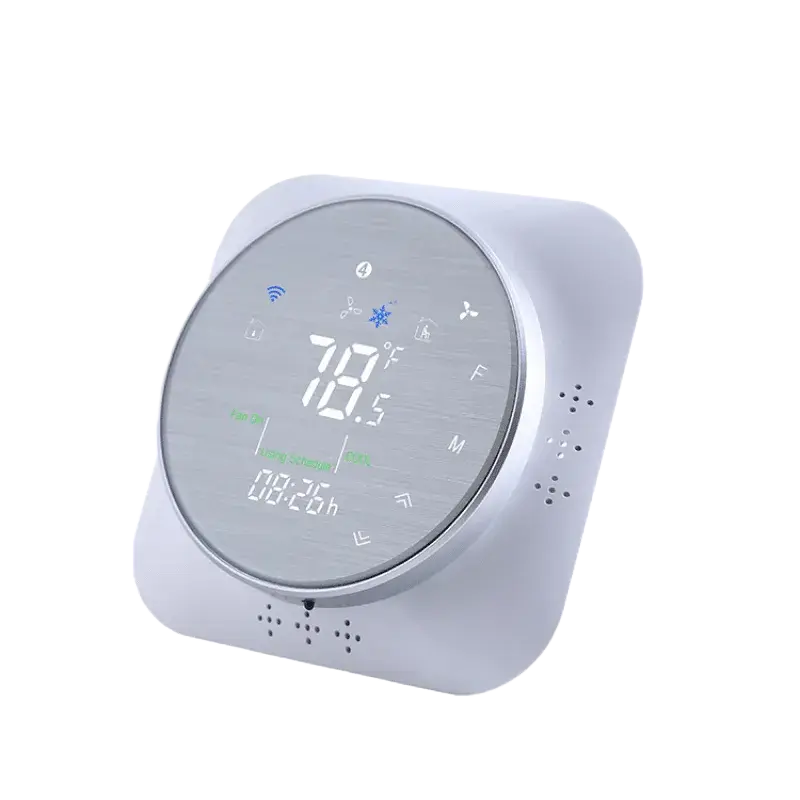
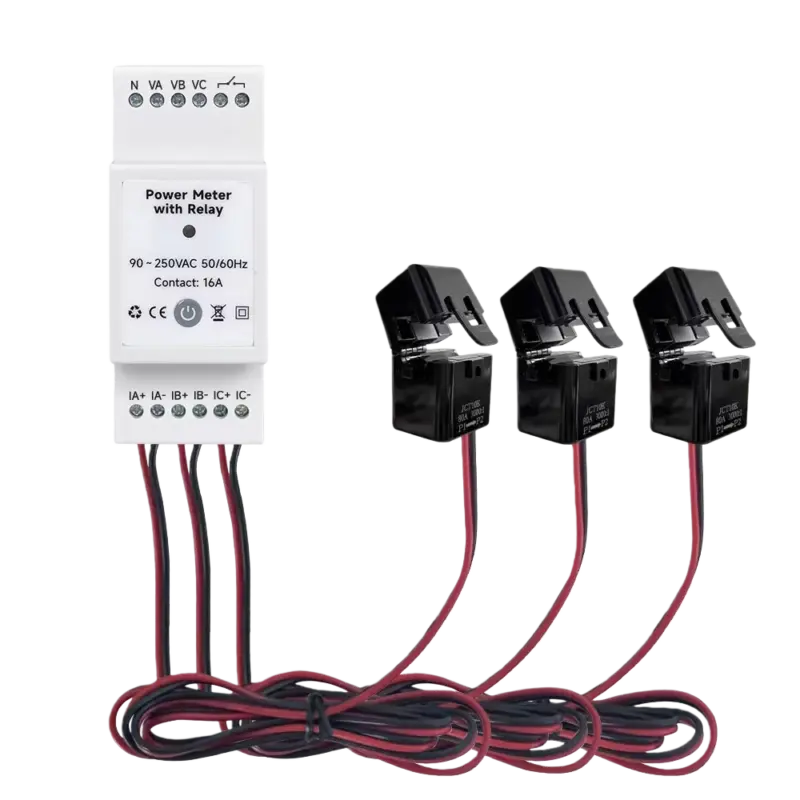
🔍Want something that works out of the box with your thermostat, energy monitor, and safety devices? Grus AquaNet is part of a unified smart home protection suite.
Explorar dispositivos AquaNet →
| Modelo | Apagado automático | Alertas de la app | Monitorización de caudales | Alertas de congelación | Precio | Oferta del Black Friday |
|---|---|---|---|---|---|---|
| Grus AquaNet | ✔ Sí | ✔ Sí | ✔ Sí | ✔ Sí | $$ | Hasta un 30% de DESCUENTO |
| Moen Flo | ✔ Sí | ✔ Sí | ✔ Sí | ✔ Sí | $$$$ | Limitado |
| Phyn Plus | ✔ Sí | ✔ Sí | ✔ Sí | ✔ Sí | $$$$ | Pequeño descuento |
| YoLink Sensor | ✖ No | ✔ Sí | ✖ No | ✖ No | $ | Varía |
| Govee Sensor | ✖ No | ✔ Sí | ✖ No | ✖ No | $ | Varía |
Other connected leak-detection options still exist across the market, but most homeowners can simplify the choice by deciding first whether they want: a basic alert sensor, a multi-sensor kit, or a true whole-home shutoff system.
3. Best Setups for Kitchens, Bathrooms, Laundry Rooms, and Basements
If you are choosing protection by room, compact sensors are still useful under sinks and near appliances—but they are only one part of the decision. Kitchens and laundry rooms are the top sources of water damage. A dishwasher leak can ruin cabinets within hours, while a burst washer hose can cause thousands in damage in minutes.
Diferentes habitaciones, diferentes riesgos. Aquí es donde los propietarios suelen instalar sensores de fugas inteligentes:
---
title: "Smart Water Leak Detector Installation Map"
---
graph TD;
    Kitchen["Kitchen Sink Area"] --> Risk1["Dishwasher Leaks"];
    Laundry["Laundry Room"] --> Risk2["Washing Machine Hose Bursts"];
    Basement["Basement"] --> Risk3["Water Heater Failures"];
    Bathroom["Bathroom"] --> Risk4["Toilet or Shower Leaks"];
    HVAC["HVAC Closet"] --> Risk5["Condensation Drain Issues"];
| Ubicación | Motivo del riesgo |
|---|---|
| Cocina | Hundiro el lavavajillas se desborda |
| Baño | Fugas en tuberías, fallas en el inodoro |
| Lavadero | Rupturas de mangueras y desbordamiento de máquinas |
| Sótano | Falla de la bomba de sumidero, fugas del calentador |
| Armario HVAC | Bandejas de drenaje de condensación obstruidas |
Si no está seguro de cómo funcionan realmente las válvulas de cierre inteligentes,Esta guía sobre válvulas de agua inteligenteslo explica en un inglés sencillo.
4. How Smart Leak Sensors and Shutoff Systems Are Typically Installed
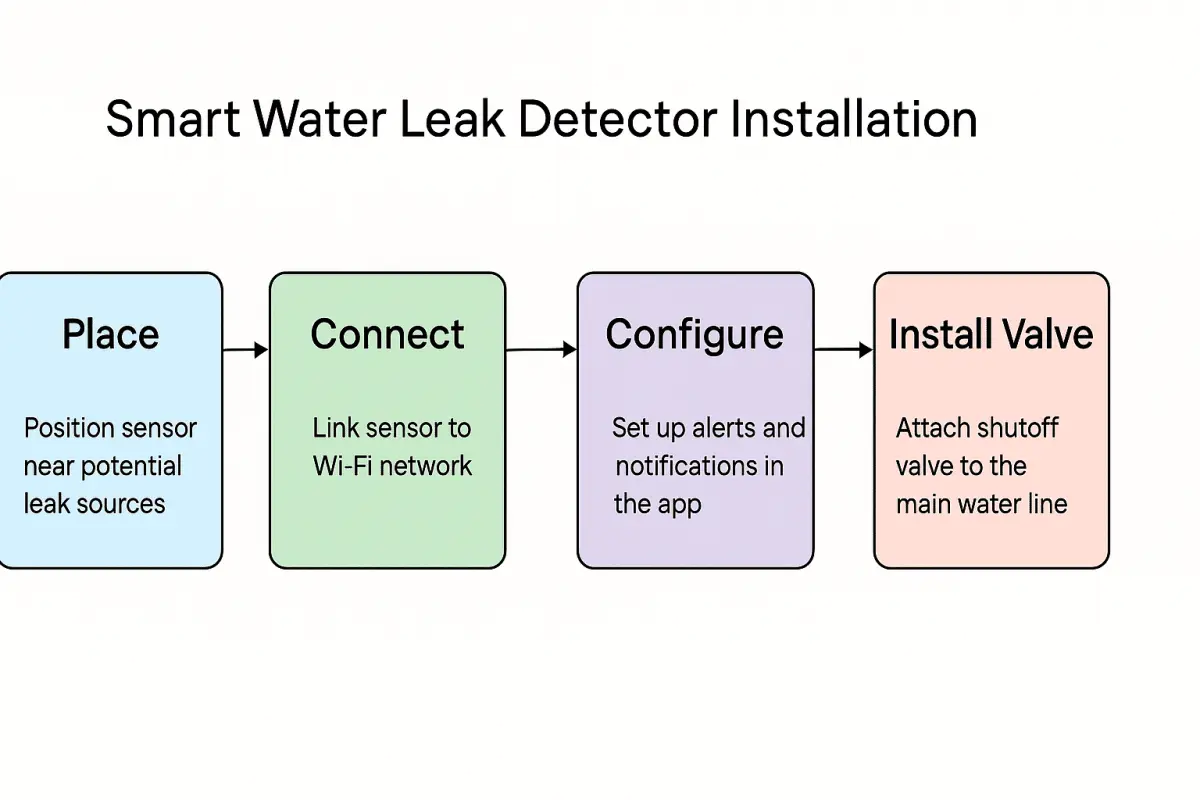
Installing a smart leak sensor isn’t rocket science—most can be set up in under 10 minutes. Here's how you can do it yourself:
🛠️A. Instalación del sensor de fugas de agua
Herramientas necesarias:Ninguno (alimentado por batería)
- Elija su ubicación:
Coloque el sensor cerca de fuentes de agua: debajo del lavabo, detrás del inodoro o al lado del calentador de agua. - Evite estos errores:
- No bloquee el flujo de aire; deje espacio alrededor del sensor.
- Evite superficies metálicas que puedan interferir con WiFi.
- Activar el dispositivo:
- Inserte las baterías y presione el botón de encendido/prueba.
- Follow the product app instructions to connect the sensor and complete setup.
Consejo: La mayoría de los sensores emiten un pitido al detectar humedad. Puedes probarlo con una toalla húmeda.
🧰B. Instalación de la válvula de cierre inteligente
Herramientas necesarias:Llave ajustable, cinta de teflón
Tiempo de instalación:~30–45 minutos
- Cierre el suministro de agua
- Localice la válvula principal de agua y cierre el flujo antes de comenzar.
- Instalar en línea con la tubería principal
- Reemplace una sección de la tubería cerca de la válvula con el cuerpo de la válvula inteligente.
- Utilice cinta de teflón para garantizar un sellado a prueba de fugas.
- Conectarse a la alimentación y a la aplicación
- Conecte el controlador de la válvula a una toma de corriente.
- Emparéjelo usando las instrucciones en pantalla de la aplicación Grus.
- Pruebe la función de apagado
- Active la válvula de forma remota o con un sensor adjunto para simular una fuga.
---
title: "Smart Water Shutoff System Flow"
---
graph LR;
    Sensor["AquaNet-LD (Leak Detector)"] --> App["Grus Home App"];
    App --> Valve["AquaNet-VM (Water Valve Controller)"];
    Valve --> Pipe["Main Water Pipe"];
Esta configuración garantiza que su sistema funcione comoEl mejor sistema de cierre de agua con detección de fugasProtegiendo tu hogar automáticamente incluso cuando estás fuera.
¿Necesitas más orientación paso a paso? Visita nuestraGuía de instalación del centro de soportepara manuales detallados.
5. Real-World Examples: How Leak Sensors and Shutoff Systems Help
Whether you’re living in a high-rise condo or managing a multi-floor home, Grus smart leak detectors adapt easily to your needs.
Escenario 1:Prevención de desastres en la cocina
- Problema:La manguera del lavavajillas se agrietó y comenzó a perder agua lentamente con el tiempo.
- Solución:AquaNet-LD detectó la humedad y activó AquaNet-VM para cortar el agua inmediatamente.
- Resultado:$0 en daños y sin interrupción de la vida diaria.
Escenario 2: Prevención de inundaciones en el lavadero
- Problema:Lavadora vieja se desbordó mientras estaba desatendida.
- Solución:El sensor debajo de la máquina detectó agua en 3 segundos.
- Resultado:Notification sent through the app, allowing the homeowner to respond quickly while away.
“Lo tenemos desde hace 4 meses y ya nos ha ahorrado una limpieza de 3.000 dólares”.— Jennifer R., California
Escenario 3: Fuga en el baño debajo del lavabo
Problema:Un goteo lento de una conexión de grifo desgastada debajo del lavabo del baño pasó desapercibido durante semanas.
Solución:Un sensor WiFi compacto colocado debajo del tocador detectó la humedad de forma temprana y envió una alerta.
Resultado:The homeowner shut off the water remotely before the cabinet warped, saving hundreds in potential repairs.
6. Detectores de fugas inteligentes con Alexa, Google y Home Assistant
Para los entusiastas del bricolaje, saber¿Qué sensores de fugas inteligentes se integran con Home Assistant?es clave. Los dispositivos Grus están diseñados paraencajar en su ecosistema de hogar inteligente existente:
| Plataforma | Compatibilidad |
|---|---|
| Asistente de Google | ✅ Control por voz |
| Amazon Alexa | ✅ Configuración de rutina |
| Cosas inteligentes | ✅ Escenas personalizadas |
| Apple HomeKit | 🔜 Próximamente |
Puedes automatizar rutinas como:
- Si se detecta una fuga → Cierre el agua + Envíe un SMS + Encienda las luces del pasillo
- Comando de voz: «Alexa, comprueba si hay fugas de agua»
Muchos propietarios también conectan detectores de fugas con untermostato inteligente o monitor de energíapara crear rutinas de automatización completa del hogar.
7. ¿Qué detector de fugas de agua es mejor para prevenir daños en el hogar?
A. Elija según el caso de uso
| Caso de uso | Dispositivo recomendado | Características principales |
|---|---|---|
| Cocina/Baño | AquaNet-M | Compacto, fácil colocación, soporte WiFi. |
| Calentador de agua / Lavandería | AquaNet-LD + AquaNet-VM | Apagado automático con alta sensibilidad |
| Protección para toda la casa | AquaNet-M (paquete múltiple) + AquaNet-BD | Alertas multizona + apagado automático |
| Casa de vacaciones | AquaNet-BD + Alertas móviles | Gestión remota, sin cuota mensual |
Si tu prioridad esPrevenir daños en el hogar, elija un sistema que combine la detección de fugas con el apagado automático.
B. Priorizar estas características en 2025
- ✅Alertas de WiFi en tiempo real(no sólo basado en sonido)
- ✅Integración con Alexa, Google, SmartThings
- ✅Batería de respaldo
- ✅Capacidades de apagado automático
- ✅Durabilidad para ambientes húmedos/mojados
No se deje llevar por sensores baratos que solo emiten pitidos locales. ¿Qué pasa si no está en casa?
8. Costo de los detectores de fugas de agua y ahorros en seguros en 2025
Los sensores de fugas económicos son baratos, pero los modelos de gama media y premium ofrecenprevención de daños en el hogary descuentos en seguros.
| Característica | Opciones de presupuesto ($10–30) | Gama media ($40–100) | Grus Premium ($60–150) |
|---|---|---|---|
| Solo alarma local | ✅ | ✅ | ✅ |
| Notificaciones WiFi | ❌ | ✅ | ✅ |
| Cierre automático de agua | ❌ | Algunos modelos | ✅ |
| Integración de aplicaciones | ❌ | Parcial | ✅ |
| Sincronización multidispositivo | ❌ | ❌ | ✅ |
| Funciona con el ecosistema de casas inteligentes | ❌ | Alguno | ✅ |
9. Reflexiones finales: Elija el mejor detector de fugas de agua para 2025
Las reparaciones por daños causados por agua pueden superar los $11,000: no espere hasta que sea demasiado tarde.
Según el Instituto de Información de Seguros,Los daños causados por el agua se encuentran entre los reclamos más comunes y costosos., averaging over $11,000 per incident. Preventive protection is no longer optional—it’s smart, proactive homeownership.
Si alguna vez ha tenido que lidiar con una tubería rota, una lavadora con fugas o un grifo olvidado...Sabes que la paz mental no tiene precio.
¿Listo para proteger su hogar?
Grus.io ofrece unasistema completo de protección del agua inteligenteEn la que confían miles de propietarios.
Producto destacado:
Detector de fugas AquaNet-LD
AquaNet-VM Válvula de cierre automático de agua
- Alertas en tiempo real
- Control de aplicaciones
- Fácil instalación
- Integración perfecta con Alexa y Google Home
💧Protege tu hogar.Evite costosos daños causados por el agua.Duerme mejor.
→Explora nuestro sistema de protección de agua para hogares inteligentes
¿Cuál es el mejor detector de fugas de agua inteligente en 2025?
The best smart water leak detectors in 2025 are those that combine WiFi connectivity, real-time alerts, and automatic shutoff capability. Popular models include Moen Flo, Phyn Plus, AquaNet and other WiFi-enabled shutoff valves.
¿Vale la pena instalar válvulas de cierre automático de agua con sensores?
Yes. Automatic shutoff valves with sensors cost more than stand-alone leak detectors, but they can prevent thousands in water damage by shutting off the supply when a leak is detected.
¿Los mejores sistemas inteligentes de corte de agua con detección de fugas reducen los costos del seguro?
Many U.S. insurers give discounts if you install a whole-home shutoff system with leak detection. Since these devices stop leaks before damage spreads, they’re often viewed as a preventive measure.
¿Qué detectores de fugas inteligentes funcionan con Home Assistant?
Several leak detectors can integrate with Home Assistant, either natively or via third-party bridges. Tuya-based devices, for example, can often be connected using integrations or community add-ons.
¿Cómo funcionan los detectores de fugas de agua inteligentes?
Smart water leak detectors use moisture or flow sensors to detect leaks. When water is detected, they send an alert through a mobile app or smart home system. Advanced models can also shut off the main water supply.
¿Cuáles son los mejores detectores de fugas de agua para cocinas y baños?
Compact, battery-powered leak sensors are most suitable for kitchens and bathrooms, where they can be placed under sinks, near dishwashers, toilets, or tubs to detect leaks early.
¿Pueden las válvulas automáticas de cierre de agua con sensores detener realmente una inundación?
Yes. Automatic shutoff valves with sensors close the main line as soon as water is detected. That means even if a pipe bursts while you’re away, the leak is contained.
¿Cuánto duran los detectores de fugas de agua inteligentes?
Battery-powered leak detectors usually last 2–3 years on a set of batteries. Shutoff valves and hubs typically last 5–10 years with proper maintenance.
¿Cuál es la diferencia entre un detector de fugas de agua y un medidor de agua inteligente?
A water leak detector is designed to sense and alert about leaks. A smart water meter tracks overall water consumption and can sometimes identify unusual usage patterns. Some advanced devices combine both functions.
¿Necesito un plomero para instalar una válvula de cierre inteligente?
It depends on the product. Some shutoff valves require professional installation on the main water line, while others likeAquanet-BDEstán diseñados para instalación de bricolaje y se pueden configurar con herramientas básicas.
¿Cuál es el mejor detector de fugas de agua para cocinas?
The best water leak detectors for kitchens are compact, battery-powered sensors that fit under sinks and dishwashers. In 2025, WiFi alerts and can trigger shutoff systems toevitar daños al gabinete.
Protecting your home from water damage is no longer optional. Investing in the best smart water leak detector gives you peace of mind—whether it’s under the sink, in the bathroom, or across your entire home.