Opening your utility bill and seeing it double is a shock.
If you’re thinking,“My electric bill doubled in one month and nothing changed,”you’re not alone. This is one of the most common homeowner complaints — and in many cases, the cause is not obvious.
Before you assume the utility company made a mistake, or that something is secretly “stealing” power, you need a structured way to diagnose the issue.
This guide walks you through:
- How to quickly verify whether the bill is wrong
- The top 80/20 causes behind sudden spikes
- A practical checklist to isolate the culprit
- Why guessing doesn’t work — and how monitoring does

Quick Triage: Is the Bill Wrong or Is Usage Actually Higher?
Before looking at appliances, start with the basics. Many doubled bills are real — but some are billing or rate issues.
1. Compare kWh, Not Just Dollar Amount
Look at:
- Total kWh this month
- Total kWh last month
- Same month last year
If the kWh doubled, usage increased.
If kWh stayed similar but cost increased, the issue is likely rate changes.
2. Check the Meter Reading Type
On your bill, confirm whether it says:
- “Actual reading”
- “Estimated reading”
Estimated readings can cause sudden corrections the following month.
3. Review Rate Changes
Utilities adjust:
- Seasonal pricing (summer/winter rates)
- Time-of-use (TOU) rates
- Tiered usage thresholds
Crossing into a higher tier alone can significantly increase your bill.
If everything checks out and kWh truly jumped, you now know the issue is real usage.
Top Causes (The 80/20 List)
In most cases, a doubled electric bill is caused by one of a few high-impact loads.
1. New High-Power Equipment
Common culprits:
- Electric heat or baseboard heaters
- Heat pumps running constantly
- Electric water heaters
- EV chargers
- Electric dryers or ovens
Even one new 240V load can add hundreds of kWh monthly.
2. Weather & Seasonal Changes
Winter:
- Electric heating can double consumption.
- Heat pumps may enter auxiliary resistance heating.
Summer:
- AC systems running longer cycles.
Check local temperature differences compared to last month.
3. Rate Plan Changes
If you recently switched to TOU (time-of-use) pricing:
- Night vs peak hour costs may differ dramatically.
- Charging an EV during peak hours can multiply cost.
4. Equipment Malfunction
Less obvious but serious issues include:
- Water heater stuck in constant heating mode
- HVAC auxiliary heat always on
- Well pump or sump pump running continuously
- Failing refrigerator compressor
- Attic or crawlspace fan stuck on
These failures often go unnoticed.
A Step-by-Step Checklist to Find the Culprit
Guessing is inefficient. Use a structured approach.
Step 1: Reverse-Engineer Recent Changes
Ask:
- What changed in the last 30 days?
- New appliance?
- Guests staying over?
- Thermostat adjustment?
- EV charging frequency increased?
Document every possible change before moving forward.
Step 2: Observe Time-of-Day Patterns
Check your utility’s daily usage data (if available).
Titta efter:
- Nighttime spikes
- Midday peaks
- Constant flat high usage
If usage remains high overnight, suspect:
- Water heater
- HVAC auxiliary heat
- Pumps
If spikes happen during specific windows, suspect scheduled loads.
Step 3: Circuit-Level Isolation (Observation Only)
Without performing electrical work:
- Turn off suspected breakers temporarily.
- Observe your main meter behavior.
- Track daily changes.
Important: This is for observation and recording only. Do not perform electrical modifications unless qualified.
Manually flipping breakers repeatedly is not sustainable — but it helps narrow suspects.
Step 4: When You Can’t Pinpoint It — Stop Guessing
If after days of observation you still don’t know:
You need data.
Not averages.
Not guesses.
Circuit-level data.
This is where a home energy monitoring system becomes essential.
How Energy Monitoring Helps (Without Guessing)
An energy monitoring system allows you to see exactly where electricity is going.
Instead of “total house usage,” you can track individual circuits.
Whole-Home vs Multi-Circuit Monitoring
There are two primary approaches:
- Whole-home (split-phase) monitoring
- Multi-circuit monitoring
For residential split-phase systems, consider:
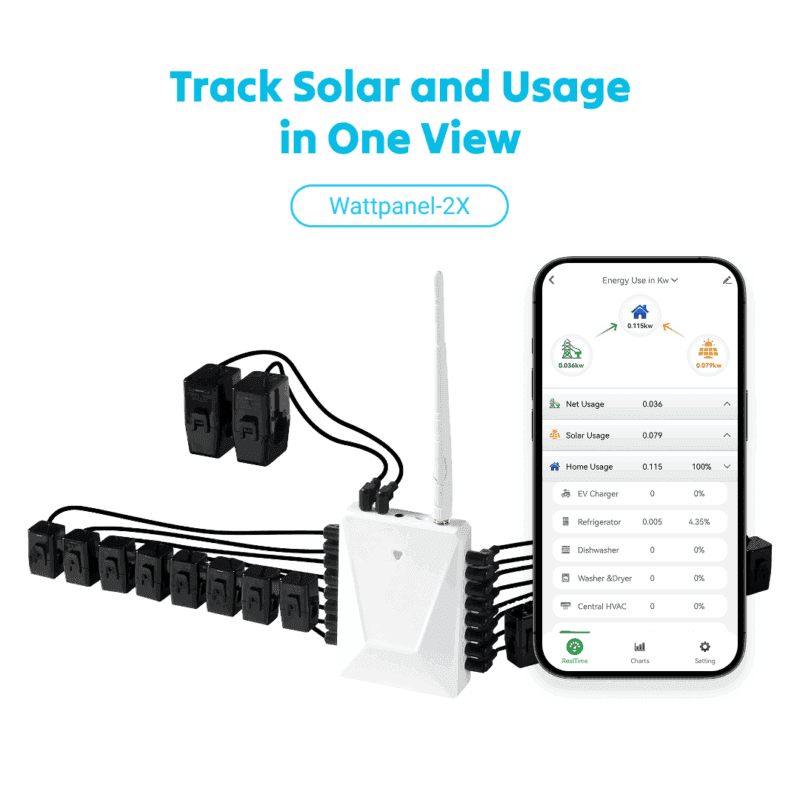
Split-phase home energy monitoring (see WattPanel-2X)
This allows you to monitor 120/240V usage across your home.
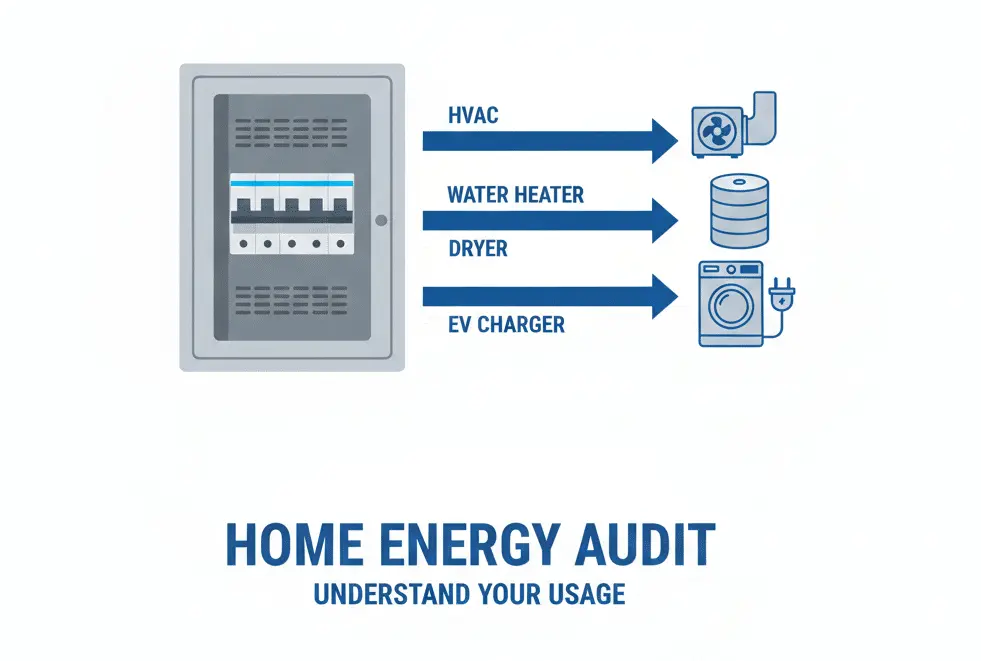
If you need to isolate multiple circuits individually, such as HVAC, water heater, dryer, and EV charger, you may need:
Multi-circuit energy monitoring (see WattPanel-3X)
This enables tracking several breakers simultaneously.
What Data You Actually Get
With circuit monitoring, you can see:
- Real-time power draw
- Daily and monthly kWh by circuit
- Peak demand times
- Historical trends
Instead of asking “why did my electric bill double,” you’ll see:
- Which breaker is consuming the most
- Which load runs overnight
- Which system spikes during peak hours
Making Decisions with Data
Once you identify the top energy consumer:
- Repair malfunctioning equipment
- Adjust thermostat strategy
- Change EV charging schedule
- Replace inefficient appliances
Energy efficiency becomes measurable — not speculative.
What to Monitor First (High-Impact Circuits)
If your bill doubled, start with the highest-load circuits.
HVAC / Heat Pump / Baseboard Heaters
Heating systems are the most common cause of winter spikes.
Check for:
- Auxiliary heat activation
- Thermostat programming errors
- Constant cycling
Water Heater
An electric water heater running continuously can double usage silently.
Common failure:
- Faulty thermostat
- Sediment buildup
- Leaking tank triggering constant reheating
Dryer / Oven / EV Charger (240V Loads)
These 240V appliances draw large power in short periods.
If usage spikes correlate with:
- Laundry days
- Cooking patterns
- EV charging sessions
You’ve found your likely contributor.
FAQ
Can a faulty appliance double a bill?
Yes. A malfunctioning electric water heater or auxiliary heat strip can run continuously and add hundreds of kWh per month.
Is it normal for bills to double in winter?
If you use electric heating, yes — especially during extreme cold. However, doubling still warrants verification.
Do smart meters show appliance-level usage?
No. Utility smart meters show total consumption only. They do not break down usage by appliance or circuit.
To see circuit-level data, you need a dedicated energy monitoring system.
Final Step: Stop Guessing. Measure It.
If your electric bill doubled in one month, the real question is:
Will you continue guessing next month?
With circuit-level monitoring, you can identify the exact source, prioritize fixes, and prevent future surprises.
Explore available options here:
→See energy monitoring options
You can also review broader learning resources:
→Energy monitoring guides