1. Qu'est-ce qu'un adaptateur C-Wire ?
À mesure que les thermostats intelligents gagnent en popularité dans les foyers, de plus en plus d’utilisateurs cherchent à passer à des thermostats intelligents afin d’obtenir une gestion énergétique plus efficace et un contrôle plus pratique. Cependant, de nombreux utilisateurs rencontrent un problème courant lors de l’installation : l’absence d’unFil C (fil commun).
Le fil en C est essentiel pour faire fonctionner des thermostats intelligents, car il fournit une alimentation continue pour supporter des fonctionnalités avancées telles que la connectivité Wi-Fi, les écrans tactiles et les algorithmes d’apprentissage. Les systèmes traditionnels de chauffage, ventilation et climatisation, ou pompes à chaleur manquent souvent de fil C, obligeant les utilisateurs à chercher des solutions alternatives lors de la mise à niveau vers des thermostats intelligents.
TheAdaptateur de fil Ca été développé pour répondre à ce problème. Il fonctionne en redistribuant le câblage CVC existant pour créer un fil C virtuel, fournissant une alimentation stable aux thermostats intelligents sans nécessiter de renouvellements complexes ni de remplacement coûteux d’équipements.
2. Fonctions du fil en C
| Fonction | Description |
|---|---|
| Fournit une alimentation continue | Le fil C fournit une alimentation constante de 24VAC aux thermostats intelligents pour soutenir leurs fonctions principales. |
| Prend en charge les fonctionnalités avancées | Les thermostats intelligents reposent sur le fil C pour des fonctionnalités telles que le Wi-Fi, les écrans tactiles, la télécommande et les algorithmes d’apprentissage, ce que les thermostats traditionnels n’ont pas nécessaire. |
Sans fil C, les systèmes recourent souvent au « vol d’énergie », qui puise de l’énergie de façon intermittente dans le fil R ou d’autres lignes de contrôle. Cela peut entraîner une alimentation instable, affectant les performances des thermostats intelligents. Par exemple, l’appareil peut perdre sa connexion au Wi-Fi ou répondre lentement aux commandes.
3. Applications de l'adaptateur C-Wire
L’adaptateur C-Wire est un dispositif idéal pour résoudre l’absence de fil C dans les systèmes CVC. En ajustant le câblage existant, il simule le fonctionnement d’un fil C afin d’assurer le bon fonctionnement des thermostats intelligents. Les applications courantes incluent :
3.1. Alimentation des thermostats intelligents
- Les thermostats intelligents nécessitent une alimentation continue à faible courant, qui ne peut pas être fournie par les fils traditionnels R (alimentation) et W (contrôle du chauffage).
- L’adaptateur reconfigure les fils existants (par exemple, fils G ou Y) pour alimenter une source d’alimentation équivalente au fil C.
3.2. Compatibilité avec les systèmes existants
- De nombreux anciens systèmes CVC et pompes à chaleur ne disposent pas de connexion C-Wire dédiée, ce qui complique les mises à niveau des thermostats intelligents.
- L’adaptateur C-Wire assure la compatibilité avec ces systèmes, évitant ainsi des coûts de recâblage ou de remplacement d’équipement.
3.3. Simplification de l'installation
- Le recâblage traditionnel peut impliquer la coupe de murs, l’ajout de fils ou la reconfiguration du tableau de contrôle CVC.
- L'utilisation d'un adaptateur C-Wire permet d'obtenir rapidement la fonction C-Wire, économisant ainsi du temps et du travail.
4. Comment fonctionne un adaptateur C-Wire
Les adaptateurs C-Wire fonctionnent en redistribuant le câblage existant ou en étendant l’interface de contrôle CVC pour créer un fil C virtuel, fournissant de l’énergie aux thermostats intelligents. Les principales méthodes de travail incluent :
4.1. Réutilisation du fil G (fil de commande du ventilateur)
- Reconfigure le G-Wire en C-Wire tout en conservant le contrôle du ventilateur via le matériel ou le logiciel.
- Avantages:Aucun câblage supplémentaire requis ; compatible avec la plupart des systèmes.
- Considérations:Peut nécessiter des ajustements à la logique de contrôle du ventilateur.
4.2. Alimentation parallèle
- Sépare l’alimentation du fil R (24VAC) et des autres fils de commande (par exemple, W ou Y) afin d’assurer une alimentation stable à faible courant.
- Avantages:Installation flexible, adaptée aux systèmes CVC multifonctions.
4.3. Génération de fils C dédiés
- Étend l'interface de la carte de contrôle CVC pour générer un fil C dédié.
- Avantages:Convient aux systèmes de chauffage ou de refroidissement complexes à plusieurs étages avec un fonctionnement stable.
5. Méthodes de connexion du fil C
5.1. Fil C et logique d'interface standard
| Terminal | Description de la fonction | Logique de connexion |
|---|---|---|
| R (Puissance) | Fournit une alimentation 24 VCA | Connectez R à la borne R du thermostat ; le fil C complète le circuit d'alimentation. |
| C (commun) | Fournit une alimentation continue | Connectez C au terminal C du thermostat pour activer des fonctionnalités avancées comme le Wi-Fi. |
| W (Chauffage) | Active les systèmes de chauffage | Connectez W à l'appareil de chauffage ; le fil C fournit une alimentation indépendante. |
| Y (Refroidissement) | Active les systèmes de refroidissement | Connectez Y au dispositif de refroidissement ; le fil C fournit une alimentation indépendante. |
| O/B (vanne d'inversion) | Bascule les modes de la pompe à chaleur entre le chauffage et le refroidissement | Connectez O/B à la vanne d'inversion ; le fil C alimente le thermostat. |
Cette configuration garantit que le fil en C peut fournir une alimentation stable au thermostat tout en assurant le chauffage, la climatisation et les fonctions de ventilateur.
5.2. Installation d'un adaptateur C-Wire
L’adaptateur C-Wire est généralement installé près de la carte de contrôle CVC (souvent à l’intérieur de la chaudière ou du traitement d’air). Il redistribue les fils existants pour générer un C-Wire « virtuel ». Les lieux d’installation courants incluent :
a. Sur le panneau de commande CVC
- L'emplacement le plus courant, connecté directement au tableau de commande.
- Les panneaux de contrôle sont généralement situés à l'intérieur :
- Fours(gaz ou électrique).
- Centrales de traitement d'air(pour pompes à chaleur).
b. Près du thermostat
- Installé derrière ou à proximité du thermostat pour éviter le démontage de l'équipement CVC.
- Convient aux utilisateurs disposant d'outils limités qui préfèrent une installation simple.
c. Modules d'alimentation autonomes
- Si une connexion directe au CVC n’est pas possible, les modules d’alimentation autonomes peuvent se brancher sur une prise murale pour alimenter le thermostat sans modifier le câblage existant.
6. Étapes pour installer un adaptateur C-Wire
6.1. Vérification de l'absence de fil C
- Inspectez la disposition du câblage du panneau de commande CVC et du thermostat.
- Si aucun fil C ou terminal C n'est disponible, procédez à l'installation d'un adaptateur de fil C.
6.2. Choisir un adaptateur compatible
- Choisissez un adaptateur C-Wire compatible avec votre système CVC et votre marque de thermostat intelligent (par exemple, Nest Power Connector, Honeywell C-Wire Adapter ou Grus EcoNet-TU).
6.3. Connectez l'adaptateur à la carte de commande CVC
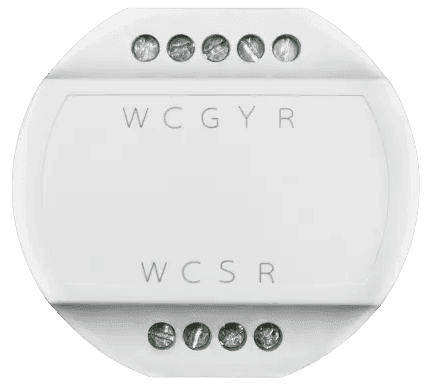
| Borne d'entrée de l'adaptateur | Description de la fonction | Se connecter à la carte de contrôle CVC |
|---|---|---|
| R | Pouvoir | Borne R du tableau de commande CVC |
| C | Fil commun | Borne C de la carte de commande CVC ou générée par l'adaptateur |
| W | Contrôle du chauffage | Borne W du tableau de commande CVC |
| Y | Contrôle du refroidissement | Borne Y de la carte de commande CVC |
| G | Contrôle du ventilateur | Maintenir la connexion du ventilateur existante |
6.4. Connectez l'adaptateur au thermostat
| Borne de sortie de l'adaptateur | Description de la fonction | Se connecter au terminal du thermostat |
|---|---|---|
| W | Signal de commande de chauffage pour activer le chauffage | Borne W du thermostat |
| C | Fil commun pour fournir une alimentation continue | Borne C du thermostat |
| S | Contrôle des signaux pour les instructions spéciales | Borne de signal du thermostat (si prise en charge) |
| R | Alimentation (24 VCA) pour alimenter le thermostat | Borne R du thermostat |
6.5. Tester le système
- Rétablissez l’alimentation du système CVC et vérifiez que le thermostat fonctionne correctement.
- Testez les fonctions de chauffage, de refroidissement et de ventilation pour confirmer la bonne connexion.
7. Comparaison des adaptateurs C-Wire populaires
| Marque | Caractéristiques | Application idéale |
|---|---|---|
| Grus EcoNet-TU | Compatible avec plusieurs marques, prend en charge les systèmes complexes | Systèmes CVC et pompe à chaleur, chauffage/refroidissement à plusieurs étages |
| Connecteur d'alimentation Nest | Conçu spécifiquement pour les thermostats Nest, facile à installer | Systèmes de chauffage/refroidissement à un étage |
| Adaptateur de fil C Honeywell | Conception compacte, idéale pour les thermostats intelligents Honeywell | Chauffage/refroidissement à un ou plusieurs étages |
| Kit d'extension de puissance Ecobee | Inclus avec les thermostats Ecobee, prend en charge les fonctions avancées | Chauffage/refroidissement à plusieurs étages, systèmes CVC complexes |
L’adaptateur C-Wire est une solution pratique pour créer un C-Wire sans nécessiter de recâblage. En choisissant le bon adaptateur et en suivant le processus d’installation standard, les utilisateurs peuvent profiter pleinement des avantages d’un thermostat intelligent avec un minimum d’effort. Que vous utilisiez Nest, Honeywell ou Ecobee, le bon choix d’adaptateur et la bonne installation peuvent vous aider à améliorer votre système CVC pour offrir une expérience de chauffage et de climatisation domestique plus intelligente et efficace.
Découvrez comment fonctionnent les thermostats intelligents à plinthes, pompes à chaleur et CVC — ainsi que des conseils d’installation et des stratégies d’économie d’énergie.
Lisez le guide de chauffage des thermostats intelligents →