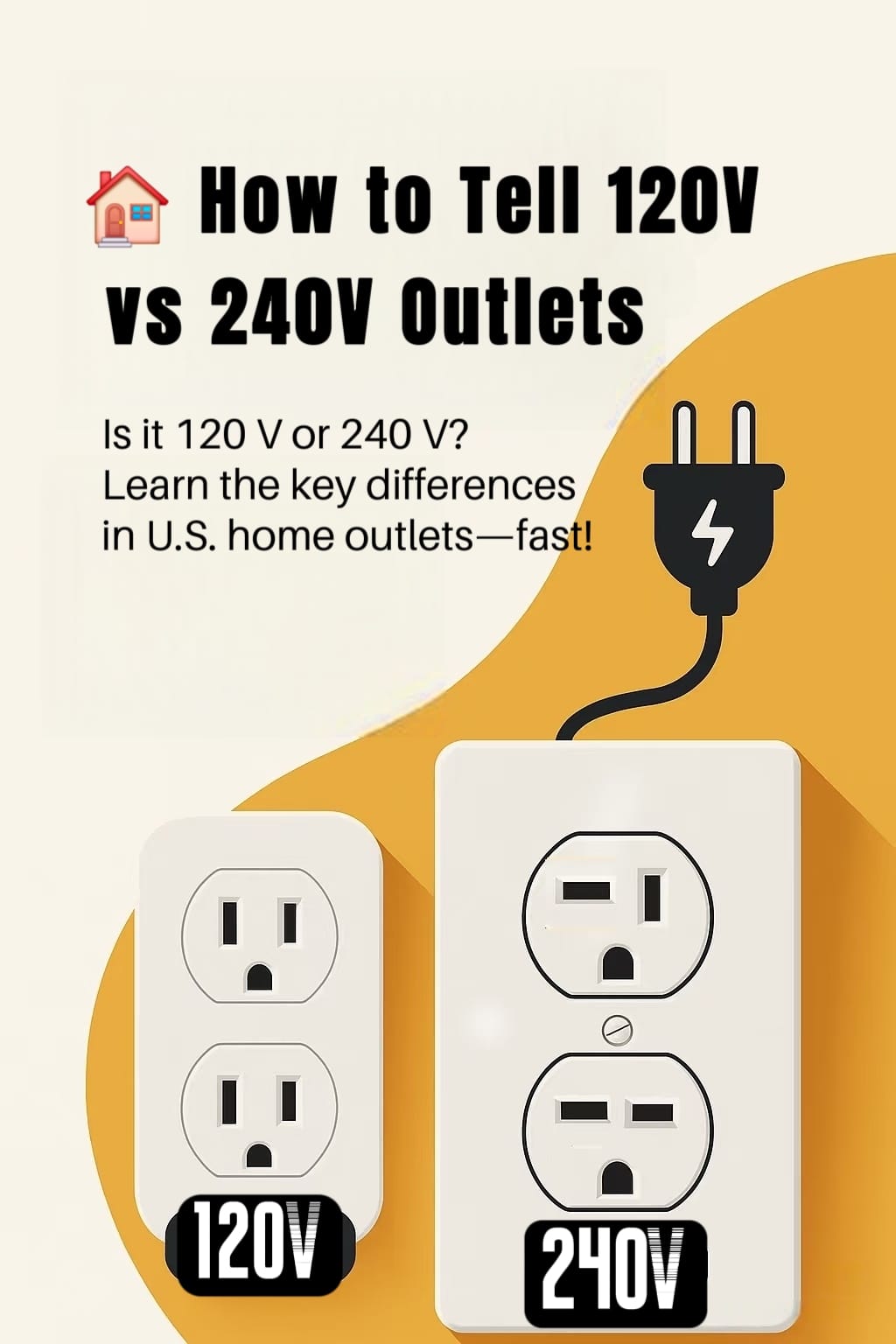
In U.S. homes, most outlets provide120 voltios, while high-power appliances use240 voltios.
The fastest way to tell the difference is to checkthe outlet shape, the appliance plug, or the breaker panel.
Quick ways to identify outlet voltage
| Controlar | 120V Outlet | 240V Outlet |
|---|---|---|
| Outlet shape | Two vertical slots + ground | Larger outlet with different slot patterns |
| Plug type | Thin two-prong or three-prong plug | Thick 3- or 4-prong plug |
| Breaker | interruptor unipolar | Disyuntor bipolar |
| Typical use | Lamps, TVs, kitchen appliances | Dryers, ovens, EV chargers |
Most homes have dozens of 120V outlets but only a few 240V outlets for heavy-duty equipment.
The sections below explain how to confirm the voltage safely before installing an appliance.
Formas rápidas de saber si un tomacorriente es de 120 V o 240 V
The easiest way to identify outlet voltage is bylooking at the outlet design and the appliance plug.
Here are the four most reliable checks homeowners use.
1. Observa la forma de la salida
A standardToma de corriente de 120 Vis the familiar wall outlet found throughout bedrooms, living rooms, and kitchens.
It usually has:
• two vertical slots
• one round grounding hole

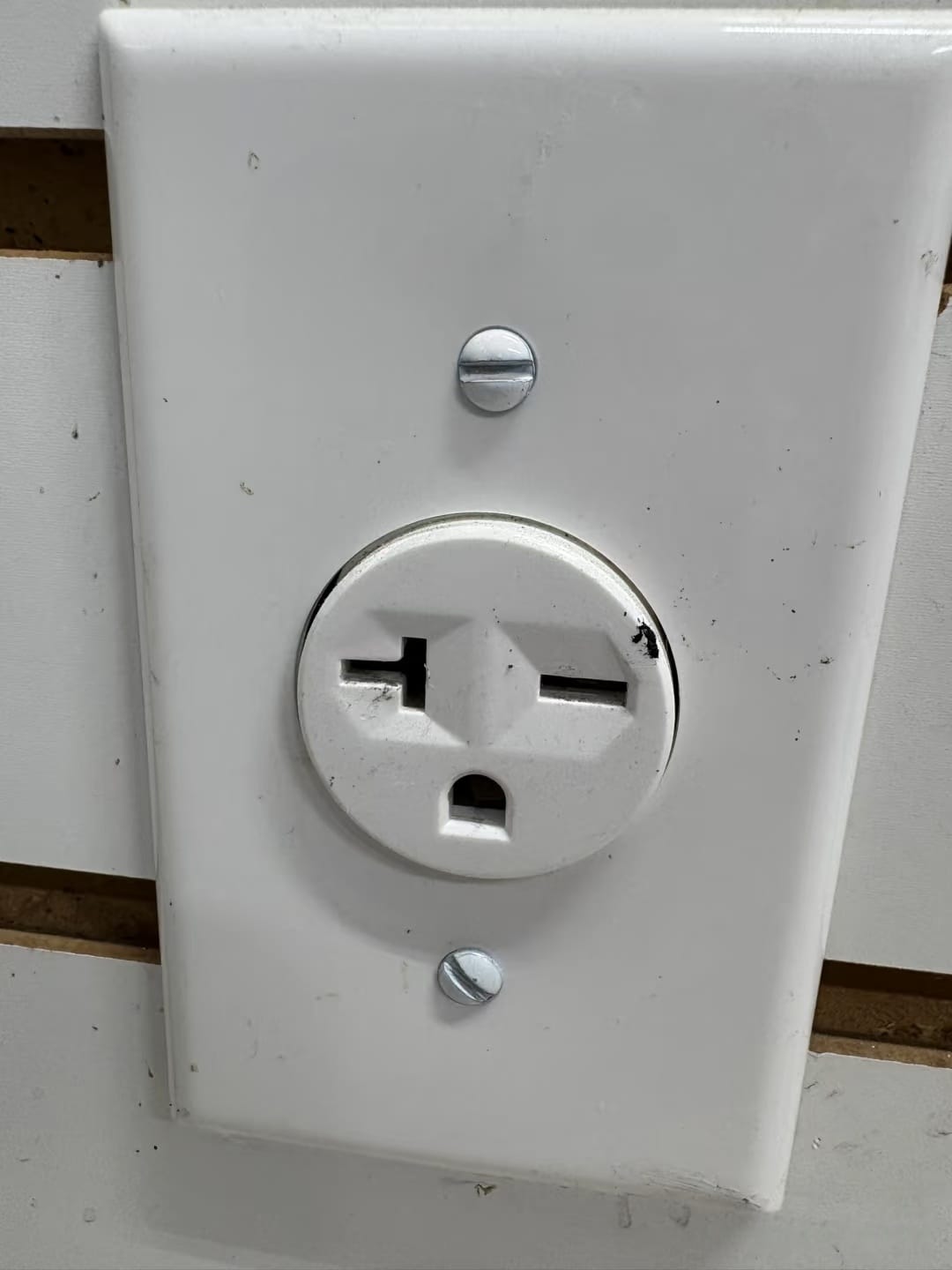
AToma de corriente de 240 Vis usually larger and shaped differently.
Depending on the appliance, it may have:
• aT-shaped slot
•L-shaped openings
•three or four prongs
These outlets are commonly found in laundry rooms, garages, kitchens, or near large appliances.
2. Check the Appliance Plug
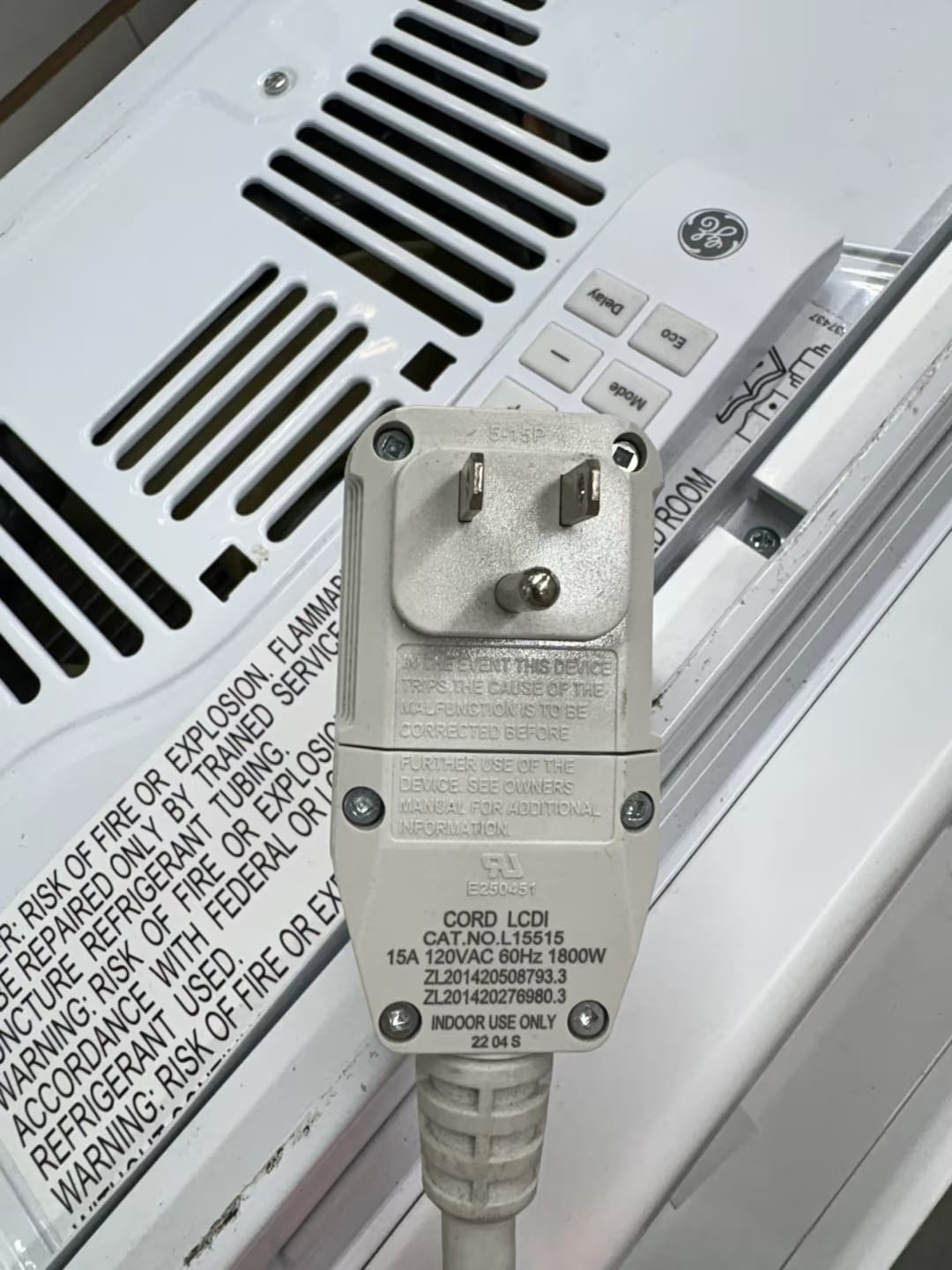
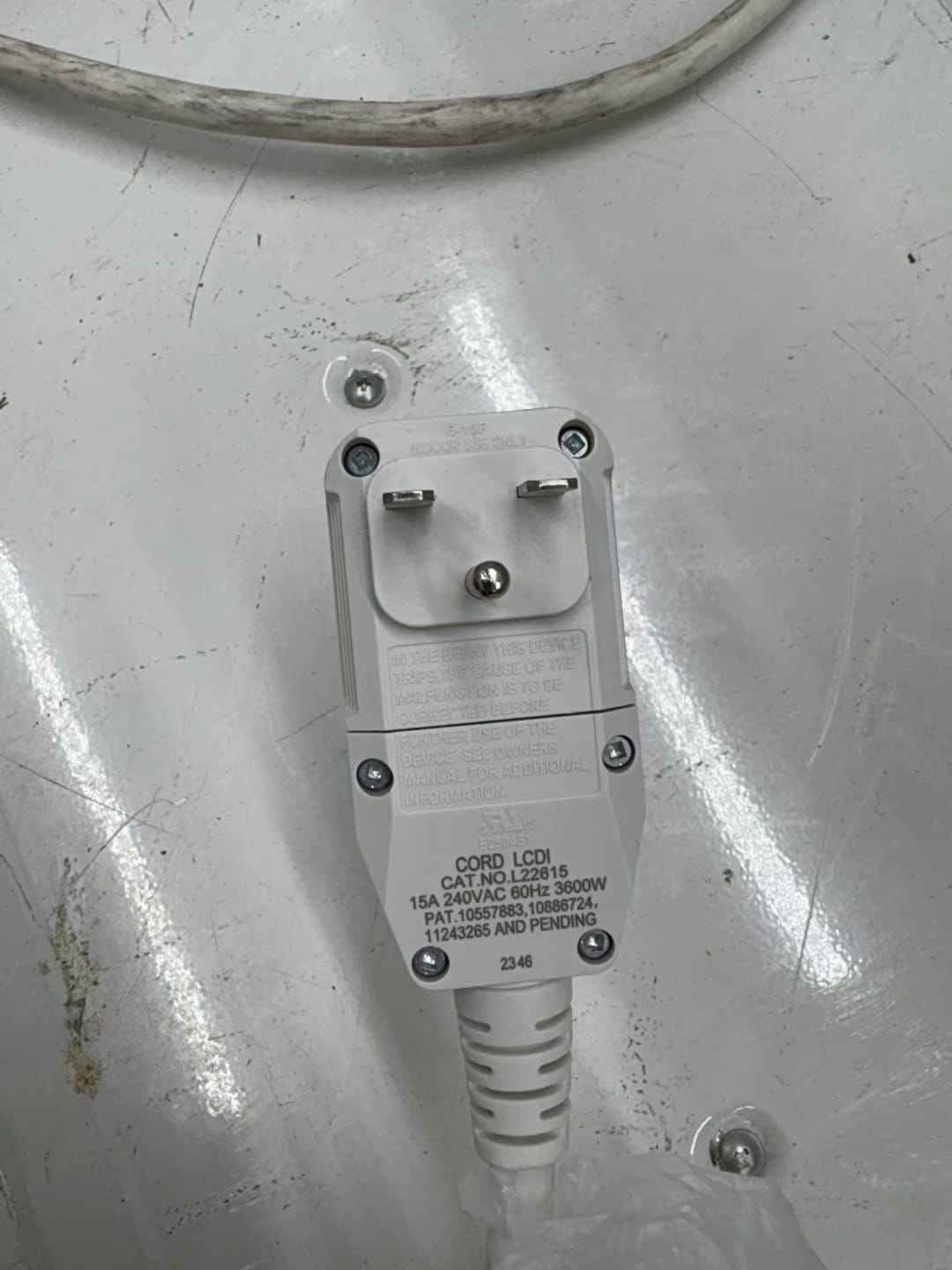
Another quick clue is the plug attached to the appliance.
Small household devices like lamps, TVs, or coffee makers usethin plugs designed for 120V outlets.
High-power appliances such as dryers, ranges, and EV chargers usethicker plugs with three or four prongs.
These plugs are intentionally designed so theycannot fit into a standard 120V outlet, preventing dangerous voltage mismatches.
3. Check the Breaker Panel
If you're still unsure, the breaker panel provides another useful clue.
•Single-pole breaker → 120V circuit
•Double-pole breaker → 240V circuit
Double-pole breakers connect to both hot wires in the home’s split-phase system, allowing the circuit to deliver 240 volts.
These breakers are commonly labeled for appliances like dryers, ranges, or air conditioners.
Safety note:
You can open the panel door and look, but donot remove panel covers or touch wiringunless you are qualified.
4. Test with a Voltage Tester or Multimeter
For a definitive answer, electricians use amultimeter or voltage tester.
A voltage reading of:
•around 120 volts → standard outlet
•around 240 volts → high-voltage outlet
Homeowners who are not comfortable using electrical testers should ask a licensed electrician to confirm the voltage.
Conceptos básicos: 120 V frente a 240 V en hogares de EE. UU.
Antes de comprobar las formas o etiquetas de los enchufes, ayuda entenderPor qué existen ambos voltajes.
La mayoría de los hogares en EE. UU. utilizan unSistema eléctrico de 120/240V de fase dividida.
Eso significa que tu casa recibe dos cables "vivos" y un neutro de la compañía eléctrica.
Dependiendo de cómo esté cableado un circuito, puede suministrar 120 o 240 voltios.
Circuitos de 120V
- Usa un cable vivo y un neutro
- Enchufes estándar de suministro
- Alimentar dispositivos cotidianos y pequeños electrodomésticos
Circuitos de 240V
- Usa ambos cables vivos juntos
- Entrega mayor potencia
- Servicio de equipos pesados
Referencia rápida:
| Voltaje | Electrodomésticos típicos |
|---|---|
| 120 V | Lámparas, televisores, portátiles, microondas, cafeteras. |
| 240 V | Secadoras eléctricas, hornos, calentadores de agua, aire acondicionado central, cargadores de vehículos eléctricos |
Un punto común de confusión es la diferencia entreTomas de corriente de 110 V y 120 V. In practice, they’re the same thing. People often use the terms interchangeably, but modern household wiring in the U.S. is standardized at 120V. When you see an appliance label that says “110V,” it’s simply designed to work with today’s 120V supply.
Así que, piénsalo de esta manera:
- 120 V = vida cotidiana
- 240 V = potencia pesada
Understanding this split is the foundation for recognizing which outlets you’re dealing with in your own home.
Cuándo verás típicamente tomas de corriente de 240 V
Si caminas por una casa típica de EE. UU., verás docenas de enchufes de 120 V, pero solo unos pocosTomas de corriente de 240 V. That’s because they’re reserved for appliances that need a lot more power than a standard plug can provide.
Estos son los lugares más comunes en los que te los encontrarás:
- LavanderíasLas secadoras eléctricas casi siempre necesitan 240 V. Si te preguntas,“¿Mi secadora necesita 240 V?”La respuesta probablemente sea sí, a menos que sea un modelo compacto o de gasolina.
- Cocinas– Los hornos grandes, las anafes y algunos microondas integrados requieren 240 V para manejar los elementos calefactores.
- Garajes– Los cargadores de vehículos eléctricos son cada vez más populares y casi todos los cargadores de nivel 2 requieren un circuito de 240 V.
- Áreas exteriores/de servicios públicos– Los compresores de aire acondicionado central, las bombas de calor y las bombas de pozo generalmente funcionan a 240 V.
Consejo profesional: Mire el panel de interruptores
Si quieres confirmación adicional, tu cuadro eléctrico puede dar pistas:
- interruptor unipolar→ circuito de 120V
- Disyuntor bipolar→ circuito de 240V
Double-pole breakers connect to both hot wires in the split-phase system and are commonly labeled for appliances like dryers, ranges, or A/C units.
Recordatorio de seguridad:
It’s okay to open the panel door and look—but do not remove covers or touch wiring unless you’re qualified.
En caso de duda, haz una foto y consulta con un electricista titulado.
¿Puedes convertir un tomacorriente de 120 V a 240 V?
Los propietarios de viviendas a menudo se preguntan:¿Puedes convertir 120 V a 240 V?if you don’t already have the right outlet? The short answer is yes—but it’s not as simple as swapping out the receptacle.
Por qué no es un trabajo que puedas hacer tú mismo
Un circuito de 240 V requiere:
- Dos cables calientesen lugar de uno
- Ainterruptor bipolaren tu panel
- Calibre de cable correcto para soportar el aumento de carga
That means converting an outlet involves rewiring from the breaker panel and ensuring everything meets code. Attempting this on your own without proper training can result in fire hazards, code violations, or damaged appliances.
Costos típicos
Thecosto de instalar una toma de 240 Vvaries depending on how far the outlet is from the electrical panel, whether your panel has room for another breaker, and whether permits are required. On average, homeowners spend:
- $250–$400para una instalación sencilla cerca del panel
- $500–$1,000+Si se debe instalar un cableado nuevo en varias habitaciones o en un garaje separado
If you’re planning for a future EV charger, heat pump, or large appliance upgrade, it’s wise to install the 240V outlet sooner rather than later.
Mejores prácticas
Contrata siempre a unelectricista autorizado. Not only will the work be safer, but it also ensures your installation passes inspection and complies with theCódigo Eléctrico Nacional (NEC).
Por qué es importante confirmar el voltaje antes de la instalación
Saber si un enchufe es de 120V o 240V no es solo un detalle técnico.
Afecta directamente:
- Compatibilidad de electrodomésticos
- Seguridad en la instalación
- Planificación de mejoras (cargadores de vehículos eléctricos, bombas de calor, calefacción eléctrica)
- Si se requiere trabajo profesional
Ocurren muchos problemas de instalaciónNo porque el aparato esté defectuoso, sino porque la instalación eléctrica fue malinterpretada.
¿No sabes qué soporta tu configuración?
If you’re planning to install or upgrade high-power equipment and aren’t fully confident in your home’s electrical capacity, the next step isn’t buying hardware—it’s understanding your system as a whole.
👉Aprende cómo los propietarios planifican de forma segura las mejoras de la capacidad eléctrica y los electrodomésticos:
→ Guía de Planificación Eléctrica y Energética del Hogar
Conclusión: Resumen rápidos
120V outlets power everyday devices such as lamps, TVs, and kitchen appliances.
240V outlets are designed for heavy-duty equipment like electric dryers, ovens, EV chargers, and large HVAC systems.
You can usually identify the voltage by checking:
• the outlet shape
• the appliance plug
• the breaker panel
If you're unsure, using a voltage tester or consulting a licensed electrician is the safest way to confirm the circuit.
Taking a few minutes to verify outlet voltage can prevent appliance damage and installation mistakes.
FAQ
¿Puede una toma de corriente estándar ser de 120 V y 240 V?
No. They are wired differently and designed with distinct outlet shapes to prevent accidents. A receptacle is always one or the other.
¿Es seguro realizar pruebas con un multímetro?
Sí, pero solo si tienes experiencia. Un método sin contacto.Comprobador de voltaje para enchufes domésticosEs más seguro para principiantes. En caso de duda, déjelo en manos de un electricista.
¿Los enchufes inteligentes te indican el voltaje?
Most smart plugs don’t measure voltage directly. They can show energy usage for 120V devices, but for full-circuit monitoring—includingelectrodomésticos de 240 V—Necesitarás un monitor de energía inteligente.
¿Qué pasa si conectas 120 V a 240 V?
Puede destruir el dispositivo al instante. Por esoToma de seguridad de 120 V y 240 VEs muy importante que los enchufes y tomas de corriente de los electrodomésticos estén diseñados específicamente para no encajar entre sí.
¿Mi secadora necesita 240 V?
Most full-size electric dryers in the U.S. do require 240V. Compact dryers and gas dryers may only use 120V, so always check the label before buying or installing.