소개
A whole house water shut off system is not just a valve. It is a control layer added to your home’s main water line to prevent large-scale damage when something goes wrong.
Most homeowners do not lose money because of a small drip. They lose money because no one shuts the water off in time.
This guide explains what a whole-house system actually does, what it does not do, how it works in practical terms, and how to evaluate whether it fits your home.
At the end of this page, you will understand the difference between a single smart water valve and a complete water protection system.
See a complete smart water protection system setup →
What a Whole-House Water Shutoff System Is
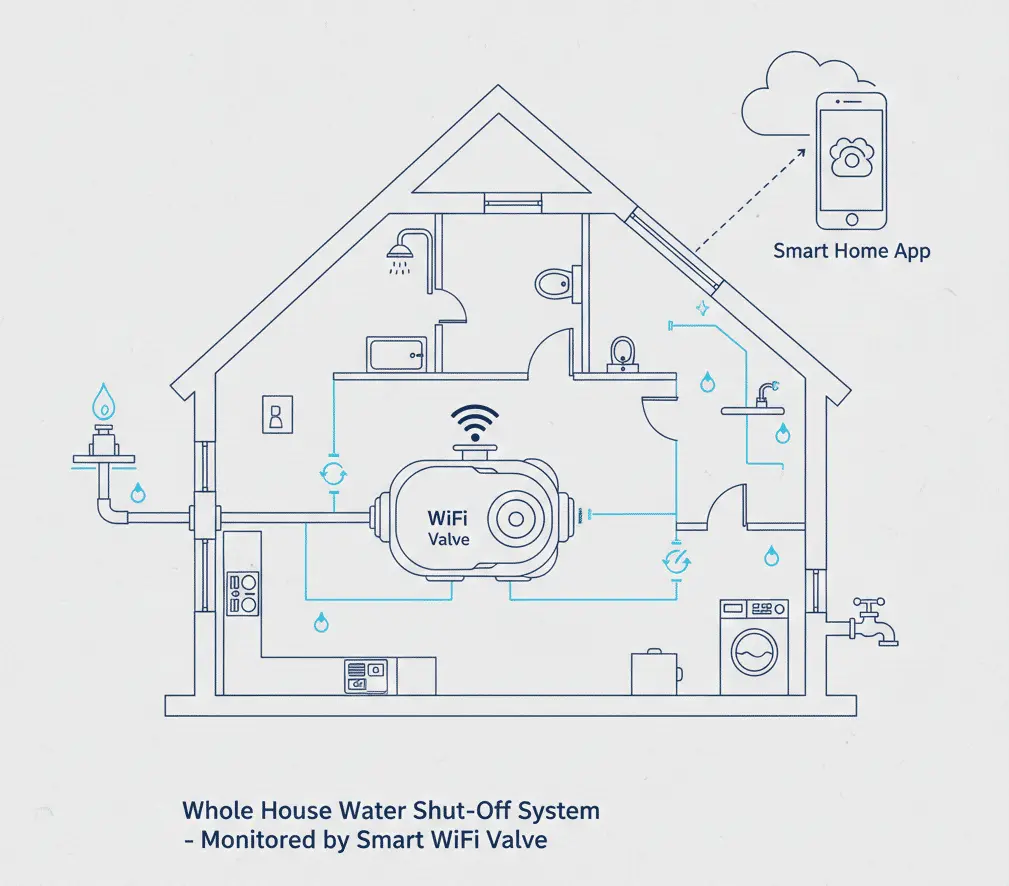
A whole house water shut off system is installed on the main water supply line of your home. Its purpose is simple: when a risk condition is detected, it stops water from entering the house.
It does not fix leaks.
It does not dry floors.
It prevents ongoing water flow from turning a minor failure into a major disaster.
In practical terms, it addresses one core problem: you cannot always react fast enough.
If a washing machine hose bursts at 2:00 AM, or a water heater starts leaking while you are on vacation, every minute of uncontrolled flow increases the cost of repair. A whole-house shutoff system reduces exposure time.
That is the difference between “water damage” and “structural renovation.”
What Problems It Prevents
A whole-house automatic water shutoff system is designed to prevent high-volume or long-duration water loss. Common scenarios include:
Washing machine supply hose rupture
These hoses can fail suddenly and release water at full line pressure. Without intervention, thousands of gallons may flow before someone notices.
Water heater tank leak
A slow tank rupture can escalate quickly. If unattended, it may flood utility rooms or basements.
Under-sink supply line failure
Small braided lines under kitchen or bathroom sinks are common failure points.
Basement flooding from internal plumbing
Finished basements are especially vulnerable due to flooring, drywall, and insulation exposure.
Extended travel or seasonal homes
If you leave home for days or weeks, even a moderate leak can become severe.
In each case, the key risk is continuous flow. The system’s value lies in limiting that flow duration.
How It Works: Components and Triggers
A whole house water shut off system typically includes three elements:
- A motorized valve installed on the main water line
- One or more trigger mechanisms
- A control interface (often app-based)
Main Shutoff Valve
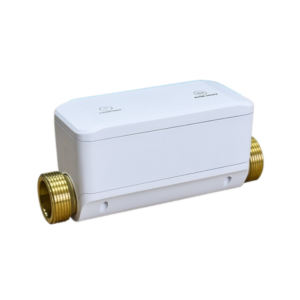
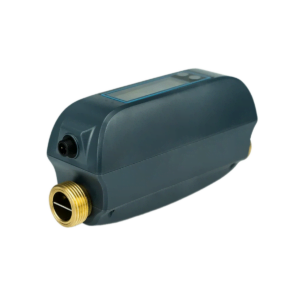
The valve is mounted directly on the primary water supply pipe. When activated, it rotates internally to block water flow into the house.
This is the mechanical core of the system.
Common Trigger Methods
Not all systems use the same detection logic. Common approaches include:
Leak sensors
Small sensors placed near high-risk areas (water heater, washing machine, under sinks). When water contacts the sensor, it sends a signal to close the valve.
Abnormal flow monitoring
Some systems monitor continuous or abnormal flow patterns. If usage exceeds expected thresholds, the system may trigger a shutoff.
Manual app-based shutoff
Users can remotely close the valve through a smartphone app.
It is important to verify which triggers are supported by the specific product you choose. Not every smart water valve includes flow analytics.
Explore our smart water shutoff valve options →
Remote Control and Manual Override
A smart water shut off valve usually allows:
App-based remote shutoff
Manual mechanical override in case of emergency
Manual access is critical. In any system, redundancy improves reliability.
Placement & Installation Basics
Where It Goes
The valve must be installed on the main water supply line, typically:
Near where water enters the home
In a basement utility area
In a mechanical closet
In a garage (in warmer climates)
Apartment vs. Single-Family Home
Single-family homes typically have full control of the main supply line, making installation straightforward.
In condominiums or apartments, installation may depend on access to a dedicated shutoff line. Some buildings restrict modifications.
Who Installs It
Installation commonly requires a licensed plumber, especially if:
The pipe needs to be cut
There is limited working space
The home uses older piping materials
Information to Prepare Before Purchase
Pipe diameter (e.g., 3/4", 1")
Available clearance space around the pipe
Power source availability
WiFi signal strength near the installation point
Without these, compatibility may be limited.
What It Doesn’t Do
A whole house water shut off system is risk reduction, not absolute prevention.
It does not:
Prevent leaks from starting
Stop damage before the first drop escapes
Function normally without power (depending on design)
Operate through a full internet outage unless designed for local triggers
Boundary Conditions to Understand
If WiFi is down, remote control may be unavailable.
If power is lost, the valve may not respond unless battery backup exists.
If a leak is extremely slow and does not contact a sensor, detection may not occur.
It is not an insurance policy.
It is a tool that lowers the maximum potential loss.
For many homeowners, lowering the loss ceiling is the goal.
Buying Checklist: 5 Practical Questions
1. What water damage scenario worries you most?
Burst hose? Water heater? Travel exposure?
2. Are you frequently away from home?
Remote monitoring becomes more important.
3. Do you need multi-room sensor integration?
A single valve may not be enough without distributed detection.
4. Are you prepared for professional installation?
Some systems require pipe modification.
5. How do you want to be notified?
App alerts? Multi-user notifications? Local alarms?
Smart water shutoff valve with app control →
FAQ
Can a whole house water shut off system shut water off automatically?
Yes, if it is connected to a compatible trigger such as leak sensors or flow monitoring logic. Not all valves are automatic by default; confirm trigger capabilities before purchase.
Do I need sensors in every room?
Not necessarily. Sensors are usually placed in high-risk locations: water heater, washing machine, under sinks, and near sump pumps.
What happens if the internet is down?
App control may be unavailable. However, some systems still respond to locally paired leak sensors. Manual override remains available.
Is it worth it for a rental property?
For landlords, the system can reduce large-loss exposure. However, installation access and tenant cooperation must be considered.
Is this the same as a smart water valve?
A smart water valve is the hardware component. A whole house water shut off system includes the valve plus detection and control logic.
결론
Water damage is rarely about small leaks. It is about delayed response.
A whole house water shut off system introduces automated response into your plumbing infrastructure. It reduces dependence on human reaction time.
It does not eliminate risk.
It limits escalation.
For homeowners evaluating modern water protection, the right question is not “Can a leak happen?” It is “How quickly can I stop it?”